The Bird’s-Eye Basics
What makes Scrum more versatile and effective than traditional project management methods?
Imagine a way of working that skips endless meetings, avoids thick progress reports, and empowers teams to create real results—fast. Welcome to Scrum, a framework that invites you to rethink how work gets done.
The Bird’s-Eye Basics
Scrum isn’t a methodology; it’s a new way of thinking. It isn’t a paint-by-numbers approach in which you end up with a product or outcome; it’s a simple framework for clearly defining accountabilities and organizing your actionable work so that you’re more effective in prioritizing and more efficient in completing the work selected. Frameworks are less prescriptive than methodologies and provide appropriate flexibility for the processes, structures, and tools that complement them. When this approach is used, you can clearly observe and adopt complementary methods and practices and quickly determine whether you’re making real, tangible progress. You create usable results within weeks, days, or (in some cases) hours.
Like the process of building a house brick by brick, scrum is an iterative, incremental approach. It gives you early empirical evidence of performance and quality. Roles are distinct and self-ruling, and individuals and teams are given the required autonomy and tools to get the job done. Lengthy progress reports, redundant meetings, and bloated management layers are nonexistent. Scrum is the approach to use if you just want to get the job done.
The term “scrum” comes from rugby, where players huddle together to move the ball as a united team. This spirit of collaboration is at the heart of the Scrum framework.

Scrum is a term that comes from the rough-and-tumble game of rugby. Huddles, or scrums, are formed with the forwards from one side interlocking their arms with their heads down and pushing against the forwards from the opposing team, who are also interlocking arms with their heads down. The ball is then thrown into the midst of this tightly condensed group of athletes. Although each team member plays a unique position, all team members play both attacking and defending roles and work together to move the ball down the field of play. Like rugby, scrum relies on talented people with varying responsibilities and domains working closely together in teams toward a common goal.
Scrum is only for software development and IT projects.
Scrum is incredibly versatile and can be applied to tech, artistic, social, and even personal projects—its potential goes far beyond software.
We want to emphasize — and have written two-thirds of this book on — an overlooked concept of scrum: its amazing versatility. People who know about scrum commonly think that it’s customized for software, information technology (IT), or tech use, but that’s just the tip of the iceberg. Applications for using scrum can be found everywhere, including large, small, tech, artistic, social, and even personal use. In Chapters 8 through 18, we show you how. Be forewarned! Scrum is such an addictive framework that you’ll be using it to coach your kid’s soccer team, plan your neighborhood watch, and even ratchet up your exercise routine.
Scrum can help teams organize a community event, streamline artistic projects, or even manage personal goals like fitness routines—its flexibility makes it useful in nearly any context.
How might the flexibility of Scrum change the way you approach tasks in your daily life or work?
Roadmap to value
Throughout this book, we discuss techniques some expert scrum practitioners apply as common practice extensions to scrum. These techniques complement, not replace, the scrum framework. We point out the differences when they occur. All the common practices we include and recommend are tried and tested — always with a clear understanding these practices are outside the basic scrum framework and are suggested for consideration in your own situations.
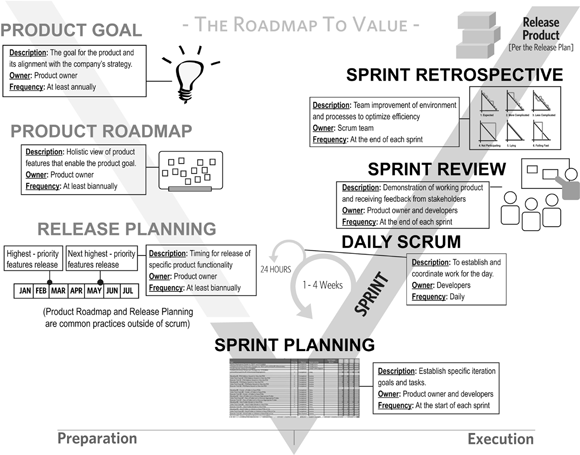
We call this aggregation of scrum and vetted common practices the “roadmap to value.” This roadmap consists of seven elements that walk you through the goal of your product to the task level and back again in a continual, iterative, and incremental process of inspection and adaptation. In other words, the roadmap to value helps you see what you want to achieve and progressively break that goal into pieces through an iterative cycle that leads to real results every day, week, and month.
You know that billion-dollar idea that’s been lurking in the back of your head for years? Follow the roadmap to value. It will show you the feasibility or fallacy of your idea and where to make your improvements — step by step, piece by piece.
Figure 1-1 shows a holistic view of the roadmap to value. This figure shows that you begin with the product goal; work through planning; and then enter the cyclical world of sprints, reviews, and retrospectives.
A structure for organizing work that provides flexibility and allows complementary processes, structures, and tools, unlike strict methodologies.
What would be the benefits of iteratively breaking down your goals using the roadmap to value?
- Scrum is a flexible framework, not a rigid methodology.
- Its roadmap to value guides teams from big goals to actionable tasks.
Scrum overview
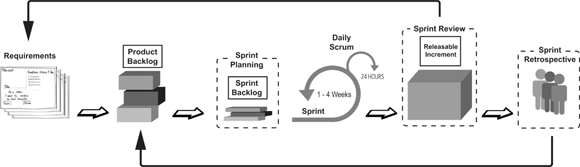
The scrum process is simple and circular, with constant and transparent elements of inspection and adaptation. First, a deliberately ordered to-do list — called a product backlog — is created and maintained. Then top-priority items are selected for a fixed, regular period — called a sprint — during which the scrum team strives for a predetermined and mutually agreed upon sprint goal.
Figure 1-2 shows a scrum overview.
An ordered list of tasks, requirements, and features that a scrum team maintains and prioritizes to guide their work.
The scrum process allows you to adapt quickly to changing market forces, technological constraints, regulations, new innovations, family preferences, and almost anything else you can think of. The key is the ongoing process of working on the highest-priority items to completion. Each of the highest-priority items gets fully developed and tested through the following steps:
- Requirement elaboration
- Design
- Development
- Comprehensive testing
- Integration
- Documentation
- Approval

The seven steps to fully build the scope of each requirement are performed for every item. Every requirement taken on during a sprint, no matter how small or large, is fully built, tested, and approved or rejected. When a backlog item is approved and deemed “releasable,” you know it works. Hope and guesswork are taken out of the equation and replaced by reality. You showcase these tangible results to stakeholders for feedback. This feedback generates new items that are placed in the product backlog and prioritized against existing known work.

What’s more important: efficiency or effectiveness? Hands down, it’s effectiveness — working on the right thing at the right time. Don’t worry about efficiency until you figure out how to be effective. A very efficient team working on the wrong things is a waste of time. A super-effective team, however, can easily learn efficiency. Always work on the right things first. As economist and management author Peter F. Drucker said, “There is nothing so useless as doing efficiently that which should not be done at all.”
Practitioners often find that Scrum’s iterative cycles and feedback loops not only accelerate development but also foster team autonomy and accountability.
Why is it more important to focus on effectiveness before efficiency in Scrum?
Want to go deeper? The science behind iterative frameworks
Research in cognitive psychology and organizational science shows that iterative, incremental approaches like Scrum improve learning, adaptation, and quality outcomes. By continuously inspecting and adapting, teams reduce risk, respond faster to changes, and build trust through visible progress.
Apply the roadmap to value to an idea or project you care about.
- Write down your main product or project goal.
- Break it into smaller objectives or tasks.
- Identify which tasks should be tackled first (your product backlog).
- Outline one sprint: What will you aim to accomplish in a set period?
- Reflect on how feedback could shape your next sprint.
Think of a project (work, school, or personal) you’re currently involved in. How could you apply Scrum’s principles—especially the roadmap to value and prioritization—to get better results, faster? What would you change about your current approach?
What is a product backlog?
Tap to revealA prioritized list of work items or tasks maintained by the Scrum team to guide development and planning.
What is a sprint in Scrum?
Tap to revealA fixed period during which the Scrum team works to complete selected tasks and achieve a specific sprint goal.
What makes Scrum different from traditional methodologies?
Tap to revealScrum is a flexible framework that emphasizes iterative progress, clear accountability, and rapid feedback, rather than rigid, prescriptive steps.
Which of the following best describes Scrum?
Scrum is a flexible, iterative framework that empowers teams to focus on effectiveness, adapt quickly, and deliver tangible results across a wide range of contexts.
The roadmap to value guides teams from product goals to daily tasks through a continual cycle of inspection and adaptation, leading to real progress.
Scrum is the approach to use if you just want to get the job done.
The Shift
- Scrum is a framework, not a rigid methodology, enabling flexibility and rapid adaptation.
- The roadmap to value helps teams break big goals into actionable tasks, iteratively achieving results.
- Effectiveness—working on the right things—is the cornerstone of Scrum’s success, with efficiency following naturally.