How can a well-crafted product goal shape the direction, motivation, and outcomes of a scrum team?
Knowing what outcomes you want beforehand is key for successful agile delivery. These desired outcomes are often best described as a product goal.

When we coach clients, we always have them create a product goal statement, so their goal is right in front of them. We’re looking for a crisp, concise, and clear elevator pitch that can be conveyed during the ground-to-fourth-floor ride. We ask them to have their product goal drafted before we first meet with them. Then we spend one hour with the people responsible for the goal, honing it into something with which we can work. It doesn’t take long to create this invaluable artifact.
Product goals are so useful that we’ve added them to our roadmap to value. Think of your product goal as a destination with a beacon. You may have 100 ways to get to the destination, and it doesn’t matter which way you take; the point is to end there. With this beacon of a statement, you always know where you’re headed because you have the goal in sight. From this stable, strategic destination, you have limitless tactical flexibility.
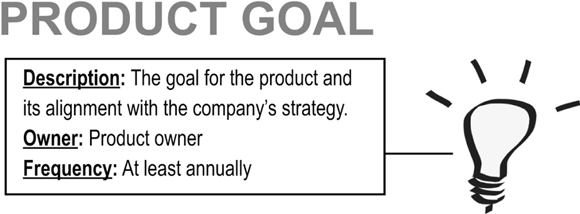
A clear statement describing the desired outcome for a product, serving as a beacon for the scrum team and guiding all work towards a strategic destination.
Scrum teams often revisit their product goals annually to ensure alignment with evolving market needs and company vision.
- Internally focused, with no marketing fluff
- Fine-tuned to the goals of the marketplace and customer needs
- Strategic in nature, showing why and what rather than how
- Reviewed annually (when part of a broader vision that looks out further)
- Owned by the product owner

Your product goal must be communicated throughout the organization or group you work with. It is the scrum team’s commitment to everything they do. The product backlog emerges from the product goal. Whether the team is designing a new sports car model or planning a wedding, everyone must clearly understand the goal, which sets expectations and the tone of the upcoming work.
What makes a product goal more than just a statement? How does it influence the team’s actions and priorities?
Structuring your goal
Geoffrey Moore, in his book Crossing the Chasm, recommends a practical model for creating your product goal. The statement should be concise—two or three sentences—structured as follows:
- For <target customer>
- who <statement of the need>
- the <product name>
- is a <product category>
- that <product key benefit, compelling reason to buy>
- Unlike <primary competitive alternative>
- our product <final statement of product differentiation>
Recommended conclusion:
- which supports our strategy to <company strategy>
Tankless water heater example:
For homeowners who desire continuous hot water flow and better energy conservation, the Acme Tankless Water Heater is an instantaneous water heater that efficiently heats water as you use it. Unlike tank-type water heaters, our product provides continuous flow at consistent temperatures with lower operating costs at 94 percent efficiency, which supports our strategy to provide for tomorrow’s generation by reducing the waste of natural resources today.
Hawaiian vacation example:
For my spouse and me, who are stressed out of our minds, the Hawaii or Bust 2022 vacation is a spontaneous, last-minute getaway that will remove us from our hectic lives long enough to provide new experiences. Unlike family vacations or structured itineraries, our product provides complete flexibility without expectations, which supports our strategy to make the most of each moment together.

Product and team goals should also be SMART goals. The SMART goal concept was developed by George Doran, Arthur Miller, and James Cunningham in their 1981 article, “There’s a S.M.A.R.T. way to write management goals and objectives.” SMART is an acronym for Specific, Measurable, Attainable, Realistic, and Timely (or time-bound).
Goals that are Specific, Measurable, Attainable, Realistic, and Timely, providing clear criteria for success.
The product goal itself is functional, but the addition of business strategy is emotional. Bring purpose to your product in the form of a company strategy that makes people’s lives better. It’s never your company strategy to make money; it’s to do something of such value that it can be monetized.
How would you describe the difference between a product goal and a company strategy? Why does this distinction matter?
Want to go deeper? The science behind effective goal statements
Research in behavioral psychology and management science shows that teams with clear, concise goals are more likely to sustain motivation, focus, and creative problem-solving. The elevator pitch model is rooted in cognitive load theory: short statements are easier to remember and communicate, ensuring team alignment. SMART criteria further boost effectiveness by making goals actionable and trackable.
Finding the crosshair
The product goal is created and owned by the product owner and is integral to the business or endeavor. One mind, however, is just that: one mind. The product owner may own this statement, but they’ll surely have better luck using collective intelligence to create and refine it. To this end, the product owner can choose to receive input from developers, the scrum master, external or internal stakeholders, and even customers themselves. Determining what to do with the input is the product owner’s choice and the product owner’s responsibility.
When product owners are open to input from others, the product owner may become aware of nuances, features, and market angles that one person alone wouldn’t think of. The product owner may be wise to take feedback and then carefully filter it through their own understanding.
The product goal should be written by a committee so everyone’s ideas are included.
The product owner is responsible for the product goal, but can choose to seek input from others and thoughtfully filter it.
- Product goals guide scrum teams as strategic beacons, shaping all work toward a clear destination.
- SMART criteria make product goals actionable and measurable.
Practice structuring a concise product goal using Geoffrey Moore’s model and SMART criteria.
- Identify a product or project you’re working on (or imagine one).
- Write a two-sentence product goal using the template (For [target customer], who [need], the [product name] is a [category] that [key benefit]).
- Add a final sentence linking your goal to a broader company strategy.
- Check if your statement meets SMART criteria.
How can seeking input from different stakeholders strengthen the product goal, and when might it create confusion?
Think about a time when you or your team worked toward a goal that wasn’t clearly defined. How did this impact motivation, focus, and success? What would have been different if the goal had followed the product goal and SMART structure?
What is a product goal?
Tap to revealA clear statement of the desired outcome for a product, guiding the scrum team’s work and strategy.
SMART goal acronym stands for?
Tap to revealSpecific, Measurable, Attainable, Realistic, and Timely.
Who owns the product goal in scrum?
Tap to revealThe product owner creates and owns the product goal.
What is the purpose of adding business strategy to a product goal?
Tap to revealTo bring purpose and emotional value, making the goal meaningful beyond just functional outcomes.
Which of the following statements best describes a product goal in scrum?
A clear, concise product goal acts as a beacon for scrum teams, providing strategic direction and aligning all work with meaningful outcomes.
Adding the company’s business strategy to the product goal brings emotional purpose, motivating teams to create value beyond profit.
From this stable, strategic destination, you have limitless tactical flexibility.
The Shift
- Product goals are the foundation of successful agile delivery, guiding teams strategically.
- SMART criteria ensure goals are actionable, measurable, and achievable.
- Emotional purpose, added through company strategy, inspires teams to create real value.