In 2019, as the COVID-19 pandemic swept across the globe, individuals, healthcare systems, governments, and manufacturers were forced to adapt quickly to rapid and relentless change. The world’s response would become a real-time experiment in agility, innovation, and resilience.
The phrase “flatten the curve” became a rallying cry worldwide, representing the effort to slow the virus’s spread so healthcare systems could keep up with surging demand.
In Wuhan, China, the first known infections of SARS-CoV-2 signaled the start of a global crisis unlike any before. COVID-19 quickly covered the entire earth, leaving destruction in its wake. At the time this content was written, Wikipedia estimated that 6.41 million people worldwide had died, and many more were surviving victims of this terrible disease. To stem the tide, people were mandated to stay home, schools were closed, and businesses either shut down or transitioned employees to work from home. Debates raged over masks, vaccines, and public safety. No one was left unscathed.
Yet, amidst the chaos, organizations found creative ways to navigate the pandemic using scrum. Let’s explore some inspiring applications.
What do you think were the biggest challenges for organizations during the onset of the COVID-19 pandemic?
Scrum in Action: Patient Care
The COVID-19 pandemic placed complex and heavy demands on health care systems worldwide. “Flatten the curve” of infections became the mantra as the world grappled with an unprecedented inflow of patients; ensuring hospital capacity was protected for those needing critical care was crucial. With cases increasing exponentially daily and casualties on the rise, hospitals turned to scrum to navigate their way through the pandemic, learning as they went.
Successful hospitals formed cross-functional teams bringing together clinical and nonclinical personnel across disciplines and departments. Together they streamlined a collaborative system that promoted efficient, effective, and high-quality patient care.
For example, the Royal Hospital in Oman found agile techniques such as scrum to be the only way to adapt to the little-known nature of the pandemic and the constant flow of new specialty-driven information, guideline modifications, and implementations. As a result, projects were defined and teams were formed to resume elective services such as surgeries or ambulatory care, while other teams enabled critical telemedicine services for their patients.
The hospital concluded that agile techniques such as scrum introduced structured methods to improve performance and processes in which teams worked together to eliminate unnecessary steps that were previously executed separately and were vulnerable to delays. They found their organization to be fast, resilient, adaptable, and suited to respond to shocks of the pandemic. They statistically improved the quality of care during the crisis months of the pandemic.
When faced with rapidly changing guidelines and medical protocols, cross-functional teams used scrum sprints to implement new procedures in days rather than weeks, ensuring patients received up-to-date care.
Want to go deeper? The science behind “flattening the curve”
“Flattening the curve” refers to reducing the peak number of COVID-19 cases at any one time to avoid overwhelming healthcare capacity. By slowing transmission through measures like social distancing, mask mandates, and lockdowns, communities could spread cases out over a longer period, giving hospitals time to manage patient load and improve outcomes.
How might forming cross-functional teams help an organization respond more effectively to a crisis?
Scrum and Ventilator Production
Because COVID-19 is a respiratory disease, ventilators were in short supply in hospitals around the world during the early days of the pandemic. Several manufacturing facilities, including automakers, changed their entire manufacturing lines to begin building life-saving respirators.
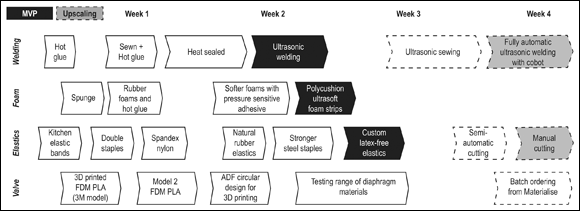
Science magazines noted that many manufacturers embraced agile values and principles to support their shift. In manufacturing, they shifted their development cycle to observing, analyzing, developing, testing, and demonstrating. Low-cost prototypes, some leveraging 3D printing, were created and rapidly tested by small, self-organizing teams who worked using the short feedback cycles of scrum.
By defining minimum viable products (MVPs) to meet regulations, they created product goals and roadmaps highlighting the MVP and future improvements (upscaled production).
The simplest version of a product that can be released to users, offering just enough features to satisfy early adopters and gather feedback for future development.
A group composed of members with different skills and expertise, working together to achieve a common objective—in this case, rapidly developing and improving critical medical devices.
Automotive engineers and medical device experts worked side-by-side, using scrum to pivot production lines from cars to ventilators in record time—saving countless lives.
What advantages did agile approaches offer manufacturers when switching to emergency ventilator production?
Dutch Government Responds to COVID-19 Using Scrum
Around the world, each country responded to the COVID-19 pandemic uniquely, but with many similarities. The Netherlands used an agile approach by forming a small team called the Outbreak Management Team (OMT), consisting of virologists, statisticians, pulmonologists, and intensive care specialists. They started by defining a goal with three objectives:
- Flatten the curve; slow down the pace of the virus’s spread
- Increase intensive care capacity to be able to help more patients
- Protect the Dutch economy from collapsing
In a rapidly changing environment, small teams empowered to make decisions can act quickly—an approach central to both scrum and effective crisis management.
Scrum is only effective for software development teams.
Scrum can be applied successfully in any industry—including healthcare, manufacturing, and government—especially during times of crisis and rapid change.
TABLE 10-1 Summary of Typical Components in a Filtering Facepiece Respirator with Minimum Viable Product (MVP) and Upscaled Production (Upscaling)
Respirator Components |
Considerations |
MVP |
Upscaling |
|---|---|---|---|
Welded edges |
The edges of the masks should be attached together without perforating them. Regular sewing is not an option. |
Ultrasonic cutting and point welding by hand. |
Ultrasonic sewing machine, Cobot point weld, ultrasonic cutting by hand |
Head straps |
The chosen head strap is a non-adjustable type made from elastic. Therefore the elastic band must have a good extension coefficient, to pull the mask firmly to the face. They should not lose their elasticity over time. Use non-latex materials or similar so the elastic bands do not slide off the back of the head. |
Nonlatex straps of polyisoprene were selected for this application. The width was fixed at 6 mm wide for optimal balance between strength, comfort, and adaptability to various head sizes. |
Same as Phase A |
Strap attachment |
The straps must be securely attached to the mask without perforating the mask. These attachments must be mechanically tested so they cannot come loose. |
A Rapid 106E electric stapling machine was selected for this application. Type 66/6 staples were used, which could not be extracted by hand. |
Ultrasonic attachment |
Scrum and agile principles enabled organizations in healthcare, manufacturing, and government to adapt quickly, collaborate effectively, and deliver critical solutions during the COVID-19 pandemic.
- Scrum empowered cross-functional teams to deliver rapid solutions in high-pressure environments.
- Agile approaches were adapted beyond software to healthcare, manufacturing, and government response efforts.
They found their organization to be fast, resilient, adaptable, and suited to respond to shocks of the pandemic.
Scrum is not limited to IT or software—its practices are powerful tools for managing uncertainty and complexity in any field.
If your organization had to rapidly respond to a crisis, who would you include in a cross-functional, scrum-inspired team?
- List at least five roles or areas of expertise you would want represented.
- Briefly describe what each team member would contribute.
- Sketch a simple workflow showing how your team would collaborate using short sprints or cycles.
In your opinion, which industry was most transformed by adopting agile methods during the pandemic—and why?
What does “flatten the curve” mean?
Tap to revealSlowing the spread of disease so that the number of cases at any one time does not overwhelm healthcare systems.
Define “minimum viable product” (MVP).
Tap to revealThe simplest version of a product that can be released to users for feedback and rapid iteration.
What is a cross-functional team?
Tap to revealA group with varied skills and expertise working together toward a shared goal.
Scrum and agile principles cannot be used outside the software industry.
Reflect on a time when you or your community had to quickly adapt during the pandemic. What lessons about teamwork and adaptability did you learn that could apply to future challenges?
How confident are you that you can explain how scrum enabled rapid adaptation during the COVID-19 pandemic?