How does Scrum help software development teams overcome complexity, deliver value faster, and stay ahead in highly competitive industries like gaming?
Many technology companies are already using scrum to great success. It allows them to be faster and more flexible to stay competitive.
Think about a software project you’ve experienced or heard about. What challenges did the team face, and how might Scrum have addressed them?
It’s one thing to understand the theory of scrum’s success; it’s quite another to see scrum in action. Although we can’t take you into the field with us, we can bring the field to you. In this lesson, you’ll explore real-world challenges faced by software companies and discover how scrum’s unique adaptability helps teams thrive.
Video-game development
This hugely popular, complex area of software development can use scrum with great success for four reasons:
- Flexibility: With scrum, you start with basic features and grow the game into more complexity. This evolution happens organically; therefore, you’re always developing what’s most important next.
- Finding the fun: Developers can add fun in small, iterative doses. The features that add the most value in terms of fun (a critical element of any game) get added first.
- Cost savings: Most games fail to break even financially. Scrum’s cost-saving nature is a company-saver. Even if funding is cut halfway through development (assuming the minimum play time is met), you still have the most important 50 percent of the features fully functioning and, if not yet marketable, at least reusable.
- Regular feedback: This feedback may come daily, from the product owner, and at each sprint review, from stakeholders (such as the publisher and marketing).
Gaming is about keeping customers happy and engaged. Feedback within scrum is incorporated quickly, so the result is what users want.
Over 50% of industry revenue in gaming comes during the Christmas season—making speed to market and adaptability critical for success.
Development flow
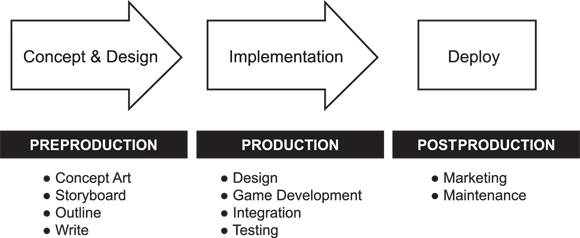
Technical development generally follows three stages for games, as shown in the diagram below:
-
Preproduction: This stage is where artists, directors, and engineers come together to find the fun. This prototyping and proof-of-concept phase aims to determine whether the game is a good, fun idea before the company enters production and spends more money.
Especially for mobile games, engineers can prototype without art quickly. For all games in this stage, teams can validate the idea of the game, define it, develop concept art, ensure funding, and assemble developers. - Production: The proof of concept is developed by directors, artists, and engineers.
- Postproduction: Professional testers test the finished product; beta testing follows; and sales, marketing, and support activities begin.
Why do traditional contracts make it difficult for publishers to see progress during game development? How does Scrum change this dynamic?
As this process implies, publishers typically engage with studios under traditional waterfall contracts and structures, paying the studio only at certain long-term milestones. This arrangement often implies that the publisher goes long periods without seeing progress.
In a scrum model, game development looks more like the diagram below, which shows the ongoing testing necessary for quality assurance. After each task — such as concept art, storyboarding, writing, or prototyping — the task is tested and either moved on or further developed.
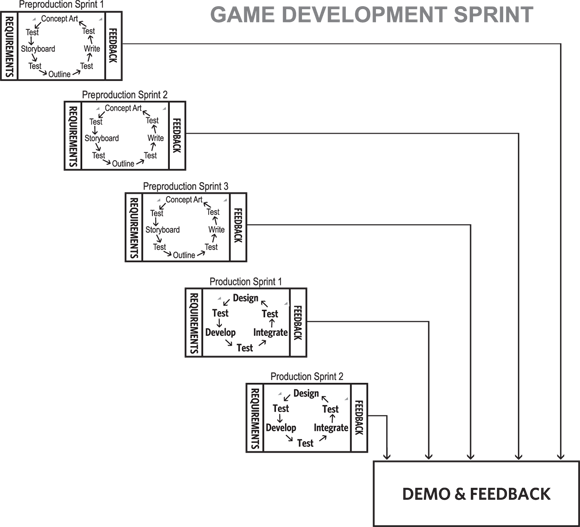
With scrum, publishers can identify and kill the nonfun stuff faster and have greater quality control because they regularly participate in sprint reviews and pay studios incrementally, in line with the delivery of working game increments.
Short sprints maintain a flow of outbound content that attracts and retains consumers. Scrum provides faster delivery of playable games to stakeholders, such as publishers and focus groups. This process allows developers to emphasize the fun factor and quickly eliminate the game-play elements that aren’t entertaining (which can also save wasted art-creation costs).

The definition of done may differ between preproduction and production. Be sure to clarify both stages upfront. A preproduction sprint’s definition of done may include different types and levels of documentation and artwork standards from a production sprint’s definition.

Ideally, games can’t ship with fewer than ten hours of play time for a single-player game. Although this amount of play time may be the release goal, publishers can review the working software after every sprint and provide invaluable feedback.
Iterative feedback loops, a hallmark of Scrum, are rooted in cognitive science. Regular feedback increases motivation, guides learning, and allows teams to correct course before mistakes become costly. For creative fields like gaming, rapid feedback ensures that the “fun factor” is prioritized and built in throughout development, not bolted on at the end.
Marketing
Games have traditionally been sold as retail products, but online and digital distribution are shifting the emphasis from retail to digital delivery. A huge need exists to constantly and quickly update, add, and push content to a game. This capability is the difference between surviving and not surviving. Speed to market is critical.
Game sales are overwhelmingly seasonal, with more than 50 percent of the industry’s revenue coming during the Christmas season. This is a major factor in the crunch time faced by many teams because the holiday season imposes a hard deadline.
Scrum’s priority-driven product backlog ensures that the highest-priority fun will be delivered in minimal crunch time, making management happy and reducing employee burnout.
Practitioners in game development stress the importance of incremental releases. By delivering playable prototypes early, teams can secure feedback from publishers and focus groups, quickly improving quality and engagement.
Major gaming studios have adopted Scrum to shorten development cycles, avoid costly delays, and release updates rapidly. This approach has transformed how teams respond to player feedback and market trends.
Art
Art is a significant portion of the development work required in video games. Console and computer games require a lot of art and animation assets, adding up to 40 percent or more of the cost of a game title. Technical and game-play issues late in production are costly.
Art, being the costliest element, is tempting to outsource overseas. But troubles with time zones and communications almost always lead to delays, rework, and customer dissatisfaction with the quality of the finished product.
Scrum allows artists and developers to work on the same team rather than in silos, with the same goals and real-time communication about what works and what doesn’t. To optimize collaboration, teams should be onshore and in-house (co-located). Onshore and co-located teams keep delays and rework costs down.
A prioritized list of features, fixes, and tasks that guides the team’s work during each sprint.
Agreed criteria that determine when a piece of work is complete. This definition may differ depending on stage or team goals.
- Scrum enables flexibility and iterative development in complex industries like gaming.
- Regular feedback and short sprints ensure that development teams focus on what matters most.
Scrum is only for software engineering and doesn’t apply to creative aspects like art or storytelling.
Scrum brings artists, developers, and storytellers together, fostering real-time collaboration and improving creative outcomes across disciplines.
Explore how iterative development can enhance enjoyment in games.
- List three features that contribute to a game’s fun factor.
- For each feature, describe how Scrum could help you test and improve it in short sprints.
What is a Sprint Review?
Tap to revealA meeting at the end of a sprint where stakeholders review progress and provide feedback on the working product.
Why is flexibility important in game development?
Tap to revealIt allows teams to adapt to changing requirements and prioritize features that enhance fun and user engagement.
What is the main financial risk in video-game development?
Tap to revealMost games fail to break even financially, making cost-saving approaches like Scrum critical for company survival.
Reflect on a creative project you’ve worked on or observed. How could Scrum’s iterative feedback and team collaboration have improved the outcome?
How does cross-disciplinary collaboration within Scrum reduce delays and rework, especially for complex projects like video games?
What is a major advantage of using Scrum in video-game development compared to traditional methods?
Scrum empowers software teams to prioritize value, adapt quickly, and collaborate across disciplines, resulting in faster delivery and higher-quality products.
Regular feedback and short sprints in Scrum ensure that features critical to user enjoyment and business success are delivered efficiently and iteratively.
Scrum’s cost-saving nature is a company-saver. Even if funding is cut halfway through development, you still have the most important features fully functioning and, if not yet marketable, at least reusable.
The Shift
- Scrum replaces rigid, milestone-driven development with flexible, iterative progress, enabling rapid adaptation to feedback.
- Cross-functional teams collaborating in real time reduce delays and maximize creative outcomes in software projects.
- Prioritizing features based on value and fun ensures leaner, more successful releases and lower risk in competitive industries.