The EMS operations portion of the test goes beyond patient care to address such issues as medical legal standards, emergency vehicle operation, environmental hazards, and incident management. Topics to bone up on for this portion of the test include the following (head to Chapter 14 for more details):
- EMS systems
- EMT safety and wellness
- Communications and documentation
- Therapeutic communications
- Medical legal concepts and ethics
- Ambulance operations
- Incident management
- Multiple casualty incidents
- Hazardous materials
- Terrorism and disasters
Within each of these areas, about 15 percent of the questions are based on pediatric patients (see Chapter 13), and the remaining 85 percent focus on adult and geriatric patients.
Getting a grip on computer adaptive testing
Unlike a traditional paper and pencil examination, the number of questions on the NREMT EMT exam varies, roughly from 70 to 120 items per exam attempt. The actual number of questions you see depends on how well or how poorly you’re performing. How does that happen?
The NREMT EMT exam is a computer adaptive test (CAT). While you’re taking the exam, the computer you take it on constantly evaluates how you respond to each question and makes adjustments to the level of difficulty of each subsequent exam item accordingly. In other words, the NREMT exam isn’t a one-size-fits-all paper exam! CAT is considered much more accurate in verifying knowledge. It also makes the test appear very challenging. You find out more about CAT in Chapter 5.
However, the exam isn’t impossible to pass. According to the NREMT 2012 Annual Report, the national average first-time pass rate in 2012 was 72 percent. Some states reported first-time pass rates as high as 84 percent.
The test questions aren’t vague or confusing. They’re written in a way that mimics realistic decision-making. In real life, you don’t always have all the information you want, but you still need to make decisions about your patient’s care. Also, sometimes there’s more than one right approach, but only one of them is the best. This concept is important and is covered in more detail in Chapter 4.
 You have an almost three out of four chance of passing the exam on your first attempt. If you’ve been diligent in your studies and reasoned your way through the different course exams, you should be in good shape.
Scoring the exam and getting your results
After you complete the exam, your test results are transmitted to the NREMT, which verifies that all necessary steps have been completed.
The NREMT uses a different method than you may expect in scoring your exam. Rather than having a simple pass/fail process, which you may be used to with paper exams, the nature of a computer adaptive test results in a more complex scoring process. Your performance on each exam item is evaluated to be above or below the given standard. Over time, the computer recognizes that your overall performance in that section is either above or below the standard. Once it does, it moves on to the next section. This means that there is no minimum number of questions that you must answer correctly; it depends on your performance.
However, how the computer scores the exam isn’t necessarily how it may order the questions themselves. In fact, the order of the questions may seem very random at times — you may first see an airway, respiration, and ventilation question, followed by a trauma question, then a medical question, then back to airway, respiration, and ventilation. Don’t worry about the order — just focus on the question in front of you.
You not only have to perform above the overall exam standard, but you must also do so in each of the five sections listed in Table 3-1. Passing each section proves that your breadth of knowledge is enough to allow you to practice.
Your results are posted in your account on www.nremt.org (see Chapter 2 for details on setting up an account). Although the NREMT states that it can take one to two business days, sometimes your result may appear as early as the same day you took the exam. If you passed, go ahead and perform a happy dance — you deserve it! On the other hand, if you didn’t pass, you’re told how you performed in each content area so that you can prepare for your next attempt. You have an opportunity to retake the exam two more times, for a total of three attempts. (Flip to Chapter 7 for more information on what to do if you don’t pass the exam the first time around.)
Completing the Practical Exam Portion
Before you can take the cognitive exam (described earlier in this chapter), your training program director must verify your ability to perform the following procedures competently:
- Patient assessment/management of a trauma patient
- Patient assessment/management of a medical patient
- Cardiac arrest management/automated external defibrillator (AED)
- Bag-valve-mask ventilation of an apneic patient
- Spinal immobilization (for both seated and supine patients)
- Long bone fracture immobilization
- Joint dislocation immobilization
- Traction splinting
- Bleeding control/shock management
- Upper airway adjuncts and suction
- Mouth-to-mouth ventilation with supplemental oxygen
- Supplemental oxygen administration to a breathing patient
Your course instructor verifies your skills either throughout the program or at the end of your training; it varies from one program to the next.
You also need to successfully complete a practical (or psychomotor) skills examination. This is usually provided in the form of a final practical exam at the end of your course. The state EMS office determines which exact skills are tested; your instructor will tell you what will be evaluated on the final practical exam.
 Find out how your final practical exam will be conducted at the beginning of your course. This way, you’ll know what to pay attention to in your training.
Your results are submitted to the NREMT by your EMT program director after you complete the testing. Once this information is entered into your account and you pay your testing fee, you’ll be cleared to sign up for the cognitive exam.
Part II
Test-Taking Tips and Strategies
Five Ways to Improve Your Study Habits
- Set the stage for optimal studying by creating an environment free of distractions.
- Develop and stick to a study schedule that is realistic and keeps you on track for success.
- Don’t reread the entire textbook! Use the practice exams in this book and online to guide your studies and focus on areas of weakness.
- Study with buddies. They can be your “outside voice” to keep you honest about your knowledge.
- Using tools like flashcards, talking aloud during studying, and finding other explanations about difficult topics can help improve your retention.
 Dig deeper into computer adaptive testing for the EMT exam in an article at www.dummies.com/extras/emtexam.
In this part …
- Break down the different parts of a multiple-choice test item so you have a better understanding of how to answer it.
- Know how computer adaptive testing (CAT) evaluates your knowledge so you can be prepared for the stress that you may feel during the EMT exam.
- Find out how to study more effectively and learn more in less time. Studying is a skill!
- Discover that it takes more than just book knowledge to pass the EMT exam. Attitude and a healthy body give you the capacity to handle the fear and stress of taking a high-stakes exam.
Chapter 4
EMS Operations
In This Chapter
 Practicing EMS within the law
Keeping yourself safe, healthy, and sane
Working on a team to resolve an emergency incident
Operating an emergency vehicle
Handling large incidents
What makes providers of emergency medical services (EMS) different from other medical personnel is where they practice — in people’s homes, places of work, out in the street. Unlike medical professionals who work in hospitals, clinics, or doctors’ offices, emergency medical technicians (EMTs) can’t control the dangers that accompany unfamiliar environments. However, being aware of the safety issues and responding to them appropriately reduces the potential for harm. This chapter describes important aspects of EMS operations: following medical legal standards, staying healthy and safe, working well with others, handling an emergency vehicle, and being on the scene of a large emergency incident.
Maintaining Medical Legal Standards
No matter where you engage your patient, there is a clear set of medical legal guidelines you should practice religiously, as you find out in the following sections. Ethics and “doing the right thing” apply as well, but it’s the law that will either protect you or, if you do the wrong thing, provide patients the ability to be compensated for their losses.
Grasping the basic legal tenets of medical practice
The basics of understanding your legal role as an EMT are grounded in the following three legal terms:
- Scope of practice: Your state laws dictate what medical procedures you can perform, as well as what you cannot do. For example, you can ventilate a patient with a bag-valve mask and oxygen, but you can’t ventilate a patient with an endotracheal tube.
- Standard of care: The way that you perform a particular procedure or technique is the way most other EMTs would do so under similar circumstances. The standards of care that apply range from being very regional (for example, system protocols that provide guidance while you are at work) to nationwide (CPR standards, for example).
- Duty to act: You are required to perform your scope of practice to the level of the standard of care. This includes nonclinical aspects of the job, such as keeping a vehicle stocked, responding to an emergency call, transferring the patient to receiving staff at a hospital, or allowing a patient to refuse medical care.
Avoiding negligence
If you breach your duty to act (see the preceding section), the patient may be able to file a lawsuit against you for negligence. To prove negligence, the patient has to be able to prove four things happened:
- You had a duty to act.
- There was a breach of that duty.
- There was an injury.
- The injury (physical, emotional, or both) was a result of the breach, or causation.
All four elements must be proven in order for a suit to be successful. For example, when you were transferring your patient to the gurney, you lost your footing and dropped her to the floor. Fortunately, she wasn’t injured by the fall. No negligence occurred in this case because the patient wasn’t injured and you didn’t perform above or below your level of training; you didn’t breach your duty to act.
 A 35-year-old male has been shot in the chest. He is unconscious; has cold, diaphoretic, and pale skin; has a rapid carotid pulse; and is tachypneic. You apply occlusive dressings to the single open chest wound, but overlook a bleeding, open wound to the patient’s back during your assessment. The patient survives his wounds and takes a long time to recover. The patient sues you for negligence. Overlooking the back wound would be an example of
(A) duty to act.
(B) breach of duty.
(C) injury.
(D) causation.
The best answer is Choice (B). Part of your training requires you to inspect the back for an injury, which you failed to do in this scenario. You had an obligation to respond when called, Choice (A), which is unrelated to overlooking the back wound. The gunshot wounds are examples of an injury, Choice (C). With regard to Choice (D), if you had controlled the bleeding sooner by identifying the back wound early, you may have reduced the extent of his shock condition (as indicated by his vital signs), possibly reducing his recovery time.
Getting the proper consent
You must establish the right to render care to the patient. This can be expressed consent, where the patient is able to indicate he wants your help. Or, it can be implied consent, when the patient is unconscious or otherwise incapacitated and it would be reasonable to ask for help. Only adults are capable of providing consent; children must be judged by the legal system to be emancipated minors in order to give consent.
Adults who are unable to determine their own medical care may have a court authorize another adult to act on their behalf. The person making such decisions has durable power of attorney.
 If you don’t obtain consent and proceed to treat and/or transport, you may end up being accused of battery (touching the patient without consent) or false imprisonment (kidnapping or holding someone against his will). If you threaten a patient or otherwise make the patient fearful of possible bodily harm, you are committing assault.
Understanding slander and libel
Speaking poorly about someone’s character is known as slander. Writing poorly about someone’s character is libel. For example, stating that a patient is “just drunk” to a receiving nurse could be seen as a slanderous statement; documenting that the patient was “drunk” or “intoxicated” can be seen as a libelous statement.
Dealing with refusals of care and/or transport
An adult, under most circumstances, has the right to refuse your treatment and transport. You have to determine whether the person is capable of making such a decision. This includes determining whether the patient is alert, oriented, and understands the consequences of not accepting your care. You also have to assess whether any existing circumstances are impairing the patient’s judgment, such as intoxication or a language barrier.
Documentation is crucial in patient refusals. It includes having the patient sign a form that affirms her right to refuse further treatment and, in many circumstances, the signature of a witness that verifies the patient did sign the form.
Maintaining confidentiality
You are required to protect the patient’s right to privacy in matters related to treatment and personal information. Federal law known as the Health Insurance Portability and Accountability Act (HIPAA) sets strict guidelines (and financial penalties!) regarding who you can share information with, which is usually limited to other medical professionals directly involved with the patient’s care. This means no talking about private patient information to other crew members or your family or friends, as well as doctors and nurses in the hospital who will not be providing care to the patient. The patient has to authorize the sharing of information with a signed release form.
Respecting advanced directives
Patients with terminal illnesses may legally request that no “heroic” or aggressive interventions be done if they die, or are dying from, that illness. The request is in written form and is generically known as a “do not resuscitate” (DNR) directive.
DNR doesn’t mean you shouldn’t treat the patient at all. You may still be required to provide supportive care and comfort. You may also need to start resuscitation during a cardiac arrest when the DNR paperwork is not available. Check with local and state policies and procedures to find out what you should do.
Steering clear of abandonment
Once you have established contact with your patient, you are obligated to stay with the patient until you release the care to an equal or higher medical authority. This person may be a paramedic who intercepts your unit or the nurse at an emergency department. Releasing a patient includes making a verbal report with the person who is receiving your patient and following up with a written report. If you fail to do so, you may be liable for abandoning your patient.
Complying with mandatory reporting
In most states, there are laws that protect the health and welfare of children and so-called dependent adults, usually older patients and adults who are unable to make independent decisions. As an EMT, you’re required to report suspected cases of abuse or neglect to specific departments, such as child or adult protective services. Immunity from prosecution is provided to protect you in case your suspicions turn out to be inaccurate.
You may be obligated to make a report in other situations as well, such as criminal circumstances like rape or domestic violence, or special clinical scenarios such as at-home births. These vary from one state to the next. Your instructor should provide you information that is relevant in the area where you will be practicing; check state regulations regarding your role as a mandated reporter.
Coping with crime scenes
EMTs often respond to situations where a violent crime has been committed, such as physical assaults, shootings, or stabbings. Your priority is to treat the patient to the best of your abilities; while doing so, try to avoid contaminating scene evidence as much as you can. For example, try not to cut through bullet or knife holes in clothing as you take it off the patient. Do not pick up anything in the area that you don’t absolutely need to, including any items you may discard such as plastic wrappers on cervical collars. Do your best to avoid disturbing the scene. Your local police will be very appreciative.
Documenting your cases
You are required to document what you observed about the patient and the environment, the findings that you assessed, the care you provided, and any changes in the patient’s condition while in your care. Documentation may be done either on paper forms or electronically with a computer, laptop, or tablet. The following are key things to keep in mind when documenting:
- Document completely. Use the CHART or SOAP method to capture all the details. Don’t leave anything blank. Cross out, and initial if possible, any sections that are not relevant.
- Document consistently. Each patient care report (PCR) should begin and end very similarly. A standardized method of documentation will have you describe the patient, your findings, your treatment, and any changes to the patient’s condition in a methodical way. The more consistent you are in documenting your assessment and treatment, the more accurate and faster it becomes.
- Document just the facts. Don’t give your opinion or interpretation of what you saw or heard. For example, your patient is not “drunk.” He has “slurred speech, is unable to maintain his balance, and has an odor similar to alcohol on his breath.” This will help you avoid being charged with libel — you’re simply recording what you saw, heard, smelled, and felt.
- Spell correctly and use good grammar. You are transmitting information to not only other healthcare professionals, but also quality improvement personnel, police investigators, and, most importantly, attorneys who want to make you look less than professional in a lawsuit. Messy documentation is often interpreted as messy patient care, no matter how well you treated the patient.
The emergency department is extremely busy when you and your partner arrive with a noncritical patient. As you wait in an exam room for a nurse to take your report, your dispatcher pages you for a “cardiac arrest, CPR in progress” at an address two blocks away from your location. You should
(A) move your patient to the hospital bed and let the staff know you are responding to a cardiac arrest nearby.
(B) notify the dispatcher that you are unable to respond to the call.
(C) have your partner respond to the call.
(D) have your partner stay with the patient while you respond to the call.
The best answer is Choice (B). Choice (A) can be construed as abandonment because you did not provide a report to a specific person who took over care of the patient. Having either of you respond without the other partner, as Choices (C) and (D) suggest, can be construed as a breach of duty because it is customary and within the standard of care to send an ambulance with two crew members.
Staying Healthy, Sane, and Safe
EMS is a physically demanding profession and has more than its share of dangerous work environments. It requires you to stay in good physical shape, keep a positive attitude, and be aware of the dangers that surround you while you’re working.
Being fit for the job
Lifting and moving patients can be difficult. Unconscious patients are literally dead weight that is difficult to control. Injured patients may need to be immobilized to a long backboard and carried down several flights of stairs. Many EMS patients are obese. Even the equipment bags can be heavy. You need to be physically fit and strong enough to avoid seriously injuring yourself or your partner. You also need to be smart enough to call for additional resources when you’re unable to perform a lift without assistance.
If you drive around in an ambulance all day, finding ways to exercise, stretch your muscles, and maintain your back strength is challenging. It’s even more difficult to eat right and avoid the fats and salts so common in fast food.
You need to develop discipline to exercise and maintain a healthy diet and lifestyle. Smoking is a no-no, as is excessive alcohol consumption. Exercises that help you to strengthen the back, abdominal, and leg muscles are easy to do and don’t require expensive training equipment. Chances are there will be someone at your future EMS workplace who can provide tips and guidance on a realistic workout and diet routine. You can also search the Internet for articles and videos on these topics; combine and enter terms like “EMT,” “workout,” and “video” in your browser.
Handling the stress of the profession
EMS is a rewarding career. You have the honor of being present at the beginning of a new life as well as the end of a life. In between, you experience situations that most people never will. These conditions can bring on emotional stress that can be difficult to acknowledge and deal with.
It’s important to recognize signs of stress that can be harmful to you. These include
- Being short tempered to coworkers, family, and friends
- Being unable to concentrate
- Sleeplessness or excessive sleeping
- Loss of appetite, interest at work, or interest in relationships
- Increased use of alcohol or recreational drugs
- Feelings of hopelessness, constant anxiety, sadness, or guilt
Dealing with stress is different for everyone. Some find comfort in discussing their feelings with people they trust. Others exercise. Adjusting your work schedule or taking time off work can help reset your outlook on life. Whatever you do, make sure it’s a positive and healthy way to cope with stress.
Many EMS organizations provide assistance to their employees who may be under a great deal of stress after a serious event like a pediatric cardiac arrest or multiple-casualty event involving many deaths. This assistance may include critical incident stress management, or CISM. CISM may include a situational defusing, which occurs immediately after the event is over. It gives supervisors an opportunity to check in with employees to see how they’re managing any stress or emotions. If the event is significant, there may be a critical incident stress debriefing (CISD), which usually occurs 24 hours after the event. There may be follow-up with mental health professionals in case the employee experiences post traumatic stress disorder (PTSD).
Stress while working can be especially dangerous. You may create a situation where your feelings provoke or worsen a confrontation. Don’t overreact to what the patient says or does! Take a deep breath and be sure not to take things personally. The patient doesn’t know you, and you won’t be going home with him, so why get angry over what is said?
Knowing that safety is job one
As an EMT, you enter people’s homes or workplaces, work in the middle of a roadway, or handle patients affected by a hazardous materials incident or major catastrophic event. You must maintain a constant state of alertness to safety hazards that exist in the environment.
Some safety concerns are common, such as trip hazards, slippery surfaces, and obstructions like low ceilings and overhead wires. Others are more serious, such as cars moving past you or downed electrical wires. Some are violent in nature — aggressive patient behavior, items that can be used as weapons, or large crowds who aren’t pleased with your work.
It’s critical that you remain observant and be prepared to act or react to maintain scene safety for yourself, your crew, and your patient, in that order. If you can’t establish or maintain scene safety, you’re not obligated to begin or maintain patient care until it’s safe to do so.
Your safety extends to communicable diseases. Maintain your immunizations and make sure you undergo periodic testing for exposure to diseases such as tuberculosis.
Hand washing is still considered to be the best way of reducing your exposure to communicable diseases. Using soap and water or an alcohol-based gel or foam is an effective hand-washing method. Spend at least 15 seconds scrubbing your hands continuously before rinsing. Wash even if you wore gloves.
You should be wearing gloves when physically touching patients. If the patient is coughing, consider wearing a HEPA mask to reduce your chance of catching an airborne illness. You may also wear protective eyewear if blood or other bodily fluids are present. Gowns can help keep these fluids off you.
Communicating Well with Others During an Emergency
With all the discussion about safety, stress, and physical activity on an emergency scene, things may seem to be a bit out of control — which they can be! EMS providers are trained to bring control to chaos. Staying calm, functioning within a team, and being able to communicate quickly, clearly, and empathetically with patients, family, friends, and bystanders will get you through even the craziest of calls.
Working on a team
Working completely alone as an EMT is extremely rare. Even in those circumstances, you’ll likely be interacting with other healthcare and public safety providers at some point during a call. More likely, you’ll be functioning as a member of a team. It may be a single partner, a fire engine crew, or even an emergency department staff — regardless of the size, everyone has a role to play.
Every team has a leader and one or more followers. Both roles are vital to the success of the team.
- When you’re the leader: As team leader, you are responsible for the overall health and safety of the team. In small teams, you may need to perform some of the scene functions, such as performing the patient assessment or collecting information from bystanders. In larger teams, you may have more team members who can perform most of the scene functions, which allows you to monitor the overall progression of the incident. The role of team leader is decided by the crew prior to arriving at the scene, to avoid any possible confusion in front of the patient or bystanders.
Now, I’m not suggesting that you make every decision on the scene. Part of being a successful team leader is to solicit input from other team members. For example, say you’re developing a treatment plan for the patient. You may consider turning to your partner and saying something like, “I think we need to immobilize the patient to a backboard and provide some oxygen, maybe 4 liters per minute, with a nasal cannula. What do you think?” This way, you may gain some additional input or other information that you may have missed during your exam.
- When you’re the follower: Team leaders can’t lead if there’s no one to follow them. Followers, or team members, need to perform their functions well and in a coordinated fashion. A lot of tasks need to be performed during an emergency incident — patient assessment, treatment, extrication, moving equipment, talking with bystanders, just to name a few. To accomplish these tasks with the least amount of effort and time takes practice and a commitment to excellence. As you gain experience, you’ll end up not only listening carefully for direction from your team leader, but also anticipating what task will need to be done next.
Interacting with others on the scene
EMS providers deal with human beings. You need to be able to listen attentively and communicate clearly. These skills come naturally to some, while others need to work at them. If you’re part of the second group, take a deep breath and relax. You can learn how to do this part of the job through diligence and lots of practice.
The most important people you need to communicate with are your patients. Keep in mind why you’re there with them in the first place — no one calls for EMS because she’s having a great day! No matter how minor an injury or illness may seem to you, it was a big enough deal for her to ask you to come. Be empathetic with your patients. Put yourself in their shoes and be supportive and respectful. Remember the golden rule: Treat others the way you want to be treated.
Often, there are family members, friends, coworkers, and bystanders who are witnesses to the emergency incident. Some can be deeply affected by what they observe. This is especially true when someone is critically ill or injured, or dead on-scene. You need to pay some attention to others on the scene to explain to them what’s happening. You have to work delicately — privacy issues do apply, even in these situations — but tending to others helps to relieve some of the fear and anxiety that they feel during such a crisis.
Just as no EMT ever really works alone, no EMS agency works alone. By definition, EMS is a community-based endeavor. Without people in the community getting sick or injured, there would be no need for EMS.
Think about this: When people call for EMS, they don’t get a choice of who comes to take care of them. Regardless of who it is, they expect to be treated with respect, compassion, and good-quality care. Living up to that expectation can be a challenge!
To foster great relations with your community, engage them outside of emergency calls. From open houses to low-cost or free CPR or first-aid training, find different ways to show your “customers” how much you care for them. When the time comes, they’ll be supportive of you!
Understanding Emergency Vehicle Operations
You may respond to emergency medical incidents in a variety of vehicles, such as ambulances, fire engines, or even your private vehicle if you volunteer as an EMT. Regardless of what it is, the vehicle must be ready to go at all times. Keeping your vehicle in tip-top condition requires preparation and ongoing maintenance.
Maintaining equipment levels and vehicle readiness
Professional emergency vehicles must be stocked with the appropriate type and levels of equipment. For ambulances, your agency or your regulatory body may have specific requirements for what needs to be available. Medical supplies, such as medications, often have expiration dates that require you to replace them when necessary.
The ambulance should be cleaned continuously. You transport sick patients, and the patient compartment is an ideal place to grow contaminants. Use approved cleaning solutions and techniques to wipe down the sides and floor of the patient compartment. A solution made of one part sodium hypochlorite (bleach) mixed in ten parts water can be used to disinfect carrying equipment such as gurneys and long backboards. Pay attention to so-called “grab” surfaces — door handles, side bars, and, in the front of the ambulance, control buttons and switches.
The vehicle itself should be checked daily for its ability to be driven. You don’t need to be a mechanic to do this; a daily operational checklist may include activities such as
- Inspecting common fluid levels, such as oil, radiator, brake, and power steering fluids.
- Inspecting the tires for wear and tear.
- Starting the engine and checking the fuel level.
- Turning on the emergency lights and noting if any have failed.
- Testing the siren, air horn, and regular vehicle horn.
- Checking the running lights, signal lights, and headlights.
- Putting the vehicle in drive and testing the parking brake and vehicle brakes.
Driving an ambulance
Perhaps the most dangerous part of an emergency incident is responding in the emergency mode. Statistics show that your chances of being injured or killed while driving with lights and siren on is far greater than in your private vehicle or driving routinely. Part of the reason is that emergency vehicles such as ambulances are heavier and have higher centers of gravity than regular vehicles, making them difficult to handle at high speeds.
Additionally, modern vehicles are well insulated, which makes hearing a siren very difficult. Drivers can also be distracted given the level of technology being used in motor vehicles, such as cellphones. Drivers in other vehicles may react unpredictably when surprised by an emergency vehicle that “suddenly” appears in their rearview mirror.
These and other factors require you to drive with due regard for other drivers while operating your emergency vehicle. Driving with lights and siren on doesn’t give you authority over other drivers. In most states, the use of emergency lighting simply requires others to yield the right of way. Many states still require you to adhere to the normal driving regulations, even in an emergency response. It simply makes sense to avoid acting crazily while responding to an emergency call. Your partner, your crew, and others driving around you will all appreciate it.
Here are a few guidelines for driving and parking an ambulance:
- Before heading to the call, determine the best route to get there. Sometimes the shortest route isn’t the best one! Factor traffic and road conditions into your route planning.
- Use your seat belt, both in the front and back of the ambulance. If you’re the driver, don’t be distracted by the radios, GPS, or computer terminals that are part of most ambulances today. Have your partner guide you to the call and operate the communications equipment so that you can focus on operating the vehicle.
- If you’re the first to arrive at a vehicle crash, you may need to use your vehicle as a protective barrier to oncoming traffic. Turn the steering wheel so that if the ambulance is struck from behind, it will veer away from the incident scene, not into it.
- If another emergency vehicle is on the scene by the time you arrive, park your ambulance so that you have more direct access to the patient compartment. Put on your reflective vest and very carefully depart the vehicle.
- Some scene calls require you to size up homes, apartments, office buildings, and other commercial buildings to locate the best route of entry and exit. Sometimes the front door is not the best way! For example, hotels often have larger service elevators toward the rear of the building that make moving a gurney and equipment much easier.
- If multiple vehicles are on-scene, park in such a way as to avoid being blocked by them. This may mean parking farther away than normal and walking into the scene with your gear. Hopefully, other responders on the scene will assist you when you’re ready to leave.
- Driving patients to a hospital requires a smooth ride. Most ambulances are built on heavy-duty van or truck chassis, which are inherently stiff and uncomfortable for riders. Drive as if you have something delicate balanced on the gurney. Accelerate, turn, and brake slowly. Time traffic lights so that you don’t have to stop at every one. Choose routes that minimize stops, hazards, or rough road surfaces.
Very rarely do you need to drive patients to the hospital in emergency mode. The time you save is minimal, and whether it saves lives is unclear.
Using air medical services
Many, if not most, EMS systems have access to an air medical service to transport critically ill or injured patients over distances that would take significantly longer to travel by ground ambulance. Most air medical transports are done by specially configured helicopters staffed by a wide range of medical personnel, including paramedics, nurses, and physicians.
The decision to use a medical helicopter is not an insignificant one. It’s costly to the patient and incurs a greater risk of injury and death due to an aircraft crash. For these reasons, helicopters are usually dispatched under specific criteria, usually when the chance of a critical illness or injury is high, and the time it will take to transport in a helicopter is far less than the time ground ambulance transportation will take.
The time interval is important to understand. It takes many minutes to ready a helicopter for takeoff. Once the air crew arrives overhead, it takes time to circle the scene to look for hazards, land the aircraft, and reduce the speed of the rotors in order to load the patient. The helicopter crew will need to reassess the patient and possibly perform additional treatments before moving the patient to the aircraft. It takes a few more minutes to load the patient into the helicopter, and then more time again to power up the unit and take off. Once it arrives at the hospital landing pad, it has to repeat the same procedure as it did before in order to land safely.
This time interval can be reduced by dispatching the helicopter at the same time as ground crews to an emergency scene where the chance of needing a helicopter is higher. In very rural areas, this may allow the air unit to arrive at about the same time as ground crews, saving time.
Performing light rescue
Depending on where you work, you may be required to know how to perform simple rescue operations. These may include breaking a car window safely with a window punch, prying open a stuck car door with a pry bar, or stabilizing a vehicle that is on its side with cribbing. At the very least, when at the scene of a motor vehicle crash, you must make sure that the ignition is turned off and that the vehicle is in park before you begin your assessment and treatment.
You are responding to an emergency call using your lights and siren. As you approach a busy intersection, you observe that the traffic light facing you is red. The traffic crossing through the intersection is not stopping. You should
(A) proceed into the intersection at the same rate you are traveling.
(B) stop at the light and wait for traffic to stop.
(C) use your air horn while continuing into the intersection.
(D) slow down and proceed through the intersection.
The best answer is Choice (B). Using your lights and siren does not allow you to drive without due regard for other drivers. Choices (A) and (D) will place you at great risk for a crash; an air horn, Choice (C), may not be heard by drivers who are moving across the intersection until they are directly in front of you.
Managing Large Incidents
Incidents that overwhelm local, immediately available resources are commonly called mass casualty incidents (MCI). These can take the form of a major vehicle crash with multiple patients, a fire or hazardous materials incident that sickens many people, or a weather-related event such as a tornado or flash flood. In such events, the normal rules of engagement are suspended and attention is focused on taking care of the greatest number of patients with the limited amount of resources.
An incident management system (IMS) is used to coordinate the resources. An IMS is able to scale up or down, depending on the size of the incident and pool of available resources. An incident commander (IC) (or one from each agency on-scene, working together in a unified command structure) interacts with other section leaders to coordinate scene activities and resources.
The EMS section focuses on providing medical care, with a medical group supervisor reporting to the operations leader, who in turn reports to the incident commander. Under the medical group supervisor are several key positions:
- Triage officer: Determines which patients need to be taken care of first
- Treatment officer: Oversees the care provided on-scene
- Transport officer: Coordinates with hospital resources and communications to send the right patients to the right facilities
- Staging officer: Coordinates arriving ambulances, which may be staged some distance away from the actual scene
As a rule, the crew from the first ambulance to arrive at an MCI will assume the roles of medical group supervisor and triage officer. The second ambulance crew will fill the roles of treatment and transport officers. If multiple ambulances are needed to transport patients, one member of the third ambulance crew will be the staging officer, while the other member assists with the treatment area.
You may have realized that this scenario means the first few ambulances may not be transporting patients right away, which seems counterproductive. It’s not — as major incidents unfold, sorting out who is most injured and needs to be transported immediately may take some time. This strategy also allows more effective use of the available medical resources.
The following sections cover triage and hazardous incidents.
Triage
Triage is a French word that means “to sort.” In mass casualty incidents, triage is used to decide which patient receives the most immediate care, who can wait to be treated, and, sadly, who is beyond help. Many EMS systems use a triage system called START, which stands for Simple Triage and Rapid Treatment (see Figure 14-1).
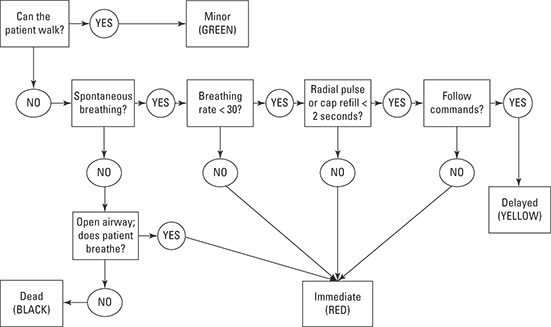
START depends upon several basic parameters. The patients are categorized by severity as immediate, delayed, minor, and deceased; these correspond to colors on triage tags to enable rapid visual assessment of triaged patients.
Triage begins with directing patients who can walk under their own power to an area where they can be reevaluated for their actual injuries. These patients are categorized as “green” or minor. With the remaining, nonambulatory adult patients, you apply the following rules:
- Is the patient spontaneously breathing?
If YES, go to Step 2. If NO, open the airway and reassess. If still not breathing, the patient is dead and categorized as BLACK. If the patient begins to breathe, then the patient is RED, or immediate.
- Is the breathing rate less than 30 breaths per minute?
If YES, go to Step 3. If NO, then the patient is RED.
- Is there a radial pulse, or is capillary refill less than 2 seconds?
If YES, go to Step 4. If NO, then the patient is RED.
- Does the patient follow commands?
If YES, the patient is YELLOW, or delayed for treatment. If NO, then the patient is RED.
This process takes only a few seconds to apply, allowing you to triage a large number of patients in a short period of time. Triage tags or tape is used to label the patients as you process them.
An explosion has occurred at a local manufacturing plant. You are the triage officer. A patient walks up to you with an amputation of the right arm at the elbow. There is a pant belt looped around the remaining arm. It is oozing blood. The patient’s skin is pale and cool to the touch; he is breathing 30 times per minute, and his radial pulse rate is 100. Using START triage, you would categorize this patient as
(A) black.
(B) green.
(C) yellow.
(D) red.
The best answer is Choice (B); as distressing as this patient’s injury is, he is walking and therefore triaged into the minor, or green, category. In the initial triage phase, he wouldn’t fit into any of the other categories. However, it’s likely that upon reaching the treatment area, he’ll be retriaged and probably moved into a more urgent category.
Hazardous incidents
The modern world is filled with a near-infinite number of chemicals that are used to make our lives better, safer, and more convenient. An unfortunate side effect is that many of them are also hazardous to health; companies worldwide spend billions of dollars to minimize spills and accidents.
EMS responds to hazardous events regularly. Unless you are specifically trained, equipped, and responsible for mitigating the hazard, your job is to notify others of a possible hazardous incident and keep unauthorized personnel from entering.
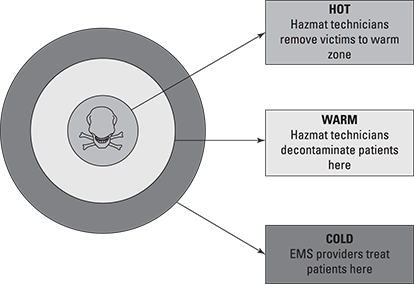
Operate only within the cold zone, where there is no contact with the hazardous material. Patients are decontaminated in the warm zone by specialists who are trained to perform this task. Hazmat technicians mitigate the actual problem within the hot zone. (Check out all these zones in Figure 14-2.)
Make sure patients are decontaminated before transporting them to hospitals. It does no good to bring the disaster to the emergency department!
Practice Questions about EMS Operations
The following practice questions are similar to the EMT exam’s questions about EMS operations. Read each question carefully, and then select the answer choice that best responds to the question.
1. You and your partner have just finished a shift and are off duty. The station pager goes off, signaling another call. No one is available to respond. Your partner does not want to go back in service. Which of the following statements is most correct?
(A) There is a duty to act, and you must respond.
(B) This may be an ethical issue, but not a legal issue.
(C) Good Samaritan laws will protect you in not responding.
(D) Your partner could be held liable for negligence.
2. A 55-year-old patient has sudden syncope. He is evaluated by EMTs at his home. He is alert, with pale, dry skin. He refuses their care and offer of transport. He subsequently experiences a cardiac arrest and dies. His family sues the EMTs for negligence. Which of the following statements is most correct?
(A) Because the EMTs failed to consider the potential seriousness of the condition and an injury occurred, they are liable.
(B) There was a breach of duty when the EMTs did not take the patient to the hospital.
(C) The patient has a right to self-determination and to make decisions about his care.
(D) There was no duty to encourage the patient to receive further medical care.
3. A 40-year-old female is at her office. She is confused, but cooperative. She is refusing your care and offer of transport. Her vital signs are normal and there are no obvious signs of illness or injury. You should
(A) advise her of possible negative outcomes of her decision.
(B) request police to respond.
(C) treat and transport.
(D) have coworkers transport her.
4. You are treating a 47-year-old female who is unresponsive, hypotensive, and breathing at a rate of four breaths per minute. One family member, who has power of attorney, wishes only supportive care for the patient. Several other family members are upset and begging you to begin resuscitation. You should
(A) move the patient to the gurney and begin transport.
(B) assist ventilations with a bag-valve mask and oxygen.
(C) contact police to question the family.
(D) administer supplemental oxygen.
5. You’re evaluating a patient with altered mental status when he becomes agitated and attempts to strike you. You should immediately
(A) step back and prepare to retreat if he becomes more violent.
(B) grab his arm and restrain him.
(C) have you and your partner grab his arms and torso.
(D) call for police assistance.
6. A patient has a fever and a productive cough. Your best way to avoid being infected is to
(A) have the patient be tested for serious airborne diseases.
(B) wash your hands after transporting the patient.
(C) place a mask over the patient’s face.
(D) wear eye protection.
7. After a call you note blood on the metal rails of the gurney, as well as the mattress. You should
(A) use hot water and soap to clean the affected areas.
(B) sterilize the gurney.
(C) use hand sanitizer to clean the rail and mattress.
(D) use a bleach-water solution to wipe down the gurney and mattress.
8. Your partner is tired, short-tempered, and treating his patients with disrespect. You are aware that he is having issues with his marriage and he has been working a lot of overtime. Which of the following ways of handling the situation would be most appropriate?
(A) Ignore the behavior, as the situation is none of your business.
(B) Report his behavior to the supervisor.
(C) Ask him how he is doing and offer to help.
(D) Talk with his wife to mediate a discussion with your partner.
9. You and your partner are preparing to remove a 300-pound patient from the third floor of a house. Which of the following approaches would be safest?
(A) Use a stair chair to carry the patient.
(B) Request that additional resources respond to the scene.
(C) Have family members assist you in moving the patient.
(D) Use the gurney to help move the patient.
10. While responding to an emergency call using lights and siren, you approach an intersection. The traffic light begins to change from green to yellow as you approach. You should
(A) slow down and prepare to stop if needed.
(B) speed up and proceed through the intersection before the light turns red.
(C) maintain your speed and prepare for an emergency maneuver if necessary.
(D) use your airhorn to clear the intersection.
11. You are 8 minutes away from a report of a major rollover auto crash. The incident is 45 minutes travel time by ground ambulance to the trauma center and 10 minutes to the community hospital. A medical helicopter can be over the incident location within 10 minutes of dispatch. You should
(A) request the helicopter to respond to the community hospital while you transport the patient to that location.
(B) request that the helicopter respond to the scene.
(C) arrive at the scene, evaluate the situation, and request the helicopter if necessary.
(D) transport the patient to the trauma center.
12. As you arrive at the scene of an industrial building, you note a person lying on the ground near several metal containers. Other persons are nearby, coughing and holding their hands over their mouths. You should
(A) begin assessing the person lying on the ground.
(B) ask the coughing individuals to move away from the scene.
(C) stop your vehicle.
(D) administer supplemental oxygen to those who are coughing.
13. A driver is trapped in her passenger car after a crash. As firefighters are preparing to extricate, you determine that the patient’s breathing is slow and shallow. The radial pulse is absent. You should
(A) maintain spinal stabilization during extrication.
(B) use a short backboard or vest device to extricate.
(C) administer high-flow oxygen via a nonrebreather mask.
(D) apply AED pads and prepare to defibrillate.
14. You arrive at a parking lot where an infant has been left alone in a passenger car. The air is quite warm and humid. Through the windshield you observe that the infant’s eyes are closed. You’re not sure whether the infant is breathing. You should
(A) attempt to find the owner of the car to unlock the doors.
(B) call for a rescue squad for extrication.
(C) break the window farthest away from the child with a hand tool.
(D) cover the car with a tarp to shield it from the sun.
15. According to START, which of the following presentations should be treated first?
(A) An adult female with an amputated arm, bleeding, crying, breathing 20 times per minute.
(B) An adult male with no obvious injuries, apneic after a jaw thrust.
(C) A young child with a fractured femur and a radial pulse rate of 90.
(D) A teenage male, altered, with cool, pale, and diaphoretic skin and a carotid pulse only.
16. You are the second unit to arrive at a multicasualty incident. You should
(A) assume the role of transport officer.
(B) assume incident command.
(C) respond to the staging area.
(D) begin triaging victims.
17. At the scene of a hazardous materials incident, patients should be decontaminated in the
(A) hot zone.
(B) warm zone.
(C) cold zone.
(D) washdown zone.
18. You are evaluating a terminally ill patient who is having difficulty breathing. Family members report having a “do not resuscitate” (DNR) form for the patient, but they are unable to find it. You should
(A) do nothing until the form is located.
(B) do nothing and document the circumstances.
(C) provide appropriate care until the form is located.
(D) have family members sign a new DNR form.
19. Under what circumstances can you legally release confidential patient information?
(A) When a detective needs information about a suspect
(B) At the family’s request
(C) When the media is recording in a public space
(D) When the patient is competent and signs a release form
20. An apartment building landlord lets you into an apartment, where you find an elderly female who has fallen but is uninjured. She lives alone; you note her apartment is filthy and there is little food in the refrigerator. She is confused and unable to recall her medical history or medications. Your best course of action is to
(A) assist her to a chair and clean up her apartment.
(B) file a report with adult protective services.
(C) notify the police of possible criminal activity.
(D) transport her to a specialized nursing facility.
Answers and Explanations
Use this answer key to score the practice questions in the preceding section. The explanations give you insight into why the correct answer is better than the other choices.
- B. Since you are off duty, and there is no expectation of your response, there is no legal duty to act in this situation as Choice (A) suggests. Good Samaritan laws, noted in Choice (C), only protect your actions on the scene of a medical incident. Because no duty to act exists, negligence, Choice (D), does not apply.
- C. There was a duty to act in this event — the EMTs were on duty and responded, contrary to Choice (D). Based on the scenario, the patient had the ability to legally refuse medical care and/or transport. The crew could have been liable if they had forced him to go to the hospital, Choice (B). There is no indication that the crew failed to perform an adequate assessment, as Choice (A) suggests.
- C. The patient does not have the capacity to make the decision Choice (A) suggests. This allows you to treat and transport under implied consent. She shouldn’t be transported by coworkers, Choice (D), because they’re not able to monitor her medically and can’t help her if her condition suddenly worsens. Having the police respond, Choice (B), wouldn’t alter the situation, as they have no jurisdiction in medical matters.
- A. The family member with power of attorney has the legal right to make decisions for the patient. Providing any intervention that may prolong the life of the patient, as in Choices (B) and (D), would be inappropriate. Medical direction, Choice (C), would have little to say in this situation.
- A. Your immediate maneuver is to avoid being injured. Calling police, Choice (D), can be your next step after you retreat. Trying to restrain the patient yourself or with a partner, as in Choices (B) and (C), is risky.
- B. The single best way to reduce cross contamination is to wash your hands, even if you wear gloves. Choice (A) doesn’t keep you from being exposed, and Choices (C) and (D) don’t provide the same level of protection.
- D. There may be more, smaller amounts of contaminant on the gurney than you can see. Choices (A) and (C) suggest methods that aren’t recommended for destroying bloodborne pathogens. Sterilizing the unit, Choice (B), requires high heat or submersion in a chemical bath, neither of which is practical.
- C. Your partner is exhibiting signs of stress, which are showing up in his treatment of his patients. Although you may need to speak to a supervisor at some point, Choice (B), it may be helpful for your partner to debrief with you first. Ignoring the situation, Choice (A), may subject your patients to unnecessary harm. Be careful not to make an assumption that the marriage is the main issue, as in Choice (D); it may be work-related.
- B. The weight of the patient is too much for two rescuers to carry safely, even with a stair chair, Choice (A). Family members may not be trained to assist in a safe manner, eliminating Choice (C). A gurney, as Choice (D) suggests, is likely to worsen the situation by adding additional weight and bulk to the carry.
- A. Driving with lights and siren is risky. Minimize the danger by slowing your forward speed before entering the intersection, Choice (A), rather than speeding up, Choice (B), or proceeding at your current speed, Choice (C). Using your airhorn, Choice (D), is less likely to be helpful because many drivers will not be able to hear it clearly, especially if they’re coming across the intersection.
- B. A medical helicopter can reduce the amount of time it takes to transport a critical trauma patient to a trauma center — if it’s dispatched appropriately. Given the scenario, the best situation is to have the helicopter very close by as you begin evaluation of the patient, thereby reducing any delay of the transport. Choice (C) will cause delay; Choice (A) will add delay between the two hospitals; and Choice (D) will likely take well over an hour to implement.
- C. Your safety is paramount. Despite your best intentions, you are of no use if you are injured or killed at an incident. Given the choices, the best action is to stop your vehicle a safe distance away from the incident, Choice (C). This action allows you to size up the scene and request additional resources. You should also deny entry to other personnel and bystanders if possible.
- A. The patient is critically injured. Time is of the essence in managing her condition; rapid extrication is appropriate. Using a short backboard or vest device, Choice (B), delays extrication. She needs to be ventilated; supplemental oxygen, Choice (C), is not sufficient. An AED, Choice (D), isn’t indicated at this time.
- C. EMTs should have simple hand tools available and should know how to use them properly. You don’t know if or when the owner of the car will be found, making Choice (A) impractical, and a rescue squad, Choice (B), may take time to reach the scene. Covering the car with a tarp, Choice (D), won’t shield the car from the ambient air temperature.
- D. START triage begins with separating patients who can ambulate from those who can’t. In the second group, you should first confirm that the patient is breathing. If not, apply a jaw thrust. If he still isn’t breathing, as in Choice (B), triage “expectant” or black.
If the patient is breathing, count respirations. If the rate is greater than 30 or less than 10, triage “immediate” or red.
If the respiratory rate is in between, check for a radial pulse. If there isn’t one, as in Choice (D), triage “immediate” or red.
If there is a radial pulse, check the patient’s level of consciousness. If alert, as in Choices (A) and (C), triage “delayed” or yellow.
- A. The first unit personnel assume the roles of incident commander, Choice (B), and triage, Choice (D). The second unit personnel assume treatment and transport. Subsequent units report to the staging area for further orders, Choice (C).
- B. The hot zone, Choice (A), is the area immediately around the incident and is most contaminated. Patients are extricated to the warm zone, Choice (B), so decontamination can be done by those who are trained and equipped to work in this area. Decontaminated patients are then transferred to the cold zone, Choice (C), where care by EMS generally begins. There is no such thing as a washdown zone, Choice (D).
- C. DNR does not mean “do not treat.” Until you can determine the level of intervention that is authorized on the form, you are obligated to provide appropriate care (unless the patient is alert and able to tell you otherwise).
- D. A patient must provide written permission for a healthcare provider or organization to release private health information. You cannot release this information to law enforcement, Choice (A), or even family, Choice (B). While the recording of the scene may be legal, it does not provide any basis for you to break confidentiality, Choice (C).
- B. Although it would be nice of you to help clean up the apartment, Choice (A), the more significant issue is that she may be unable to care for herself. It’s possible that she has family that is neglecting her needs; filing a report will begin an investigation to determine whether other issues are involved. There is no criminal element to this scenario, making Choice (C) unnecessary; you may end up transporting to an emergency department, but not a specialized nursing facility, Choice (D).
Part IV
Putting Your Knowledge into Practice
Five Tips for Answering Multiple-Choice Questions
- Be sure to pick the best answer, as there may be more than one correct answer.
- Read the question stem carefully. Try to answer the question without looking at the choices, and then see which of the choices best fits your response.
- If none of the choices seems to answer the question, play detective. Eliminate any answer that is clearly incorrect. Better to make an educated guess between two choices than three or four.
- If you get stuck between two choices, silently read the stem and each choice as if it were one sentence. One may sound more correct than the other.
- Above all, don’t panic. If you get lost in the question, step back and take a moment to reread the stem. It’s possible that you may have missed an important piece of information or misinterpreted part of the question.
Get the scoop on getting and maintaining your EMT certification, elements of the EMT computer exam, and more on the Cheat Sheet at www.dummies.com/extras/emtexam.
In this part …
- See where you stand by taking two full-length practice exams, each composed of 120 multiple-choice questions. Don’t cheat yourself; take these exams as if they were the real thing — no distractions and no stopping for breaks.
- Review the answers after you’re done. Take note of any areas that seem to be weak spots for you, and review your notes, textbook, and the material in this book before taking another practice test.
Chapter 15
What makes EMS providers unique compared to hospital-based medical personnel?
Tap to revealEMS providers deliver care in uncontrolled environments, such as homes, workplaces, and public spaces, often facing unpredictable hazards.
What is scene safety in EMS operations?
Tap to revealThe continuous process of assessing and minimizing risks at an emergency scene to protect both responders and patients.
Name one essential aspect of EMS operations highlighted in this lesson.
Tap to revealFollowing medical legal standards, staying healthy and safe, teamwork, emergency vehicle operation, and managing large incidents are all key aspects.
How confident are you that you can explain why scene safety is critical for EMS providers?
Every EMS response begins with assessing and controlling hazards—if you’re not safe, you cannot help others.
The Shift
- EMS providers must constantly assess and adapt to unpredictable and potentially hazardous environments.
- Operational success in EMS depends on legal awareness, personal safety, teamwork, and effective communication.
- Scene safety is the foundation of every successful emergency response—protecting yourself comes first.