In This Chapter
 Reviewing the structures and functions of the respiratory system
Assessing patients’ breathing and knowing whether to oxygenate or ventilate
Picking out potential airway and breathing problems
Take a deep breath and hold it for as long as you can, until it’s so uncomfortable that it feels like your lungs will burst. When you finally explode and draw in that first panicky breath, let that feeling serve as a reminder of how important your respiratory system is. If it doesn’t function well, life literally comes to a standstill.
The national EMT exam makes the importance of this fact abundantly clear in the number and complexity of questions it dedicates to this area. Having the ability to apply your knowledge of the airway, ventilation, and oxygenation to situations quickly, accurately, and confidently is critical. In this chapter, you get the basics on the respiratory system, discover when to oxygenate and ventilate, and figure out how to handle a variety of airway and breathing problems.
Getting an Overview of the Respiratory System
In a sense, the respiratory system serves a very simple purpose: to bring oxygen in and get carbon dioxide out. However, the task is much more complex than that and requires a sophisticated set of structures:
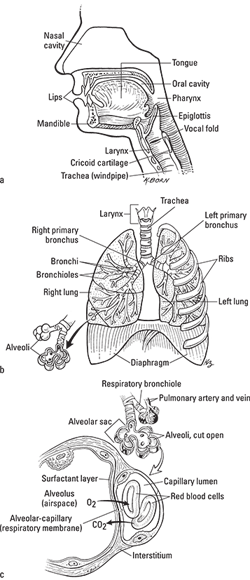
- The upper airway (see Figure 9-1a) consists of the nares (nostrils), mouth, nasopharynx, pharynx, and larynx. Combined, they work to not only channel air in and out of the body but to warm, humidify, and filter it as well.
- The lower airway (see Figure 9-1b) begins at about the level of the vocal cords and includes the trachea, mainstem bronchi, and bronchioles, terminating in the alveoli. The bronchi, bronchioles, and alveoli comprise the lungs. The main function of the lower airway is to produce efficient gas exchange between the alveoli and capillaries surrounding each alveolus (see Figure 9-1c). Blood passing through the capillaries absorbs the oxygen onto red blood cells, and then circulates oxygen to the body’s cells. At the same time, carbon dioxide is released into the alveolus, which is then exhaled out of the body.
You need oxygen to produce adenosine triphosphate (ATP), the energy block used by the body, and you need to regulate carbon dioxide so just enough is available to the body and the rest is released to the atmosphere. This process takes place in the alveoli, where the cell walls are thin enough to allow gases to diffuse freely from areas of high concentration to areas of low concentration. So, oxygen diffuses from the alveoli to the capillaries (into the blood), and carbon dioxide diffuses from the capillaries into the alveoli (out of the blood).
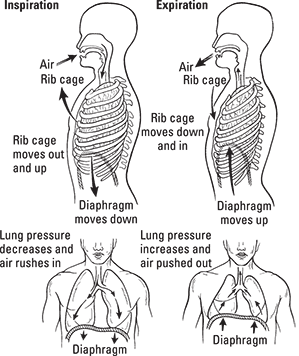
Of course, the concentration of gases would equalize quickly if the gases just stayed in the alveoli. Breathing, or ventilation, is the mechanical effort the body makes to move gases into and out of the lungs. Ventilation occurs with the use of the diaphragm and intercostal muscles (see Figure 9-2):
- Inspiratory phase: When these muscles contract, the chest cavity increases in size as the diaphragm moves downward and the ribs are pulled outward by the intercostal muscles. This produces a slight negative pressure inside the cavity, causing the lungs to expand and drawing air in. This is the inspiratory phase of ventilation.
- Expiratory phase: During the expiratory phase, the reverse occurs. The diaphragm relaxes and moves upward, and the intercostal muscles relax as the chest returns to its resting position. The chest cavity shrinks, creating a positive pressure on the lungs. They return to their smaller resting state, pushing air out of the alveoli and back through the lower and upper airways into the atmosphere.
Under normal resting conditions, this cycle of inspiration and exhalation occurs about 12 to 20 times a minute, every minute of your life. Chemoreceptors, found primarily in the brainstem, detect levels of carbon dioxide and oxygen. They send signals to the brain, which, in turn, trigger an increase or decrease in the work of breathing.
You might think oxygen levels in the body would be the primary driver for respiratory control. But carbon dioxide (CO2) is the real mover and shaker. That’s because CO2 is used to help create conditions in the body’s fluids that are best suited for various life functions. So, in a healthy person, the body depends on detecting a rise in CO2 more than it depends on a drop in oxygen as a reason to breathe.
 Patients who retain CO2 all the time, such as those with chronic obstructive pulmonary disease (COPD), lose their ability to sense that gas. They end up depending upon hypoxic drive, using oxygen levels to regulate their breathing.
 A 30-year-old male is hyperventilating after receiving very emotional news. His breaths are fast and deep. Which of the following statements is most accurate in this situation?
(A) Inhaling too much oxygen will cause breathing to slow, allowing oxygen levels to fall to normal levels.
(B) Inhaling too much oxygen will cause breathing to speed up.
(C) Exhaling too much carbon dioxide will cause breathing to slow, allowing carbon dioxide levels to rise to normal levels.
(D) Exhaling too much carbon dioxide will cause breathing to speed up.
The correct answer is Choice (C). Assuming everything else is normal, as carbon dioxide levels fall within the bloodstream, the brain will signal the respiratory system to slow down, allowing it to retain carbon dioxide and build it back to normal levels. Choice (A) may be true, but only if the patient has COPD and depends upon oxygen levels to control breathing. Neither Choice (B) nor (D) is true.
Knowing the Airway and Breathing Issues to Look for When You Assess Patients
As an EMT, you can’t assume anything about your patient’s condition, even when he appears “normal” at first glance. In your primary assessment, take a few seconds to consciously evaluate how someone is actually breathing. You can start by asking patients how they are feeling; watch and listen to how they respond.
Understanding when breathing is (and isn’t) normal
Ironically, normal breathing is hard to see. That’s because your respiratory system is very effective at its job. There’s so much surface area in the alveoli that gas exchange is very easy. Therefore, the body needs to exert very little energy to make gases move between the alveoli and capillaries. If everything about the respiratory system is working well, the patient will likely be able to speak in full sentences, spending little energy in the process.
It also takes very little to get the respiratory system to work harder. Suddenly being frightened causes you to breathe a little faster as your body prepares a “flight or fight” response.
Difficulty breathing begins with an increase in rate (tachypnea). The patient may breathe deeper (hyperpnea). If the condition doesn’t improve, accessory muscles, such as those in the shoulders and neck, kick in to maximize the chest cavity on inspiration.
If your patient is experiencing a mild level of respiratory distress, you may notice that he has difficulty completing a long sentence, needing to stop midway to take a breath. Or, he may speak more quickly than normal to try to complete a sentence before he needs to take another breath.
In early stages of distress, the patient may want to only sit up; as the condition worsens, the patient may assume a tripod position, holding his upper body up by putting his hands on his knees and straightening his elbows. In really bad situations, the patient may be forced to stand up in order for the diaphragm to contract and push deep into the abdominal cavity.
Deciding when to oxygenate
EMTs used to give oxygen to everyone, regardless of what the complaint was. Chest pain? Give oxygen. Toe pain? Yep, give that gas too! After all, what harm could oxygen do, right? Medical experts have since discovered that inhaling more oxygen than necessary can be harmful for certain conditions, and it isn’t helpful in situations where it isn’t necessary.
 Translated, this means that you need to assess the patient for his ability to absorb oxygen and use it. You do this using your powers of observation coupled with a pulse oximeter. If the patient appears to be ventilating adequately (having a good tidal volume and rate, without the use of accessory muscles), check for oxygen saturation levels with your oximeter. Ideally, the saturation level should be between 94 and 99 percent.
What does this mean? If the patient is breathing normally, and his oxygen saturation level is greater than 94 percent, you don’t need to administer oxygen. If the saturation level is lower or normal but the patient has mild respiratory difficulty, a nasal canula with oxygen flowing between 2 and 6 liters per minute (LPM) is probably fine. If the patient is working hard to breathe, a nonrebreather mask at 12–15 LPM may be needed. Carefully monitor saturation readings and the patient’s level of distress. If things don’t improve, you may need to provide manual ventilation (see the next section).
Oxygen is carried on hemoglobin proteins located within the red blood cells (RBCs). Each hemoglobin can carry up to four molecules of oxygen. As hemoglobin picks up oxygen, the color of the RBC changes from a dusky, dark red to a brighter shade. A pulse oximeter can detect these shades of red and calculate the percentage of red blood cells that are carrying oxygen in their hemoglobin. Normal amounts are around 94 percent or higher. Once oxygen saturation drops to about 92 percent, the change in subsequent saturation levels can be quick, dropping to 85 percent or even lower within a few minutes.
A 42-year-old male is complaining of abdominal pain and cramping after eating a fried chicken dinner. He is alert, with pink, warm, diaphoretic skin. His vital signs include a pulse rate of 92, a blood pressure of 142/90 mm Hg, and a respiratory rate of 18 breaths per minute. His oxygen saturation level is 96 percent. What should you do next?
(A) Administer oxygen at 4 LPM with a nasal cannula.
(B) Administer oxygen at 15 LPM with a nonrebreather mask.
(C) Perform a secondary assessment.
(D) Begin immediate transport.
The correct answer is Choice (C). Based on the patient’s chief complaint, relatively normal vital signs, and lack of evidence of respiratory distress, oxygen, Choices (A) and (B), is not indicated. There is also no indication of an emergent condition that requires immediate transport, Choice (D).
Recognizing when to ventilate
To know when to ventilate is to know when the patient crosses the line between respiratory distress and respiratory failure:
- Respiratory distress: In respiratory distress, the patient is compensating for a potential hypoxia problem by breathing faster, deeper, and/or harder. By doing so, the patient’s mental status remains good, as do his oxygen saturation levels (see the preceding section).
- Respiratory failure: If the compensatory mechanisms don’t maintain adequate oxygen or carbon dioxide levels, the patient’s well-being begins to falter. Mental status changes from alert to confused to unconsciousness as the brain runs out of oxygen or fills with carbon dioxide. Oxygen saturation levels drop below normal. The patient’s drive to breathe weakens, causing ventilations to become inadequate. This state, in turn, makes oxygen levels fall even further, creating a vicious cycle. Breathing slows and becomes even more shallow. If left untreated, respiratory failure will deteriorate to respiratory arrest, followed quickly by cardiac arrest.
Recognizing early signs of respiratory failure is key. If the patient looks tired, is having difficulty remaining alert, or his skin becomes very pale or cyanotic, cool, and clammy, it’s time to break out your bag-valve mask (BVM) and deliver manual ventilations.
 An early sign of hypoxia is anxiety. The brain is so sensitive to oxygen levels that minor changes trigger it to start sending out alerts. If your patient looks or feels anxious, definitely provide reassurance, but also consider whether you’re seeing the first signs of a more serious problem.
A 70-year-old female is complaining of shortness of breath that began shortly after a nap. She is alert and appears anxious. She is breathing 30 times per minute and says her fingers and face feel numb. You should
(A) assist with her breathing with a bag-valve mask and oxygen.
(B) provide supplemental oxygen at 4 LPM using a nasal cannula.
(C) have her breathe into a face mask without oxygen attached.
(D) tell her to control her anxiety and that will help with her breathing.
The correct answer is Choice (B). Even though she is breathing quickly, she is alert and communicating with you, which indicates she is getting enough oxygen to her brain. Therefore, she’s not in respiratory failure and doesn’t require artificial ventilation, Choice (A). However, she may be in true respiratory distress, trying to maintain oxygen levels. The last thing you want to do is to have her rebreathe her own CO2 and reduce the amount of available oxygen, Choice (C). While she may be experiencing anxiety, she may be hyperventilating for another reason, such as having a pulmonary embolus. Choice (D), although tempting, isn’t likely to control her breathing.
Taking Action on Potential Airway and Breathing Problems
Many conditions can affect the airway and breathing, causing someone to become short of breath. And, because the respiratory system reacts to events happening inside the body, many nonrespiratory conditions can cause difficulty breathing as well. I don’t cover them all in the following sections, but a good rule of thumb is to always think beyond the breathing tube when a patient is having trouble breathing yet her respiratory system seems okay.
Upper airway conditions
Given that the airway is the only way for air to enter and exit the body, anything that partially or completely blocks it is troublesome, to say the least. Table 9-1 lists common conditions you should be familiar with, their signs and symptoms, and treatment options for each.
Table 9-1 Conditions Affecting the Upper Airway
|
Problem |
Signs and Symptoms |
Action Steps |
|
Anaphylaxis causing major swelling of the upper airway |
Exposure to an allergen such as a bee sting or peanuts; drooling; reddened oropharynx; muffled or whispered voice; possible hypotension. |
Assist the patient in using an epinephrine injector; administer supplemental oxygen; ventilate as necessary to maintain oxygen saturation. |
|
Croup |
Usually occurs in young children; fever; stridor, raspy cough; sometimes relieved with a quick change in air temperature and/or humidity. |
Have parent assist with positioning the child comfortably; administer blow-by, humidified oxygen. |
|
Epiglottitis |
High fever; drooling; reddened oropharynx; muffled or whispered voice; unable to lie down. |
Don’t stick anything into the mouth! Help the patient into a comfortable position; administer blow-by oxygen. |
|
Foreign body obstruction |
Full obstruction: Air is unable to pass by the obstruction. No noise or breathing sounds from airway; skin turns pale to cyanotic; universal choking sign. |
Conscious patient: Administer abdominal thrusts (child and adult) or chest thrusts/back blows (infant). If airway is partially obstructed, encourage patient to cough; keep suction available and prepare to act if airway becomes fully obstructed. |
|
Pertussis |
Prolonged coughing spells; “whoop” sound when patient takes a deep breath after coughing; more prevalent in children; dark, thick mucous production; 1–2 week history of mild fever and coughing that worsens in duration and discomfort. |
Wear personal protective equipment (PPE), including a HEPA mask; administer supplemental, humidified oxygen. |
|
Tongue blocking the airway |
Patient has altered mental status or is unresponsive, allowing tongue to relax and block the airway. Snoring sounds may be heard. In severe situations, breathing may become irregular or absent. |
Perform head-tilt, chin-lift technique; if neck trauma suspected, utilize a modified jaw-thrust maneuver. Insert oropharyngeal or nasopharyngeal airway to help control the tongue. |
A 65-year-old male fell off a stepladder while attempting to replace a light bulb. You find him unresponsive to painful stimulus. He has a large hematoma to his left temple. He has slow, irregular, snoring respirations and his skin is pale, cool, and diaphoretic. After taking manual spine precautions, you should next
(A) apply a head-tilt, chin-lift and insert an oropharyngeal airway.
(B) administer high-flow oxygen with a nonrebreather mask.
(C) apply a modified jaw thrust and insert an oropharyngeal airway.
(D) ventilate with a bag-valve mask with high-flow oxygen.
The right answer is Choice (C). There are indications that a spinal injury may exist (mechanism of injury, a head injury, and a patient who is unable to communicate). A modified jaw thrust will open the patient’s airway while minimizing motion to the cervical spine, unlike a head-tilt, chin-lift procedure, Choice (A). The patient’s ventilation status is inadequate for simple supplemental oxygen, Choice (B). You’ll need to ventilate the patient, Choice (D), but not until after opening the airway.
Lower airway conditions
Table 9-2 lists a variety of common conditions affecting the lower airway structures, causing shortness of breath.
Table 9-2 Conditions Affecting the Lower Airway
|
Problem |
Signs and Symptoms |
Action Steps |
|
Asthma |
Episodic respiratory distress; wheezes auscultated during breathing; may have past medical history; may have prescribed inhalers. |
Assist with patient’s prescribed emergency inhaler if available; administer supplemental oxygen; ventilate if necessary to maintain oxygen saturation. |
|
Bronchiolitis; respiratory syncytial virus (RSV) |
Presents mostly in children to 2 years of age; gradual onset of fever, cough, and general weakness. |
Wear personal protective equipment (PPE); administer supplemental, humidified oxygen. |
|
Chronic obstructive pulmonary disease (COPD) |
Chronic shortness of breath that has abruptly become worse; wheezes, crackles, or rhonchi auscultated during breathing; patient may be thin with an enlarged chest wall (emphysema) or appear bloated and heavy with dusky skin (chronic bronchitis); probable past medical history; may have prescribed inhalers; smoking history. |
Assist with patient’s prescribed emergency inhaler if available; administer supplemental oxygen; ventilate if necessary to maintain oxygen saturation. |
|
Cystic fibrosis |
Genetic condition; chronic illness with acute worsening; heavy mucous production. |
Help patient into a comfortable position; suction; administer supplemental oxygen; ventilate as needed to maintain saturation. |
|
Pneumonia |
Fever; 1–2 week history of flu or cold symptoms; productive cough with yellow to green sputum production; may auscultate crackles, rhonchi, or wheezes in lung fields; may have chest pain that worsens with cough. |
Help patient into a comfortable position; administer supplemental oxygen (consider humidification). |
|
Pulmonary edema |
Sudden onset; may auscultate crackles or wheezes in lung fields or sounds may be very diminished as condition worsens; if hypertensive, may have jugular venous distension; pedal edema; in worse cases, produces frothy, pink-colored sputum with cough; may have history of congestive heart failure, hypertension, or myocardial infarction. |
If blood pressure (BP) is normal or high, assist patient in sitting upright with feet dangling for comfort; administer supplemental oxygen; ventilate as necessary to maintain saturation. Consider continuous positive airway pressure (CPAP). |
|
Pulmonary embolism |
Sudden onset; lung sounds remain clear or may have a localized wheeze; may have chest pain; may have tender calf in lower leg; recent history of immobilization such as surgery or a long air flight; oral birth control user or smoker. |
Administer supplemental oxygen; ventilate if necessary to maintain oxygen saturation. This condition may mimic psychogenic hyperventilation; do not use paper bag or withhold oxygen. |
|
Spontaneous pneumothorax |
Sudden onset; may occur after prolonged coughing or heavy lifting; lung sounds may be normal, or diminished on one side; may experience sharp chest pain; may have history of asthma, COPD, or connective tissue disease. |
Help patient into a comfortable position; administer supplemental oxygen. |
A 52-year-old female is in respiratory distress. Her heart rate is 104, and her blood pressure is 148/82 mm Hg. She is breathing 24 times per minute and her oxygen saturation level is 95 percent. She tells you that she has been experiencing cold-type symptoms for ten days; during the last two days she has been producing yellow sputum when she coughs. She has a history of asthma, angina, and hypertension, and takes medication for both conditions, including a rescue inhaler and nitroglycerin tablets. You note no accessory muscle use when she breathes. You auscultate her lungs and hear rhonchi. You should
(A) assist with administering her rescue inhaler.
(B) administer oxygen at 4 LPM via nasal cannula.
(C) administer oxygen at 15 LPM via a nonrebreather mask.
(D) assist with administering a nitroglycerin tablet.
The correct answer is Choice (B). The information provided in the question points to pneumonia as the underlying cause of the patient’s respiratory distress. There are no signs of an acute asthma attack or angina, so assisting with her medications, Choices (A) and (D), isn’t indicated. Her level of respiratory distress is not severe, as indicated by a reasonable oxygen saturation level and lack of accessory muscle use. High-flow oxygen, Choice (C), isn’t indicated.
Nonrespiratory conditions
When other, nonrespiratory conditions arise that affect oxygen and/or carbon dioxide levels in the body, the respiratory system attempts to compensate by working harder. Some of the more common ones are listed in Table 9-3.
Table 9-3 Nonrespiratory Conditions that May Affect Breathing
|
Problem |
Signs and Symptoms |
Action Steps |
|
Environmental/industrial exposure to toxic gas or chemicals |
Hazardous scene; may involve multiple victims; coughing; nausea, vomiting; may have secretions from eyes, nose, or mouth; lung sounds may be clear or may contain wheezes or crackles; headache, blurred vision (especially with carbon monoxide poisoning). |
Operate in cold zone; decontaminate if necessary; remove patient to fresh air; administer supplemental oxygen; ventilate if necessary to maintain saturation. |
|
Metabolic acidosis |
Condition resulting from excessive hydrogen ion (H+) buildup in the blood causing high acid levels. The body attempts to shift the acid levels back to normal by buffering H+ with bicarbonate, causing CO2 to form. The patient breathes faster and deeper (Kussmaul’s respirations) to remove the extra CO2. |
None directly. Provide supplemental oxygen if indicated. Don’t attempt a procedure that would cause the patient to retain more CO2, such as breathing into a paper bag or an oxygen mask without oxygen being administered through it. |
|
Myocardial infarction |
May have chest discomfort; normal lung sounds; may be elderly, female, or diabetic. |
Help patient into a comfortable position; administer supplemental oxygen; ventilate if necessary to maintain saturation. |
|
Opioid (narcotic) overdose |
Opioids like heroin and morphine cause altered mental status and suppress the respiratory drive, causing slow, shallow respirations that deteriorate to respiratory arrest. |
Insert OPA or NPA to control airway; perform head-tilt, chin-lift maneuver; begin ventilations with bag-valve mask and oxygen. |
|
Psychogenic hyperventilation |
Psychological trigger; normal lung sounds; carpopedal spasms; numbness in face, hands, or feet. |
Help patient into a comfortable position; coach to control breathing; administer supplemental oxygen. Do not use paper bags or other home remedies. |
By no means is this an exhaustive list; just be sure to keep your mind open to the possibility that someone who is having trouble breathing is experiencing a problem not related to the respiratory system.
An alert, 80-year-old male complains of sudden shortness of breath. His skin is pale, cool, and moist. He tells you he began feeling this way about an hour ago, while he was sitting and reading a book. His vital signs include a respiratory rate of 16 breaths per minute, his pulse is 90 and regular, and his blood pressure is 160/96 mm Hg. He has a history of high blood pressure and diabetes, and is allergic to bees. Lung sounds are clear bilaterally. His oxygen saturation level is 97 percent. You should
(A) administer high-flow oxygen via a nonrebreather mask.
(B) place the patient in position of comfort.
(C) encourage him to drink some orange juice with sugar.
(D) assist with an epinephrine autoinjector, if he has one.
The right answer is Choice (B). Although the patient’s presentation is vague, his age and a sudden onset of feeling short of breath point to a possible myocardial infarction. Keeping the patient calm and comfortable is key to preserving myocardial tissue. Although the patient feels like he is short of breath, there’s little evidence of respiratory distress. High-flow oxygen, Choice (A), is not warranted. He is alert, suggesting hypoglycemia, which Choice (C) alludes to, is not the culprit. There is no evidence of a severe allergic reaction as Choice (D) implies.
Practice Questions about the Airway, Respiration, and Ventilation
The following practice questions are similar to the NREMT EMT exam’s questions in this section. Read each question carefully and then select the answer choice that most correctly answers the question. Try to answer each question without looking up the answers, so you can better understand what you do — and don’t — know.
1. At a drugstore, an adult patient presents with cool, pale, and diaphoretic skin and difficulty breathing, with wheezing auscultated in both lungs. Bystanders report the patient walked in 5 minutes ago, unable to talk and very short of breath. His heart rate is 126, his blood pressure is 90/60 mm Hg, and his respiratory rate is 24 breaths per minute. He is able to follow simple commands. You should
(A) administer low-flow oxygen via a nasal cannula.
(B) perform abdominal thrusts.
(C) assist the patient with his prescribed epinephrine autoinjector.
(D) assist ventilations with a bag-valve mask and oxygen.
2. An elderly female presents supine in her bed, alert and in respiratory distress. You can hear audible crackles as she breathes. Her blood pressure is 240/120 mm Hg, her heart rate is 100 and irregular, and her respiratory rate is 22 breaths per minute. You should immediately
(A) begin bag-valve-mask ventilations with supplemental oxygen.
(B) place her into a sitting position, with her feet dangling over the edge of the bed.
(C) administer low-flow oxygen via a nasal cannula.
(D) turn her left lateral recumbent and administer high-flow oxygen via a nonrebreather mask.
3. A 72-year-old male with a history of chronic obstructive pulmonary disease (COPD) has been increasingly short of breath over the past 24 hours. He reports having a fever, chills, and a cough over the past ten days. His skin is warm, pale, and dry; his breathing rate is 24 times a minute. You should
(A) administer low-flow oxygen via nasal cannula.
(B) administer high-flow oxygen via a nonrebreather mask.
(C) administer medium-flow oxygen via a venturi mask.
(D) encourage him to cough.
4. A 13-month-old child presents in his parent’s arms and is in respiratory distress. The parent reports the child has had a fever, runny nose, and decreasing appetite in the past four days. The child cries when you examine him. He has a nonproductive cough and warm, flush skin. His breathing rate is 30 times per minute, and his heart rate is 120. You should
(A) assist ventilations with a pediatric bag-valve mask and oxygen.
(B) suction the nose and mouth with a bulb syringe.
(C) administer oxygen using the blow-by technique.
(D) administer pediatric acetaminophen.
5. A 21-year-old male complains of chest tightness and difficulty breathing after a fight with his girlfriend. His respiratory rate is 34, his heart rate is 110, and his blood pressure is 136/90 mm Hg. He feels tingling around his face and in his hands. His skin is pale, warm, and dry. You should
(A) administer low-flow oxygen via a nonrebreather mask.
(B) coach the patient to rebreathe his breath with a paper bag.
(C) help the patient into a supine position.
(D) administer low-flow oxygen via a nasal cannula.
6. An elderly male presents with sudden stridor, coughing, and wheezing at a restaurant. His skin is pale, warm, and diaphoretic. Patrons report that the patient was enjoying his lunch when this episode began. You detect a strong radial pulse. Your next step is to
(A) encourage the patient to continue coughing.
(B) deliver abdominal thrusts.
(C) administer low-flow oxygen via nasal cannula.
(D) inspect the patient’s mouth.
7. A 72-year-old female presents supine in bed, responsive to painful stimulus by moaning. Her respiratory rate is 12 breaths per minute and shallow. Her heart rate is 126, and her blood pressure is 78/60 mm Hg. You hear diminished lung sounds bilaterally and crackles throughout. Her skin is pale, cold, and clammy. You should
(A) administer low-flow oxygen via nasal cannula.
(B) administer high-flow oxygen via a nonrebreather mask.
(C) ventilate with a bag-valve mask and oxygen.
(D) have her sit up with her feet dangling off the side of the bed.
8. A 30-month-old child presents sitting on the edge of her bed, appearing short of breath. Parents report she has had a fever and body chills and aches over the past 36 hours. Her skin is hot, pale, and dry. She nods her head when you speak but doesn’t say anything herself. You can hear stridor, and you observe that she is drooling. Which of the following procedures should you perform?
(A) Inspect her mouth, using a tongue depressor.
(B) Suction her mouth by inserting a rigid-tip catheter.
(C) Maintain her position of comfort and transport her.
(D) Administer high-flow oxygen via a nonrebreather mask.
9. A 19-year-old female is having difficulty breathing. You note accessory muscle use. Her respiratory rate is 20 breaths per minute, with a prolonged expiratory phase. Although she appears alert, she can’t speak more than one- or two-word sentences. You should
(A) assist her ventilations with a bag-valve mask and oxygen.
(B) administer low-flow oxygen via a nasal cannula.
(C) prepare to suction her airway.
(D) assist the patient in using her prescribed multidose inhaler.
10. A 24-year-old male is discovered unresponsive on the floor of his bedroom. He does not respond to a painful stimulus. He has a radial pulse rate of 104 and a breathing rate of 5 breaths per minute. His lung sounds are clear. You should immediately
(A) insert an oral airway and ventilate with a bag-valve mask and oxygen.
(B) administer high-flow oxygen via a nonrebreather mask.
(C) determine his blood pressure.
(D) turn the patient to a left lateral recumbent position.
11. A 35-year-old female is complaining of chest pain and shortness of breath while sitting at her office. You observe that she is breathing 30 times a minute, has a rapid radial pulse, and has pale, cool, dry skin. Her heart rate is 120 and she is alert. This episode began 30 minutes ago while she was preparing for a meeting and has gotten steadily worse since. Which of the following procedures should you perform first?
(A) Determine the level of stress she had while preparing for her meeting.
(B) Perform a detailed physical examination.
(C) Administer high-flow oxygen via a nonrebreather mask.
(D) Administer low-flow oxygen via a nonrebreather mask.
12. A 56-year-old male is in respiratory distress. He is breathing 18 times a minute, with pursed lips as he exhales. He appears alert. His pulse is 104 and irregular, and his blood pressure is 132/82 mm Hg. You note his skin is pink, warm, and diaphoretic. He is thin, and you can see accessory muscle movement. Wheezes can be auscultated toward the top of his lung fields. You should
(A) administer low-flow oxygen with a nasal cannula.
(B) administer high-flow oxygen with a nonrebreather mask.
(C) ventilate with a bag-valve mask and oxygen.
(D) assist with his prescribed nitroglycerin tablets.
13. An elderly female presents unconscious on the floor. Her skin is pale, cool, and dry. She is breathing at a rate of 4 times per minute. You can hear snoring sounds when she breathes. She has a faint, slow carotid pulse. You should first
(A) perform a head-tilt, chin-lift procedure and insert an oropharyngeal airway.
(B) perform a jaw thrust, and suction with a hard-tip catheter.
(C) manually stabilize the cervical spine and perform a jaw thrust.
(D) administer high-flow oxygen with a nonrebreather mask.
14. A 20-year-old male presents prone in bed. Roommates say that he returned from a party earlier that evening complaining of a headache. He is unresponsive to painful stimulus, and vomits when you roll him over to a supine position. You should
(A) insert an oropharyngeal airway.
(B) insert a nasopharyngeal airway.
(C) place the patient in a sitting position.
(D) suction the airway with a rigid-tip catheter.
15. A patient has overdosed on narcotic painkillers. He is supine in bed and responsive to verbal stimulus by moaning. He curls into a semifetal position when you touch him. Left alone, he has slow, snoring respirations, and he turns pale in color. You should
(A) insert an oropharyngeal airway.
(B) insert a nasopharyngeal airway.
(C) suction the patient’s airway.
(D) manually stabilize the cervical spine.
Answers and Explanations
Use this answer key to score the practice questions in the preceding section. The explanations give you insight into why the correct answer is better than the other choices.
- C. Although the scenario is vague, you have enough information to deduce that the patient is experiencing anaphylaxis. Being at the drugstore, he may have been seeking medications to correct his anaphylactic reaction. His vital signs and poor lung sounds also support a suspicion of anaphylaxis. Although he is critically ill, he’s still alert and following your commands, negating the immediate use of a bag-valve mask, Choice (D). He is moving air into his lungs, eliminating an obstructed airway and the need to perform abdominal thrusts, Choice (B). Low-flow oxygen, Choice (A), would be inadequate for his level of distress.
- B. The scenario suggests pulmonary edema as a result of congestive heart failure (CHF). She is alert and doesn’t require bag-valve-mask use at this moment as Choice (A) suggests. Low-flow oxygen, Choice (C), is inadequate for her presentation, and turning her left lateral recumbent, Choice (D), isn’t as effective as sitting her up to have gravity assist in pooling some of the fluid in the lungs.
- A. The scenario suggests a history of infection, specifically pneumonia. His skin signs suggest that low-flow oxygen will be adequate; any higher concentration, as Choices (B) and (C) suggest, is unnecessary. Coughing, Choice (D), may help the patient to expectorate (produce sputum) but won’t necessarily improve the patient’s complaint.
- C. Although the child is ill, his vital signs are within the normal range for his age. He is alert and recognizes your presence. Blow-by oxygen may help reduce the respiratory distress, and won’t be as claustrophobic to the child as a mask placed over his face. He doesn’t need to be ventilated, Choice (A), and bulb suctioning, Choice (B), will likely irritate him. As an EMT you’re not permitted to administer acetaminophen, as Choice (D) suggests.
- D. Although his condition appears to be psychogenic hyperventilation, a pulmonary embolus can also have the same signs and symptoms. This possibility makes Choices (A) and (B) potentially harmful. Getting the patient in a supine position, Choice (C), is unlikely to make a difference.
- A. The sudden onset and location of the sound strongly suggest a partially obstructed airway. He’s not fully obstructed, so abdominal thrusts, Choice (B), are unnecessary. The priority is to have the patient clear his own airway, rather than inspect his mouth, Choice (D), or provide oxygen, Choice (C). Encouraging the patient to cough and hopefully dislodge the foreign body is the best choice.
- C. Your clinical findings suggest she is in respiratory failure and possible cardiogenic shock. She requires assisted ventilation in order to promote gas exchange. Supplemental oxygen, Choices (A) and (B), won’t be enough, and her blood pressure is too low to sit her up as Choice (D) suggests.
- C. The presentation suggests epiglottitis and that soft tissue in the upper airway is swelling. You don’t want to take the chance of irritating that airway for any reason, making Choices (A) and (B) inappropriate. She is oxygenating adequately, so even putting a mask over her face, Choice (D), may feel stifling and worsen her stress.
- D. The scenario suggests an asthma attack. She is compensating, making a bag-valve mask, Choice (A), unnecessary at this point. No secretions are reported, making suctioning, Choice (C), unnecessary as well. High-flow oxygen would be better than low-flow, Choice (B), considering her level of distress. However, that choice isn’t given for the question, so your best bet is Choice (D).
- A. His breathing rate is inadequate, making bag-valve-mask use necessary. Supplemental oxygen, Choice (B), would be enough only if the patient were moving air in and out of the alveoli. Performing the rest of the exam without intervening in the primary assessment, Choice (C), would be inappropriate. If the patient were breathing adequately, the recovery position, Choice (D), would be an option, but he isn’t.
- C. The scenario describes a patient in compensatory respiratory distress. Although there may be some indications of psychogenic hyperventilation, there is also strong suspicion of a pulmonary embolus. Administering the appropriate flow rate of oxygen through the mask is correct, rather than a lower rate as Choice (D) suggests. You may perform Choices (A) and (B) later in the exam, but you need to evaluate her distress early, during the primary assessment.
- A. The scenario suggests a patient with a history of chronic obstructive pulmonary disease (COPD) due to his skin color and body shape. Although he’s in distress, he doesn’t appear to be in respiratory failure. High-flow oxygen, Choice (B), is unnecessary at this point, as is assisting his ventilations, Choice (C). There’s no suggestion of cardiac ischemia, so nitroglycerin tablets, Choice (D), assuming they’ve been prescribed for the patient, are unnecessary.
- C. You have no clear description about how the patient ended up on the floor, so assume a trauma mechanism until proven otherwise. A jaw thrust will reduce movement of the spine as you open the airway. A head-tilt, chin-lift procedure, Choice (A), is riskier. Snoring respirations are a sign of an airway blocked by the tongue, not secretions as Choice (B) implies. The patient’s respiratory rate is too slow for simple supplemental oxygen, as Choice (D) suggests.
- D. The scenario suggests immediate suctioning. You’ll likely use an airway adjunct shortly, either Choice (A) or (B), but you need to clear the airway first. Placing the patient in a sitting position, Choice (C), isn’t helpful because you’ll spend a lot of energy trying to support his body and likely won’t be able to do much else.
- B. An overdose on narcotics suppresses the respiratory drive and gag reflex. The patient does respond to verbal stimulus, which implies that he may gag if an oropharyngeal airway, Choice (A), is inserted. Snoring respirations are an indication of the tongue blocking the airway, not secretions, as Choice (C) implies. There are no indications of a trauma mechanism, so you don’t need to stabilize the cervical spine, Choice (D).
Chapter 10
What is the primary function of the respiratory system?
Tap to revealTo take in oxygen and expel carbon dioxide, supporting cellular metabolism and life.
Define oxygenation.
Tap to revealOxygenation is the process by which oxygen is delivered to the blood for transport to the body’s cells.
What does ventilation refer to?
Tap to revealVentilation is the movement of air in and out of the lungs, enabling gas exchange.
Describe a real or imagined scenario where a patient’s airway is compromised. What steps would you take to assess and manage the situation?
What is the first step you should take when assessing a patient’s breathing?
The respiratory system is vital for life, and rapid, accurate assessment and management of airway and breathing problems is essential for every EMT.
Not all breathing problems are solved with oxygen alone—recognizing when to oxygenate or ventilate saves lives.
If your respiratory system doesn’t function well, life literally comes to a standstill.
The Shift
- Recognize the critical role of airway, respiration, and ventilation in emergency care.
- Apply rapid assessment skills to determine when to oxygenate or ventilate.
- Understand that correct management depends on accurate diagnosis—not all breathing difficulties require oxygen alone.