In This Chapter
 Walking through practice exam questions
Getting the answer explanations
Jumping into further study
One way to understand how prepared you are to take the NREMT exam is to perform a preassessment — take a practice exam to see where you stand, right now. You may find out that you’re doing just fine and that all you need is a little tune-up on just a couple of areas. If so, that’s great! On the other hand, you may realize that you need to review a few areas and study them further. The preassessment can help you focus first on the areas that you need to study the most. Later, you can review the areas you’re more familiar with.
Keep in mind that test-taking is a skill that you can improve with practice. However, your base knowledge must be good enough to allow you to analyze a question for its information.
Going through the Preassessment Questions
Try to go through this first set of questions without looking up the answers. It’s important for you to get a good sense of what you know — and what you don’t. An honest appraisal helps you identify your areas of weakness. Then, you can focus your precious study time on what matters most and do any last-minute “cleanup” on topic areas that you know well.
If you can, try to answer the questions all in one sitting. Doing so helps get your brain in “game mode.” Chapters 15 and 17 contain much longer practice exams; the 60 questions in this chapter will likely take 40 minutes to an hour to complete.
When you study each question, take a moment to consider how confident you are in your chosen answer. If you don’t feel very confident about your choice, you may want to make a notation to that effect in the margin next to the question. When you check the answer later, you can find out whether your self-appraisal was accurate.
Finally, leave no question unanswered. Even if you’re not confident and can only venture a guess, go ahead. Sometimes your subconscious brain has information that you’re not fully aware of; besides, you don’t want to leave any question unanswered during your actual EMT exam.
1. You determine that your unconscious patient has an inadequate airway. You insert an oropharyngeal airway. The patient vomits. You should first
(A) place the patient into a prone position.
(B) remove the airway.
(C) suction the airway until it’s clear.
(D) place the patient in a sitting position.
2. Your patient is supine in bed, unresponsive to verbal stimulus and having difficulty breathing. You note that the patient’s lips, face, and fingers are cyanotic and that there’s pink, frothy sputum in the mouth and nose. You should first
(A) suction the mouth and nose.
(B) place the patient into a sitting position with feet dangling.
(C) begin bag-valve-mask ventilations.
(D) apply a jaw thrust.
3. A 7-month-old infant presents limp and unresponsive in his mother’s arms. You note no air exchange and a weak, slow brachial pulse. The mother reports that the infant was playing with toys in a crib when he suddenly turned blue and stopped breathing. You should
(A) administer five abdominal thrusts.
(B) suction the mouth.
(C) administer five back blows and five chest thrusts.
(D) begin chest compressions.
4. A 16-year-old female says she is short of breath. She is alert and is speaking seven to eight words in between breaths. She has hives on her chest and arms, and her skin is pale. You should
(A) ventilate the patient with a bag-valve mask.
(B) insert a nasopharyngeal airway.
(C) administer supplemental oxygen.
(D) apply continuous positive airway pressure (CPAP).
5. An unconscious 25-year-old female has pale, cool, and diaphoretic skin. Her respiratory rate is 6 times a minute. You cannot hear lung sounds with a stethoscope. Your next step is to
(A) administer abdominal thrusts.
(B) administer high-flow oxygen.
(C) ventilate with a bag-valve mask.
(D) turn the patient onto her side.
6. A 4-year-old child is having breathing difficulty. He isn’t responding to your commands, he has cyanosis around his lips and fingers, and he’s drooling from his mouth. His parents report the patient has a high fever and didn’t want to lie down to rest. What should you do?
(A) Administer oxygen via blow-by mask.
(B) Ventilate using a bag-valve mask.
(C) Apply a nasal cannula and oxygen at 6 LPM.
(D) Administer a combination of back blows and abdominal thrusts.
7. A 56-year-old male with a history of asthma complains of substernal chest pressure that radiates to his jaw. He is alert, with cool, pale, and diaphoretic skin. His respiratory rate is 24 breaths per minute, and lung sounds are clear. You should
(A) assist his breathing with a bag-valve mask.
(B) assist with the patient’s multidose inhaler (MDI).
(C) lay the patient supine with his legs elevated.
(D) administer supplemental oxygen using a nasal cannula.
8. Lifeguards have pulled a 7-year-old child out of the pool. She is unresponsive and apneic with a rapid carotid pulse. What should you do?
(A) Assist ventilations with a bag-valve mask.
(B) Begin chest compressions with a rate of at least 100 times per minute.
(C) Apply AED pads and prepare to shock.
(D) Suction the mouth and nose.
9. A 56-year-old male is alert and in respiratory distress after being rescued from a burning apartment. You note soot on his face and soot-tinged secretions from his mouth and nose. There is audible stridor when he breathes. He is able to speak in four- to five-word sentences with a hoarse voice. You should
(A) place him supine and assist with ventilations.
(B) place him supine and administer supplemental oxygen.
(C) have him sit if tolerated, and administer supplemental oxygen.
(D) have him sit if tolerated, and assist with ventilations.
10. A 2-year-old child has a fever, cough, and audible stridor. The parent awoke to the child coughing forcefully with an unusual sound that improved after the child stepped outside into the winter night air. What is the most likely cause for this presentation?
(A) Foreign body airway obstruction
(B) Epiglottitis
(C) Asthma
(D) Croup
11. A 70-year-old female awoke at 2 a.m. very short of breath. She is awake and coughing, with wheezing auscultated in both lungs. Her blood pressure is 210/136 mm Hg, her pulse is 100, and her breathing is 22 times per minute. Her medical history includes hypertension, and her feet appear swollen. What is the most likely cause of this presentation?
(A) Chronic obstructive pulmonary disease (COPD)
(B) Congestive heart failure
(C) Anaphylaxis
(D) Pulmonary embolus
12. A 47-year-old male experiences a rapid onset of chest discomfort that he describes as “stabbing” in between his shoulder blades. He is pale and diaphoretic, and he feels faint. His blood pressure is 102/64 mm Hg, his breathing rate is 20 breaths per minute, and his heart rate is 120 beats per minute. Which of the following procedures would be most beneficial?
(A) Assess for bilateral radial pulses.
(B) Assess for pedal edema.
(C) Auscultate lung sounds.
(D) Palpate the area for tenderness.
13. An 80-year-old female has a sudden syncopal episode while sitting and watching television. She is now awake and lying on her couch, complaining of “achiness” in her epigastric region. She is also nauseous. Her blood pressure is 132/86 mm Hg, her pulse rate is 60, and her respiratory rate is 16 breaths per minute. She ate a normal meal about 2 hours earlier. Bowel and urine output have been normal. What underlying condition do you suspect?
(A) Dehydration
(B) Peptic ulcer
(C) Angina pectoris
(D) Myocardial infarction
14. An elderly female is unconscious to painful stimulus after a sudden collapse. You detect a pulse and a respiratory rate of 4 breaths per minute. Your partner begins to apply the AED pads to the patient’s chest. You should
(A) administer high-flow oxygen using a nonrebreather mask.
(B) begin a secondary assessment.
(C) stop your partner from applying the AED pads.
(D) begin chest compressions.
15. Your team arrives to find a 50-year-old male collapsed on the floor of a restaurant. Witnesses report the patient was returning from the restroom when he slumped to the floor. You find him gasping, without a pulse. What is the correct sequence of steps in managing this patient?
(A) Open the airway, check for breathing, give two rescue breaths, and begin chest compressions.
(B) Begin chest compressions, apply the AED pads, and defibrillate as soon as indicated.
(C) Apply AED pads, shock immediately if indicated, give two rescue breaths, and begin chest compressions.
(D) Open the airway, begin chest compressions, apply AED pads, and defibrillate if indicated after 2 minutes.
16. A 2-year-old child is electrocuted by a 220-volt circuit. He presents apneic and pulseless. You and your partner should
(A) perform compressions and ventilations at a ratio of 30:2.
(B) perform compressions at a rate of at least 100 per minute and at a depth of 1 inch.
(C) perform compressions and ventilations at a ratio of 15:2.
(D) apply AED pads and defibrillate immediately if indicated; then begin compressions.
17. A 78-year-old female has a sudden episode of confusion and dizziness. Family reports the patient can speak clearly but her words “don’t make sense.” She has a history of hypertension and Type 2 diabetes. Her skin is pink, warm, and dry. Her blood pressure is 146/86 mm Hg. You suspect that the patient is experiencing
(A) a stroke.
(B) diabetic ketoacidosis.
(C) insulin shock.
(D) a hypertensive emergency.
18. After 2 minutes of CPR, you analyze a patient’s rhythm using your AED. A shock is indicated. What should you do next?
(A) Check for a carotid pulse; if no pulse, defibrillate.
(B) Defibrillate and then check for a carotid pulse.
(C) Defibrillate and then administer chest compressions.
(D) Analyze again to confirm rhythm; then defibrillate.
19. A 65-year-old male presents with chest pressure and difficulty breathing. His blood pressure is 86/50 mm Hg, he has a pulse rate of 110, and he’s breathing 24 times per minute. You can hear crackles in both lung fields during auscultation. You should
(A) sit the patient upright to improve his breathing ability.
(B) assist his ventilations with a bag-valve mask.
(C) provide supplemental oxygen.
(D) assist the patient with his prescribed nitroglycerin.
20. The purpose of the automated external defibrillator is to reverse which of the following cardiac rhythm disturbances?
(A) Ventricular standstill
(B) Ventricular fibrillation
(C) Asystole
(D) Sinus rhythm without a pulse
21. A driver has been struck on the driver’s side door by a second motor vehicle moving at a high rate of speed. He is awake, confused, and breathing fast. There’s profuse bleeding from a large laceration to his left forearm. You can palpate a weak, fast carotid pulse only. What should you do next?
(A) Control the bleeding.
(B) Administer high-flow oxygen.
(C) Assist his ventilations with a bag-valve mask.
(D) Rapidly extricate him from the vehicle.
22. A patient has been assaulted with a metal bar. You see bruises to the left side of his head, the left lateral chest wall, and the right upper quadrant of his abdomen. His blood pressure is 98/68 mm Hg, he has a heart rate of 136 beats per minute, and he has a respiratory rate of 26 breaths per minute with equal, clear lung sounds. His skin is cool, diaphoretic, and pale. Which injury would most likely cause his presentation?
(A) Hemothorax
(B) Brain injury
(C) Ruptured spleen
(D) Lacerated liver
23. A 19-year-old male has been shot. A small, round wound is located in the right anterior chest wall. The patient is coughing up blood and has difficulty breathing. Lung sounds are absent over the right side. His blood pressure is 146/84 mm Hg, and he has a heart rate of 98 and a respiratory rate of 24 breaths per minute. You should
(A) place the patient in a supine position, with legs elevated.
(B) assist ventilations with a bag-valve mask.
(C) seal the wound with an occlusive dressing.
(D) place the patient on his left side.
24. In a head-on collision, a poorly restrained 18-month-old child became loose from his car seat, causing him to strike the back of the front passenger seat. He presents supine on the car floor, tachypneic and with cyanotic, cool skin. He doesn’t cry, and he grunts when he breathes. Lung sounds are diminished over the left side, and you note crepitus of the rib cage over that side. You should
(A) immobilize the patient on a pediatric backboard and lay him on the affected side.
(B) assist ventilations with a pediatric bag-valve mask.
(C) administer high-flow oxygen via a pediatric nonrebreather mask.
(D) administer low-flow oxygen via a pediatric nasal cannula.
25. A 45-year-old female has abdominal pain after being assaulted by her boyfriend. Her left upper quadrant is tender to palpation, and you observe bruising to the area. Her blood pressure is 136/84 mm Hg, and she has a heart rate of 86 and a respiratory rate of 16 breaths per minute. She is alert, anxious, and upset. What should you do?
(A) Place her supine on the gurney, administer high-flow oxygen, and transport to a trauma center.
(B) Determine the full extent of her relationship with the assailant.
(C) Place the patient in a position of comfort and transport her to her hospital of choice.
(D) Advise the patient to see her primary physician for pain management.
26. A 9-year-old child fell off his skateboard. He presents awake, crying, and cradling his left arm. The elbow is bent at an unusual angle. The child can’t feel his hand, and you observe that the fingers appear white with prolonged capillary refill. You should
(A) splint the elbow in the position of deformity.
(B) apply gentle manual traction in line with the limb.
(C) carefully flex the injured arm and secure it with padded board splints.
(D) make two attempts to restore distal circulation by manipulating the elbow.
27. A 35-year-old man has severed his left hand with an electric saw. There is minimal bleeding from the distal arm. Which of the following describes the most appropriate care?
(A) Use direct pressure to control bleeding; wrap the severed hand in plastic and place on ice.
(B) Use a tourniquet to control bleeding; wrap the severed hand in plastic and place on ice.
(C) Use a pressure point and elevation to control bleeding; wrap the severed hand with cool, wet towels.
(D) Use direct pressure to control bleeding; place the severed hand into an ice bath.
28. You find a 75-year-old male lying unresponsive in bed. Family reports that the patient was last seen two days ago in a normal state. He takes thyroid medication and a blood thinner. His pulse rate is 60, his blood pressure is 210/104 mm Hg, and he has a respiratory rate of 8 breaths per minute. Lung sounds are clear, and there’s bruising to the left side of his head and to his abdomen. Which is the most likely cause of the patient’s presentation?
(A) Acute alcohol poisoning
(B) Subdural hematoma
(C) Acute ischemic stroke
(D) Internal hemorrhage
29. A 10-year-old female was struck by a motor vehicle while riding her bicycle. She is unresponsive to painful stimulus, is breathing shallowly at 10 times per minute, and has a pulse rate of 68 per minute. You note her pupils are unequal and notice an obvious deformity to the right humerus and right femur. Her abdomen is firm. Her helmet is damaged on the right side. Your priority of care is to
(A) ventilate the patient with a bag-valve mask and oxygen, immobilize the patient with a cervical collar and backboard, splint the femur with a traction splint, and begin transport.
(B) immobilize the patient with a cervical collar and backboard, administer oxygen with a nonrebreather mask, begin transport, and splint the femur with a traction splint.
(C) ventilate the patient with a bag-valve mask and oxygen, immobilize the patient with a cervical collar and backboard, begin transport, and splint the femur and humerus if time permits.
(D) ventilate the patient with a bag-valve mask and oxygen, place the patient on a gurney, begin transport, and splint the femur and humerus if time permits.
30. A patient has been struck over the head during an assault. He responds to pain by moaning only. His arms are slightly flexed which increases with a sternal rub. His eyes remain closed throughout your exam. How would he score on the Glasgow Coma Scale?
(A) 6
(B) 8
(C) 9
(D) 10
31. An 87-year-old female presents in a nursing home bed with a rapid onset of confusion, screaming, and altered mental status. Staff reports that the patient is normally quiet and keeps to herself. She has a history of hypertension, atrial fibrillation, Type 2 diabetes, and glaucoma. Her pulse rate is 90, her blood pressure is 200/104 mm Hg, and she’s breathing at 20 breaths per minute. Her skin is pale, warm, and dry. You suspect that she’s experiencing
(A) acute hypoglycemia.
(B) acute hyperglycemia.
(C) a stroke.
(D) a psychotic episode.
32. A mother is holding her 14-month-old son. She reports the patient was getting ready to fall asleep when his body stiffened for a few seconds and then began to “jerk” rhythmically for about a minute. The child had been running a high fever and has had normal urine output and bowel movements. The child is awake and is crying loudly and clinging to his mother. You should
(A) cool the child with wet towels.
(B) transport the child and parent to the hospital.
(C) have the mother bottle-feed the child.
(D) administer a baby aspirin to the child.
33. A 65-year-old female has been experiencing vomiting and loose stools for 72 hours. She is confused, and her skin feels cool and diaphoretic. You can detect carotid pulses only. You should
(A) perform a detailed physical exam.
(B) elevate her legs and reassess.
(C) have her drink fluids.
(D) prepare for immediate transport.
34. A 27-year-old male complains of itching and coughing after a meal. You observe hives on the patient’s face and arms. His blood pressure is 160/92 mm Hg, his pulse rate is 90, and he’s breathing 22 times per minute. Lung sounds are clear bilaterally; the patient is alert, anxious, and agitated. What should you do next?
(A) Assist the patient in administering his prescribed epinephrine autoinjector.
(B) Administer an oral dose of diphenhydramine (Benadryl).
(C) Administer syrup of ipecac.
(D) Prepare for transport.
35. Your patient presents with difficulty breathing and feeling faint. He had returned from the dentist’s office, where he’d taken a dose of antibiotics after a surgical procedure. You can auscultate wheezes in both lungs; his pulse rate is 120, and his blood pressure is 88/50 mm Hg. You should
(A) contact the dentist to determine the type of antibiotics.
(B) help the patient sit up to help his breathing.
(C) help administer the patient’s prescribed epinephrine autoinjector.
(D) administer continuous positive airway pressure (CPAP).
36. A 74-year-old female presents in her bed, unresponsive to painful stimulus. Family reports the patient has had flu-like symptoms for a week but has refused to see a doctor. Her pulse is 110 and regular, her blood pressure is 70 by palpation, and her respirations are 28 and shallow. Her skin is cool, cyanotic around her lips, and dry. Which of the following best describes your treatment?
(A) Assist ventilations with a bag-valve mask and oxygen; keep the patient supine.
(B) Administer high-flow oxygen with a nonrebreather mask; place the patient in a sitting position.
(C) Expose the patient to promote cooling; assist ventilations with a bag-valve mask and high-flow oxygen.
(D) Administer low-flow oxygen with a nasal cannula; place the patient in recovery position.
37. A 7-year-old child has been coughing and vomiting for the past 6 hours. He presents very tired, not reacting to your presence, and saying, “My head hurts.” His skin feels very warm to the touch. What should you do next?
(A) Transport immediately.
(B) Don protective eyeglasses and a mask.
(C) Place the child in a cool water and alcohol bath.
(D) Have the patient drink several glasses of water.
38. A 53-year-old female presents lying on her couch. She responds to verbal stimulus by moaning. Her husband reports she has been feeling “weak” for the past three days, sleeping on the couch. Her pulse is 104, her blood pressure is 106/82 mm Hg, and her breathing rate is 18 per minute, with deep breaths. Her skin is warm, flushed, and dry. She has a history of Type 2 diabetes and hypertension. You should
(A) administer oral glucose.
(B) assist ventilations with a bag-valve mask.
(C) assist the husband with administering the patient’s diabetic medications.
(D) prepare the patient for immediate transport.
39. A 70-year-old man is sitting in his kitchen, confused but cooperative. His wife reports that this episode began about an hour ago. He is a diabetic who takes insulin daily. He also has a history of hypertension. His skin feels cool and diaphoretic and looks pale. His blood pressure is 110/70 mm Hg, his pulse rate is 96, and his respiratory rate is 20 breaths per minute. He moves his arms equally and speaks clearly. Which of the following conditions best fits the patient’s presentation?
(A) Hyperglycemia
(B) Stroke
(C) Hypoglycemia
(D) Transient ischemic attack (TIA)
40. A 35-year-old male says that there are people “out to get him.” He asks if you hear the voices, too. You should
(A) focus on reality, such as people in the room.
(B) agree with what the patient hears.
(C) forcefully tell him that voices are not real.
(D) restrain the patient.
41. Parents report their 3-year-old child may have ingested two or three tablets of a grandparent’s antihypertensive medication about 45 minutes earlier. The child appears alert, clings to a parent, and appears frightened. You should
(A) administer activated charcoal.
(B) administer syrup of ipecac.
(C) contact poison control.
(D) have the child drink milk.
42. You respond to a report of a “person down” in an apartment. On arrival, you find several members of a family complaining of headaches and nausea, and another person is unresponsive in bed. You should first
(A) begin resuscitation of the unresponsive person.
(B) retreat out of the apartment.
(C) administer oxygen to patients with headaches.
(D) call for additional resources.
43. A 32-year-old male is found unresponsive on the floor of his apartment. There are no signs of trauma. His blood pressure is 168/108 mm Hg, his heart rate is 50 beats per minute and bounding, and he is breathing 9 times per minute and irregularly. You note a medical alert bracelet that states he has hemophilia. You should first
(A) administer high-flow oxygen via a nonrebreather mask.
(B) transport immediately.
(C) perform a detailed physical exam to detect possible injuries.
(D) assist his ventilations with a bag-valve mask with high-flow oxygen.
44. A patient is having difficulty breathing at a dialysis center. A nurse reports that the patient had not yet begun her dialysis session when she became short of breath. The patient is alert and using accessory muscles to breathe. You auscultate crackles in both lung fields. Her blood pressure is 170/112 mm Hg, and her heart rate is 90 beats per minute and irregular. She is breathing 22 times a minute. Her skin is pale, warm, and diaphoretic. You should
(A) sit her up and administer oxygen via a nonrebreather mask.
(B) lay her supine and administer oxygen via a nonrebreather mask.
(C) place her in a semi-Fowler’s position and assist ventilations with a bag-valve mask and oxygen.
(D) sit her up and assist her ventilations with a bag-valve mask and oxygen.
45. A 57-year-old female was robbed, badly beaten, and sexually assaulted. Your priority in treatment is to
(A) preserve evidence of the sexual assault.
(B) determine baseline vital signs.
(C) identify traumatic injuries.
(D) get a detailed description of the attack.
46. A woman has just given birth. The newborn has a respiratory rate of 40 and a pulse rate of 90 beats per minute. You should
(A) provide blow-by oxygen.
(B) begin chest compressions and reassess in 30 seconds.
(C) assist ventilations with a pediatric bag-valve mask.
(D) suction the mouth and nose.
47. You are delivering a newborn. As the head emerges from the birth canal, you note dark-colored, sticky secretions covering the infant’s face, nose, and mouth. What should you anticipate?
(A) This is a normal delivery.
(B) The newborn is in distress and may require resuscitation.
(C) There may be a delay in delivering the placenta.
(D) You’ll need to stimulate the newborn to breathe immediately.
48. Which of the following drug types is likely to cause tachycardia, hypertension, and dilated pupils?
(A) Cannabis
(B) Stimulants
(C) Hypnotics
(D) Cholinergics
49. Which stage of labor is associated with placental delivery?
(A) First
(B) Second
(C) Third
(D) Fourth
50. An amateur runner collapses while running a marathon. He is alert, complaining of dizziness and weakness. His heart rate is 120 beats per minute, and his blood pressure is 106/78 mm Hg. His skin is cool and clammy. You suspect that he is experiencing
(A) heat stroke.
(B) heat cramps.
(C) heat exhaustion.
(D) heat intolerance.
51. You have arrived at a hospital with a trauma patient. There is a large amount of blood on the floor and walls of the ambulance as well as on the gurney. What would be the best way to clean the unit and return it to service?
(A) Use hot water and a towel to wipe up the blood.
(B) Spray 1:10 bleach and water solution to contaminated areas and wipe with a towel or mop.
(C) Allow the blood to dry and then use a broom to brush it away.
(D) Heat-sterilize the ambulance.
52. Operating an ambulance in an emergency mode allows you to
(A) disregard driving laws related to speed and signal lights.
(B) park anywhere at any time.
(C) drive with due regard for other motorists.
(D) not stop if you’re involved in a minor traffic collision.
53. After being lifted on a gurney into the ambulance, your patient no longer wants to be transported to the hospital. He is alert, appears not to be under the influence of alcohol or drugs, and understands the ramifications of refusing transport. However, you feel that the man has a significant underlying condition and believe that he should go to the hospital. Which of the following statements regarding this situation is correct?
(A) A mentally competent adult can withdraw his or her consent to treatment at any time.
(B) Any patient who refuses EMS treatment must legally sign a patient refusal form.
(C) The best approach is to transport him to the hospital.
(D) Once inside the ambulance, he cannot legally refuse EMS transport.
54. Which of the following would be a primary prevention program?
(A) A community-focused education program on the risks of driving while texting
(B) A traffic signal that is installed at an intersection after a fatal motor vehicle crash
(C) Training EMS providers on how to apply a new cervical collar
(D) Installing an AED at a pool
55. One role of continuous quality improvement (CQI) is to
(A) institute disciplinary actions.
(B) identify areas of practice that could be done better.
(C) have all EMTs maintain licensure through the state EMS office.
(D) focus only on the quality of emergency care.
56. What four general legal elements must be proven to have happened in a medical negligence lawsuit?
(A) Damages, causation, duty to act, breach of duty
(B) Causation, physical injuries only, duty to respond, expectation of payment
(C) Duty to act, breach of duty, damages, deliberate intent
(D) Breach of duty, damages, incompetence, malfeasance
57. If you forcibly transport a patient against his will, even though he is capable of refusing your services, you may be found guilty of
(A) assault.
(B) battery.
(C) false imprisonment.
(D) defamation.
58. Although laws may vary from state to state, EMTs in all states must report which of the following circumstances to proper authorities?
(A) Elder abuse
(B) Drug use
(C) Domestic violence
(D) Child abuse and neglect
59. People react differently toward death and dying. However, common stages of grieving include
(A) denial, bargaining, depression.
(B) acceptance, anger, euphoria.
(C) anger, suicidal thoughts, bargaining.
(D) excitement, acceptance, delirium.
60. Hepatitis B is an example of which type of communicable disease?
(A) Airborne
(B) Bloodborne
(C) Foodborne
(D) Vectorborne
Looking at the Preassessment Answers and Figuring Out How to Proceed
When you’re done, look at the answers to see how you did. You may be tempted to rationalize that you really did know the answer, but set that thought aside for a moment. Knowing the actual answer is like having 20/20 hindsight; the answer seems so obvious. Yet you had a reason for answering the question the way you did; you may have misunderstood the question or missed a vital piece of information.
As you score your answers, record the topic sections for each of the questions you answered incorrectly. Here’s the breakdown of topic sections and question numbers:
- Questions 1–10 cover Airway, Respiration, and Ventilation.
- Questions 11–20 cover Cardiology and Resuscitation.
- Questions 21–30 cover Trauma.
- Questions 31–50 cover Medical and Obstetrics/Gynecology.
- Questions 51–60 cover EMS Operations.
If you like, you can use the following table to record your results.
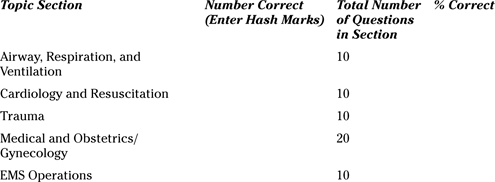
Record the number of questions you got right for each section, and then divide each number by the total number of questions in each section. Multiply your result by 100; that number is your percent score for that section. For example, suppose you got eight questions right in the Airway, Respiration, and Ventilation section; there are ten questions in that section. Eight divided by ten is 0.8; multiply that number by 100 to get 80 (80%).
You may find out that you did more poorly in some sections than others; study the chapter of this book that covers the section you scored most poorly on first. When you finish that, focus on the next-worst section; repeat the process until you’ve reviewed all the sections.
One final note: You’ll see questions related to children throughout the NREMT exam. However, pediatric emergency care is different enough from adult care that it has its own chapter in this book. Refer to Chapter 13 if you have any questions about providing emergency care for children.
- B. It’s most likely that the oropharyngeal airway triggered the patient’s gag reflex. Removing it will stop the reflex. Turning the patient face down, Choice (A), or upright, Choice (D), won’t help maintain a patent airway. Suctioning the airway, Choice (C), will be helpful, but not until the airway has been removed.
- A. You need to ensure that the patient’s airway is patent, so clearing the airway of any potential obstructions comes first. You may need to ventilate the patient, Choice (C), but the question doesn’t give you enough information to make that decision. Without knowing the blood pressure, putting the patient into a sitting position, Choice (B), may be dangerous. None of the information in the question suggests a trauma mechanism, so a jaw thrust, Choice (D), would be inappropriate.
- D. A likely scenario for this presentation is a foreign body airway obstruction. Given the patient’s age, abdominal thrusts, Choice (A), are inappropriate. Back blows and chest thrusts, Choice (C), would be indicated if the patient were still awake. There’s no indication that the obstruction is in the mouth, so you wouldn’t suction the mouth, as Choice (B) suggests.
- C. The patient is alert and responding appropriately, which indicates respiratory distress and not respiratory failure. This makes bag-valve-mask use, Choice (A), and a nasopharyngeal airway, Choice (B), inappropriate. You have no information about lung sounds, and she has a near normal speaking rate, so CPAP, Choice (D), is not indicated.
- C. The patient’s respiratory effort is too slow to support adequate ventilations, so you need to assist with a bag-valve mask. High-flow oxygen alone, Choice (B), isn’t helpful without adequate rate and tidal volume. There’s no information to suggest that she’s experiencing a foreign body airway obstruction, so you wouldn’t administer abdominal thrusts, as Choice (A) suggests. If her ventilations were adequate, the recovery position, Choice (D), would be helpful; this isn’t the case.
- B. This child appears to have signs of an upper airway disorder, possibly due to epiglottitis. You can deduce that his ventilations are inadequate due to his mental status and skin signs. Therefore, supplemental oxygen alone, Choices (A) and (C), isn’t adequate. There are no signs of a foreign body airway obstruction, so back blows and abdominal thrusts, Choice (D), aren’t appropriate.
- D. This patient appears to have adequate breathing, based on his rate and lung sounds. Therefore, you don’t need to assist with ventilations, ruling out Choice (A). The complaint sounds more related to a cardiac condition than to asthma, making Choice (B), assisting with a multidose inhaler, less likely. The patient should be placed in a position of comfort, which is more likely to be sitting than lying, Choice (C).
- A. The patient is in respiratory arrest. Her heart rate is fast, making chest compressions, Choice (B), unnecessary at this point and contradicting the use of the AED, Choice (C). There’s no indication of secretions or water in the upper airway, so suctioning, Choice (D), isn’t needed.
- C. Stridor and a hoarse voice indicate some type of air restriction in the upper airway. Having the patient in a sitting position is most likely to promote optimal airway patency; laying the patient supine, as Choices (A) and (B) suggest, would most likely make the air restriction worse. The patient is alert and responding appropriately; assisting ventilations, Choice (D), at this point may cause more harm than good if the patient becomes agitated.
- D. The description best fits an upper airway disorder; however, asthma, Choice (C), is a lower airway condition. Epiglottitis, Choice (B), and a foreign body airway obstruction, Choice (A), don’t respond to changes in humidity or ambient temperature.
- B. Her very high blood pressure and swollen legs make COPD, Choice (A), a less likely cause of the wheezing. There are no indications of an excessive immune reaction such as anaphylaxis, Choice (C). A pulmonary embolus, Choice (D), rarely causes unusual lung sounds like wheezing; if it does, the wheezing is usually well localized in one small region of a lung.
- A. Although the description and location of the pain may reflect a myocardial infarction, you’d more strongly suspect an aortic aneurysm or dissection. If the wall of the aorta near where it exits the left ventricle weakens and begins to bulge (aneurysm) or separate (dissection), blood flow to the head and arms may be compromised. Uneven pulses can quickly point to the presence of this life-threatening condition, so you need to assess for bilateral radial pulses, Choice (A). Although you’ll perform the procedures noted in Choices (B), (C), and (D) — assessing for pedal edema, auscultating lung sounds, and palpating the area for tenderness — as part of your assessment, they aren’t likely to produce more definitive information.
- D. Older patients and females often experience heart attacks differently from adult men. For example, chest discomfort may be absent. Having a sudden fainting episode while sitting still indicates a sudden pressure change within the Cardiology and Resuscitation system, most likely the heart in this case. A normal urine output reduces the likelihood of dehydration, Choice (A). Peptic ulcers, Choice (B), aren’t likely to cause syncope, and angina, Choice (C), is usually brought on by a predictable level of exertion and resolves with rest.
- C. The AED may detect a shockable rhythm such as ventricular tachycardia that’s still generating a pulse; however, the AED doesn’t know that and will try to shock the patient. The patient has a pulse and therefore doesn’t require chest compressions, Choice (D). However, she requires ventilation with a bag-valve mask, not just supplemental oxygen, as Choice (A) indicates. You’ll perform a secondary assessment, Choice (B), but not at this point in the scenario.
- B. The research points to early and effective chest compressions as a major contributor to positive outcomes in cardiac arrest. Any delay in administering chest compressions, as is the case in Choices (A) and (C), results in worse outcomes. Current research supports defibrillating the patient in ventricular fibrillation as soon as possible, not waiting 2 minutes, as Choice (D) suggests.
- C. Unlike adult cardiac arrest, pediatric cardiac arrest is usually the result of respiratory failure and arrest rather than a primary cardiac event. The American Heart Association continues to recommend administering five cycles of CPR before applying the AED, contrary to Choice (D). Two-person CPR is considered to be superior to one-person CPR; with two rescuers available, delivering more ventilation is possible with a ratio of 15 compressions to two breaths, not 30:2, as Choice (A) indicates. Chest compressions in a child between 1 year old and puberty should be at least one-third the depth of the chest, which is closer to 2 inches than 1, ruling out Choice (B).
- A. Although the patient has a history of diabetes, she doesn’t show the clinical signs associated with changes in blood sugar levels. Blood sugar so high that it results in diabetic ketoacidosis, Choice (B), takes days to weeks. Very low blood sugar causes the patient to become pale, cool, and diaphoretic — signs that are similar to a patient experiencing shock; that’s why the term “insulin shock,” Choice (C), is used to describe hypoglycemia. Blood pressure so high that it causes a hypertensive emergency, Choice (D), is usually greater than 180/120 mm Hg; although this patient’s pressure is higher than normal, it is still within the range of simple hypertension.
- C. In treating cardiac arrest, you shouldn’t delay chest compressions for any period of time; the immediate response helps maintain adequate blood flow to the heart muscle. This means that Choices (A) and (B) aren’t appropriate; Choice (D) isn’t indicated because, by design, AEDs are very accurate in detecting ventricular fibrillation or ventricular tachycardia.
- C. This patient’s blood pressure is too low to support nitroglycerin use, Choice (D). Having the patient sit up, Choice (A), with such a low blood pressure may cause his pressure to fall even further, cutting off blood flow to the heart and brain. There’s no information to suggest that the patient is in respiratory failure to indicate Choice (B).
- B. In ventricular fibrillation, Choice (B), an AED provides a brief power-spike of electricity to a heart, which causes all the cells to stop fibrillating at once. If the heart is ready, it will then begin to contract normally. A heart in asystole, Choice (C), won’t respond to a defibrillation shock. A heart that has an organized electrical rhythm, Choice (D), but doesn’t contract has what’s known as pulseless electrical activity (PEA). An AED by design won’t defibrillate this rhythm. Ventricular standstill, Choice (A), is when the atrial may be conducting energy but the ventricles are not responding. This, too, fails to respond to a defibrillation shock.
- A. In trauma, every blood cell counts. We depend on red blood cells to carry as much oxygen as possible. No doubt you’ll need to provide oxygen, as Choices (B) and (C) suggest, but both of those procedures take time to begin, and the patient continues to bleed in the meantime. You shouldn’t delay definitive treatment with extrication, Choice (D).
- D. The patient has signs of shock: hypotension, tachycardia, and poor skin signs. With no external signs of bleeding, you must assume that he’s bleeding internally. Clear lung sounds rule out a hemothorax, Choice (A). It’s unlikely that massive bleeding that could cause shock would occur inside the skull, as Choice (B) suggests. The spleen, Choice (C), is located in the far upper-left quadrant of the abdomen; there’s no indication of an injury there.
- C. Based on the description, the patient’s right lung has been compromised, likely by a pneumothorax. Being supine, Choice (A), or on his side, Choice (D), will likely worsen his breathing, and there’s no indication that the patient is in shock. Likewise, there’s no indication that the patient is in respiratory failure, so you wouldn’t assist ventilations, Choice (B).
- B. The crepitus, diminished lung sounds, and mechanism of injury (MOI) point to the presence of at least several broken ribs, if not a full flail segment. Regardless, the patient’s skin signs and respiratory effort indicate impending respiratory failure. Administering supplemental oxygen, Choices (C) and (D), won’t help if the patient isn’t ventilating adequately. You’ll likely immobilize the child’s spine but not until later in the process; laying the patient on his side, Choice (A) likely won’t help and may make care during transport more difficult.
- C. There are no signs to indicate that the patient has an internal hemorrhage from the assault, so treating for shock and transporting to a trauma center, Choice (A), aren’t necessary. Your focus is on identifying and managing the injuries, not determining the full extent of the relationship, Choice (B). At this point, EMS providers are not permitted to refuse transportation to a patient, as Choice (D) implies.
- B. You need to reduce the dislocation if the arteries supplying blood to the distal arm and the associated nerve bundle are being impinged by the injury. Splinting the elbow in its position, Choice (A), likely won’t improve circulation, nor will flexing the elbow, Choice (C), assuming you can do so. Excessive manipulation of the elbow, Choice (D), may cause more damage and should be avoided.
- A. Given the amount of bleeding described, a tourniquet, Choice (B), isn’t necessary. Direct pressure and elevation, Choice (C), hasn’t been demonstrated to be effective, and it isn’t necessary in this situation. The severed hand is best preserved when kept dry and as cold as possible, without freezing. This contradicts the use of an ice bath, Choice (D).
- B. None of the information points to acute alcohol use, Choice (A). He could be experiencing a stroke, Choice (C), but the injury to the head points more toward a trauma-related event. Although bleeding in the abdomen, Choice (D), is possible, you’d expect shock signs rather than severe hypertension.
- C. This patient has experienced multiple injuries and is critically injured. Although she has signs of possible internal bleeding to the abdomen, her slower heart rate and poor respiratory rate point more toward a brain injury. Beginning controlled ventilations is imperative; simply providing supplemental oxygen, Choice (B), won’t accomplish this. The spine has to be protected from further harm, making Choice (D) incorrect. The femur and humerus injury, although significant, can be splinted during transport; you shouldn’t do this before you transport, as Choice (A) indicates, thereby delaying care at the hospital. In fact, unless you have an adequate number of rescuers to assist, applying a traction splint while en route may be impractical.
- A. In the Glasgow Coma Scale, no eye opening = 1, incomprehensible sounds = 2, and abnormal flexion = 3, for a total of 6. A score of less than 8 is very serious.
- C. Don’t be misled by the setting — you must first suspect a medical cause of acute altered mental status rather than a psychotic episode, Choice (D). In hyperglycemia, Choice (B), the patient tends to be less responsive and more lethargic than what the question describes. Low blood sugar, Choice (A), usually presents signs similar to shock — cool, clammy skin and a fast pulse rate but not hypertension.
- B. Although the child could have suffered a seizure as a result of the fever, the seizure could also be due to something more serious, such as meningitis. Exposing the child’s skin to let the body cool slowly may be helpful, but rapidly cooling with towels, Choice (A), may be too drastic. There’s no indication of dehydration, so any feeding, as Choice (C) suggests, should be withheld until the child is evaluated by a pediatrician. Aspirin and children don’t mix, and EMTs aren’t authorized to dispense aspirin, ruling out Choice (D).
- D. Your primary assessment indicates the patient has inadequate circulation, probably due to severe dehydration. Elevating the legs, Choice (B), hasn’t been shown to be helpful in restoring blood pressure. Taking time to perform a detailed physical exam, Choice (A), is inappropriate in this situation because the patient is showing signs of shock and requires immediate transport. She can’t have anything by mouth at this point as Choice (C) suggests; if she vomits, she could have further problems with a now-compromised airway.
- D. The patient is not exhibiting signs of anaphylaxis, so epinephrine, Choice (A), isn’t indicated. As an EMT, you aren’t authorized to administer diphenhydramine, Choice (B). Inducing vomiting with syrup of ipecac, Choice (C), is unlikely to help reduce the allergic reaction, because the allergen is already in the patient’s bloodstream.
- C. This patient is experiencing anaphylaxis that’s causing his bronchioles to constrict and his arteries to dilate excessively. An epinephrine autoinjector, Choice (C), will buy the patient some time by temporarily reversing the reaction. With such a low blood pressure, having the patient sit up, Choice (B), is dangerous. CPAP, Choice (D), may actually lower the blood pressure even further as it creates pressure on the great vessels in the chest, restricting blood flow. Finding out more information about the antibiotic, Choice (A), may be helpful, but it won’t change the course of treatment.
- A. This patient appears to be in septic shock. She isn’t maintaining her own ventilations, making supplemental oxygen, Choices (B) and (D), ineffective. You should preserve the patient’s body temperature in shock instead of cooling her any further as Choice (C) indicates; if the patient begins to shiver, she will waste precious energy stores that can be used to maintain perfusion.
- B. You suspect the patient has signs of meningitis, a very contagious infectious disease, especially through airborne droplets. To reduce cross-contamination, you need to isolate yourself — and the patient — before transport, Choice (A). Using alcohol as part of a bath, Choice (C), isn’t considered a standard practice in alleviating fever. The patient should have nothing by mouth, contrary to Choice (D), until he’s evaluated more fully at a hospital emergency department.
- D. You suspect that the patient is experiencing hyperglycemia. The patient is not alert enough to administer oral glucose, Choice (A). Her breathing rate and depth appear adequate, so no further assistance is necessary, eliminating Choice (B). As an EMT, you are only permitted to assist someone with specific prescribed medications such as nitroglycerin, an inhaler, or an epinephrine autoinjector, ruling out Choice (C).
- C. You suspect that the patient’s blood sugar level is lower than normal, giving him signs of insulin shock. Hyperglycemia, Choice (A), produces more of a normal or flush skin and takes days to weeks to develop. The fact that he has good movement of his arms and speaks clearly reduces the likelihood of either a stroke, Choice (B), or a TIA, Choice (D).
- A. For patients who appear to be delusional, don’t go along with them, Choice (B), or make a big deal, Choice (C). You may consider restraining the patient, Choice (D), if he becomes aggressive, but at this point, you have no reason to do so.
- C. Poison control will have information on how to treat the specific medication ingestion and will also be able to tell how serious the situation is. Having the child ingest anything further at this point, as Choices (A) and (D) indicate, may not be helpful, and it may cause further problems such as compromising the airway during forced vomiting, the result of Choice (B).
- B. Multiple persons sickened inside a closed space should immediately clue you in to a major safety issue, carbon monoxide in this case. Although you may perform some care on-scene as Choices (A) and (C) indicate, you must wait until the scene is safe for you to enter. You’ll likely call for additional resources, Choice (D), but only after ensuring your own safety.
- D. His breathing effort is inadequate; simple supplemental oxygenation, Choice (A), wouldn’t be enough. Immediate transport is warranted, but you have to manage problems with airway, breathing, and circulation before extrication and transport, Choice (B). A detailed physical exam, Choice (C), should be conducted but only after transportation has begun, because the exam can prolong on-scene time.
- A. The patient could be fluid overloaded from her renal failure, causing pulmonary edema. Her blood pressure is high enough to support her in the sitting position, which will help improve her breathing ability. Laying her in semi-Fowler’s position, Choice (C), or flat, Choice (B), will worsen her breathing ability. She isn’t in respiratory failure (she’s alert and not breathing faster than 30 or less than 10), so a bag-valve mask, Choice (D), is unnecessary at this stage.
- C. Although preserving a crime scene, Choice (A), is important, it’s a secondary concern to managing any major injuries sustained during the attack. Taking a set of vital signs, Choice (B), is also important, but that occurs after the primary assessment, as does soliciting a history of the event, Choice (D).
- A. The newborn’s respiratory rate is adequate, but the heart rate is below normal, so assisting ventilations as Choice (C) suggests isn’t appropriate; however, if the heart rate remains low after supplemental oxygen is provided, it may become necessary. The heart rate is above 80, which is considered to be the cutoff for chest compressions, Choice (B). Suctioning, Choice (D), should have occurred before the vital signs were assessed because creating and maintaining airway patency is critical.
- B. The dark secretions are meconium, the newborn’s fecal matter. Meconium isn’t normal as Choice (A) suggests; it’s a sign that the infant is in distress. There’s no relation between the presence of meconium and the timing of placenta delivery, Choice (C). You don’t want to stimulate breathing, Choice (D), until you can suction as much of the meconium as possible out of the mouth and nares.
- B. Stimulants, Choice (B), activate the sympathetic branch of the autonomic nervous system (ANS), causing the body to have a “flight or fight” reaction. Heart rate increases, blood pressure rises, and the pupils dilate. Marijuana, Choice (A), causes feelings of euphoria and drowsiness; it doesn’t affect the ANS directly. Hypnotics, Choice (C), are sedatives that depress the ANS, which may result in respiratory depression. Cholinergics, Choice (D), stimulate the parasympathetic branch of the ANS, causing bradycardia, hypotension, increased salivation, mucous production, nausea, and vomiting.
- C. The first stage of labor, Choice (A), is the dilation of the cervix, which allows the soon-to-be newborn to pass out of the uterus and be delivered during the second stage, Choice (B). The placenta is delivered afterward, during the third stage, Choice (C). There is no fourth stage of labor, Choice (D).
- C. When the body experiences strenuous activity, it begins to heat up. It cools itself through several mechanisms, including secreting sweat — diaphoresis — and allowing it to evaporate. If that fluid is not replaced, the body becomes dehydrated and leads to heat exhaustion, Choice (C), as it did for this runner. Heat stroke, Choice (A), occurs when cooling mechanisms fail and body temperature rises to a dangerously high level. Victims of heat stroke, Choice (A), tend to have dry, hot skin and worsening altered mental status. Heat cramps, Choice (B), are muscle spasms, possibly caused by localized electrolyte imbalances due to excessive sweating. Heat intolerance, Choice (D), is more of a chronic issue than a sudden, emergent problem.
- B. Using hot water alone, Choice (A), may not disinfect surfaces contaminated with bloodborne pathogens. Allowing the blood to dry, Choice (C), takes much too long and keeps the unit out of service. You can’t find a heat-sterilizer unit, as Choice (D) suggests, that’s big enough to handle an ambulance!
- C. Even while driving with lights and siren, you’re responsible for not only your personal safety but also the safety of those around you. In other words, you’re required to take the driving environment into consideration before driving faster than the posted speed limit or proceeding through a controlled intersection without stopping, Choice (A). Unless you’re at a scene of an emergency, you’re required to follow all laws regarding parking, contrary to Choice (B). If you’re involved in even a minor crash, Choice (D), you must stop at the incident and cancel your response.
- A. Although having a patient sign a form, Choice (B), each and every time he refuses treatment is optimal, it doesn’t always happen. In such cases, have a reliable witness such as a law enforcement officer or family member sign a statement stating that you tried to have the patient sign but were unable to. You can’t transport a competent adult patient against his will, ruling out Choice (C). A patient can accept treatment without having to consent to transport, contrary to Choice (D).
- A. A primary prevention program aims to reduce the likelihood of a negative event happening. Installing a traffic signal after a fatal crash, Choice (B), is a bit like closing the barn door after the horses are gone. Training EMS providers on using cervical collars, Choice (C), doesn’t prevent the incidence of cervical collar use. While installing an AED at a pool, Choice (D), may be helpful in a cardiac arrest after a drowning, it doesn’t prevent the drowning from occurring.
- B. The intent of continuous quality improvement (CQI) is to identify both strengths and weaknesses of an organization’s practice, and develop processes that improve both. CQI incorporates clinical, operational, and administrative practices, not just emergency care, as Choice (D) states. Quality assurance is more focused on ensuring practices adhere to a certain standard, such as licensing, Choice (C). While disciplinary procedures, Choice (A), may arise from CQI review, they’re not a responsibility.
- A. Negligence is a civil action in which four legal elements must be proven to have occurred. The EMT must have had a duty to act (and by implication, act within acceptable guidelines). The EMT must have subsequently breached, or failed to perform that act (or have performed in an unacceptable manner). There must be an injury that occurred during the time of treatment, but it’s not limited to physical injuries alone as Choice (B) indicates. Finally, there must be a relationship between the breach of duty and the injury itself. This is causation. Deliberate intent, as noted in Choice (C), must be proven in a gross negligence lawsuit. Malfeasance, a component of Choice (D), also relates to deliberate intent.
- C. You cannot treat or transport a patient who refuses your services when he is legally able to make his own decisions. Threatening someone with bodily harm is assault, Choice (A). Battery, Choice (B), is the unlawful touching of another person. Saying or writing something about someone that damages his reputation is called defamation, Choice (D).
- D. Although elder abuse, drug use, and domestic violence, Choices (A), (B), and (C), respectively, are serious issues, not all states require EMTs to report their suspicions. All 50 states and the District of Columbia mandate the reporting of child abuse and neglect, Choice (D).
- A. Most people are thought to experience various stages of grieving, either for themselves or a loved one who is dying or has died. Those stages include denial, anger, bargaining, depression, and acceptance. Not all people process death in the same way or at the same time.
- B. Hepatitis B is a virus that is transmitted from one person to another through blood, Choice (B). An example of an airborne disease, Choice (A), is the common cold. Hepatitis A can be transmitted through food, Choice (C), such as raw shellfish. Mosquitos are examples of vectors, Choice (D), that can carry diseases such as malaria.
Chapter 9
What is the main purpose of taking a preassessment before studying for the NREMT exam?
Tap to revealTo determine your current strengths and weaknesses so you can focus your study efforts where they are needed most.
How does practicing test-taking benefit your EMT exam performance?
Tap to revealIt helps you develop the skill of analyzing questions, leading to better performance under exam conditions.
What should you do with the results of your preassessment?
Tap to revealFocus on studying the areas where your performance was weakest before reviewing topics you already know well.
A preassessment is a powerful tool to pinpoint your current strengths and weaknesses, making your EMT exam preparation more focused and effective.
Test-taking is a skill that can be improved with practice—don’t just study content, practice answering questions under exam-like conditions.
Describe a specific strategy you plan to use after your preassessment to target your study time on the areas you need most.
How confident are you that you can use a preassessment to plan your EMT exam study strategy?