Imagine a sales team where everyone knows exactly what needs to happen next, impediments are surfaced instantly, and each win is a team achievement. That’s the power of applying Scrum principles to sales — a roadmap to value that goes far beyond individual quotas or static plans.

The goal-setting model for sales may need to be tweaked from product development approaches — adapt the framework to fit your reality for maximum effect.
Mapping the Road to Value in Sales
The Scrum sales process is high-touch and common sense, mirroring the roadmap to value in seven stages:
-
Sales goal:
This strategic goal supports the year’s sales targets.
Example: Grow gross sales in Dallas by 20 percent this fiscal year by increasing the company’s social media presence and analytics. Follow up with a personal phone call or email to everyone who provides contact information.
-
Product roadmap (high-level) and product backlog (broken down):
Define what’s needed to achieve the goal, at both high and low levels:
- Sales strategy development
- Acquisition of tools
- Development of collateral
- Sales process development and fine-tuning
- Execution needed for specific deals in the process
- Assigning key (detailed) social media sites to a team member
- Finding a tool for tracking sales funnels that the team will use
- Defining such reporting processes as analytics workflows
-
Release planning:
Intermediate-level plan for the next sales cycle.
Example: Prioritize backlog items for the next quarterly sales cycle.
-
Sprint planning:
As a team, set a sprint goal and create tasks for the pulled backlog items.
Example: Create sales collateral materials broken down into tasks.
-
Daily throughout the sprint:
Hold daily scrum meetings to review progress toward the sprint goal, coordinate tasks for the day, and identify impediments.
Example: Coordinate who will be reviewing social media copy and procuring artwork.
-
Sprint review:
Demonstrate the collateral materials developed in the sprint.
Example: Demonstrate to stakeholders that the Facebook page is operational or mailing lists of past customers are compiled.
-
Sprint retrospective:
Review what worked well and what didn’t.
Example: Facilitate knowledge transfer. If service/installation people are learning how new customers are being acquired, identify ways to help them continue the company messaging that leads to the sale.
In your experience, which stage of the sales process typically receives the least attention, and how might a Scrum approach change that?
Scrum in Action: Visualizing the Sales Pipeline
The process of converting leads to closed sales is often referred to as the sales pipeline or funnel. Visualizing this process is key to transparency and improvement.
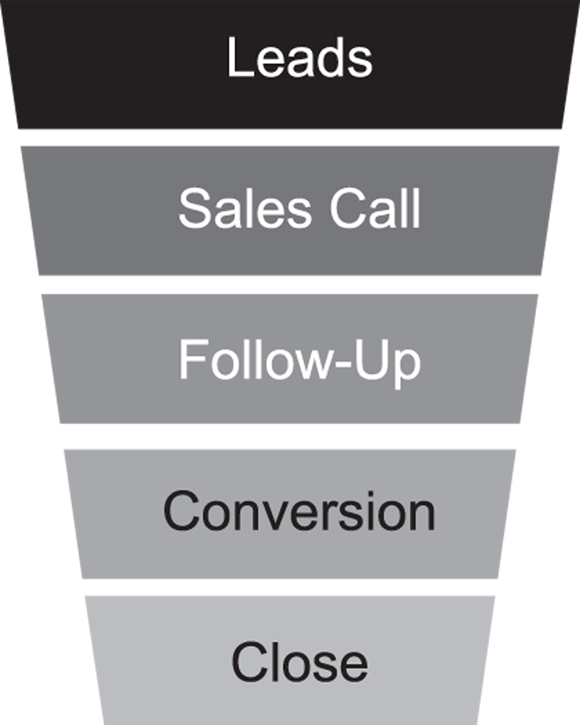
A sales manager at an agile-based organization implemented a backlog item task board with columns for each sales funnel stage. The team and management instantly saw where each opportunity stood and could adapt estimates based on real data.
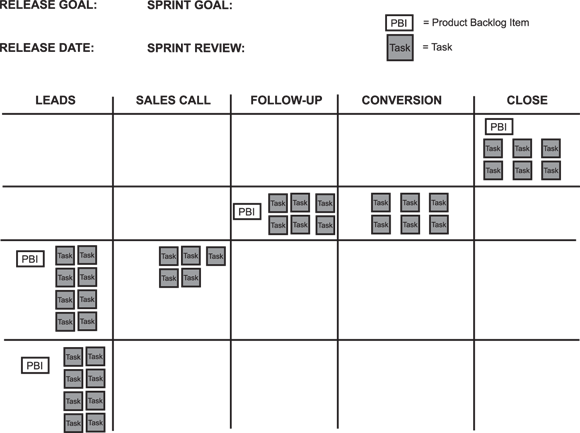
What advantages might a visible sales task board offer compared to traditional reporting methods?
- Leads: Each swim lane represents a lead. All leads are discussed, vetted, and prioritized before the sales call is initiated. While marketing can try to qualify leads, the trust a salesperson builds by offering value to a not-quite-ready lead is invaluable when closing deals.
- Sales call: The team qualifies the lead and positions the offering as the solution, with tasks outlined during sprint planning.
- Follow-Up: When the lead expresses interest, the team coordinates and executes tasks to move the opportunity forward.
- Conversion: The team identifies obstacles to closing the deal and works together to overcome them.
- Close: The contract is won, and the team documents how the win was achieved.
A visual representation of the journey that prospects take from initial contact through to a closed deal, broken into stages like Leads, Sales Calls, Follow-Up, Conversion, and Close.
Scrum’s emphasis on continuous communication means sales teams stay tightly aligned with what prospects need — leading to more effective, customer-centric selling.
An organized list of all actionable sales items, prioritized and broken down to make progress visible and achievable in iterations.
Sales is best handled by lone “superstars” who own the process end-to-end.
Scrum demonstrates that a cross-functional team, collectively possessing all the needed skills, outperforms any one individual by making the process visible, collaborative, and adaptive.
How does cross-functional collaboration improve the outcome of a sales process compared to a siloed or individual approach?
“A visible funnel in the form of a task board is quite valuable.”
Want to go deeper? Why visibility matters in sales pipelines
When the entire sales team can see every opportunity and its status, bottlenecks and stalled deals become obvious. This transparency enables faster interventions, more accurate forecasting, and a culture of shared ownership — all core to agile thinking.
Sketch a basic sales funnel as a task board for your team or business.
- List the main stages (e.g., Leads, Sales Call, Follow-Up, Conversion, Close) as columns.
- Add 2–3 sample leads as cards. For each, jot down what actions are needed to move them forward.
- Share your board with a colleague and discuss what you notice about visibility and next actions.
Think about a time when a sales opportunity was lost or stalled due to poor communication or lack of visibility. What could a Scrum-based approach have changed in that scenario?
- Scrum brings transparency, collaboration, and adaptability to sales pipelines.
- Task boards make the sales process visible and actionable for the entire team.
Applying Scrum to the sales process transforms it from an individual pursuit to a visible, adaptive, and team-driven path to value.
What is the primary benefit of using a sales task board in Scrum-based sales teams?
What is a sales backlog?
Tap to revealAn organized list of all actionable sales items, prioritized and broken down for team action in sprints.
What does the sales funnel visualize?
Tap to revealThe stages a prospect goes through from lead to closed sale.
What is a sprint review in sales Scrum?
Tap to revealA meeting to demonstrate the collateral and results developed during the sprint to stakeholders.
How could adapting Scrum principles change the way your current sales or business development team operates?
Scrum’s collaborative, transparent framework empowers sales teams to turn every opportunity into a shared, actionable pursuit toward value.