Scaling Agile is more than just multiplying teams—it’s about orchestrating complex work across people, locations, and cultures, all while staying true to the core values of Scrum. Large-Scale Scrum (LeSS) offers a framework to do just that, enabling organizations to deliver value with hundreds or even thousands of contributors.
LeSS was developed by Craig Larman and Bas Vodde based on years of real-world experience helping large organizations adopt Agile at scale.
Another method of incorporating the scrum framework into massive products is Large-Scale Scrum (LeSS).
Products have been successfully developed with LeSS with as few as four to five small teams to programs that encompass 1,500 people and span a half-dozen countries. In other words, how big would you like large to be? LeSS can scale scrum up or down to work in many environments.
Viewing a product area as a system made up of interrelated and interdependent teams, optimizing for collaboration and overall outcomes rather than just improving individual teams.
At the foundation of LeSS is systems thinking, where a system is thought of as an organized entity (in this case, a product area) made up of interrelated and interdependent parts (teams). The creators of LeSS specifically see that optimizing the whole doesn’t come from optimizing the parts of a whole. Optimizing parts only optimizes the parts, so LeSS optimizes collaborations between multiple teams, even across different locations.
Optimizing the whole doesn’t come from optimizing the parts of a whole. Optimizing parts only optimizes the parts.
LeSS has only a few rules and two frameworks: LeSS and LeSS Huge. The difference lies in the size of the total teams involved.
Why do you think focusing on optimizing collaboration between teams might lead to better results than just improving each team individually?
LeSS Framework
The LeSS framework applies to products with up to about eight scrum teams.
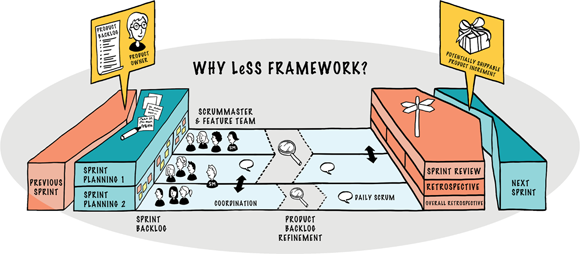
Courtesy of Craig Larman and Bas Vodde
In the LeSS framework, there is one product owner and one product backlog for the complete shippable product. The product owner shouldn’t work alone on product backlog refinement; that person is supported by multiple teams of developers working directly with customers, users, and other stakeholders. All prioritization goes through the product owner, but clarification can happen directly between the teams, customers, and other stakeholders.
A way to scale Scrum for up to eight teams, maintaining a single product owner and backlog, with decentralized coordination and shared practices.
While much of LeSS remains true to the one-team scrum framework, the differences are important:
- Sprint planning is split into two parts: the first is common for all teams to select requirements for the sprint, and the second is for each team to plan their implementation details.
- All developers from all teams are invited to the first part of sprint planning; at least two members per scrum team attend, along with the product owner. They share information with their teams for the second part.
- Independent sprint planning and daily scrums allow members from different teams to attend each other’s meetings, fostering information sharing.
- Cross-team coordination is decentralized and informal, relying on cross-team talking, component mentors, travelers, scouts, and open spaces.
- Backlog refinement is done for the overall product backlog with representative developers from each team and the product owner. Individual team and multi-team refinements happen every sprint.
- Sprint reviews are conducted in a “science fair” format, with multiple spaces staffed by team representatives where stakeholders can visit and discuss items of interest.
- Overall sprint retrospectives are held in addition to individual team retrospectives, allowing inspection and adaptation of the entire system and processes.
Want to go deeper? The science behind LeSS “science fair” sprint reviews
The “science fair” approach to sprint reviews allows stakeholders to interact directly with multiple teams, increasing engagement, visibility, and meaningful feedback. This open format mirrors real scientific conferences, encouraging dialogue and exploration rather than passive observation, and ensuring that insights can directly improve both products and processes.
Visualize how teams in a LeSS framework communicate and coordinate.
- Draw a diagram of five Scrum teams working on the same product.
- Identify points where teams would need to coordinate (e.g., backlog refinement, sprint reviews, daily scrums).
- Label each coordination point as either formal (scheduled meeting) or informal (ad hoc, direct communication).
- Reflect: Where might communication breakdowns occur, and how could informal networks help?
How might the “science fair” sprint review approach strengthen stakeholder engagement compared to traditional sprint reviews?
LeSS Huge Framework
With LeSS Huge, the sky is the limit regarding overall product size. A few thousand people organized in teams could work on one product.
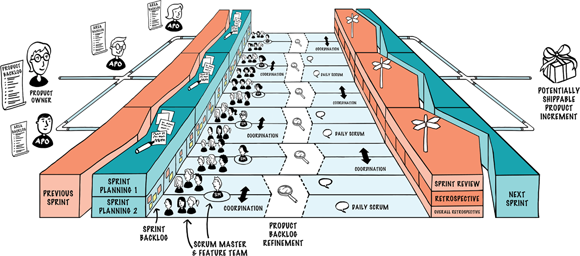
Courtesy of Craig Larman and Bas Vodde
As in scrum and LeSS, you have one product, one definition of done, one product owner, and one sprint. LeSS Huge is a stack of LeSS for each “requirement area.” Requirement areas provide structure for more than eight scrum teams to work together effectively without overburdening the product owner. An Area Product Owner (APO) specializes in a customer-centric area and is given ownership to act as a product owner in that area. Each APO works collaboratively with the product owner and other APOs as a product owner team. For example, in a large software suite, requirement areas might be Microsoft Word, Excel, PowerPoint, etc.
Each requirement area uses LeSS, and the set of all required areas is in LeSS Huge. Some of the differences are:
- A product owner team planning meeting happens before the sprint planning meeting.
- Area-level meetings are added. Sprint planning, review, and retrospective meetings are done at the area level, and area-level product backlog refinement occurs.
- Overall sprint reviews and retrospectives involving all teams are done to coordinate work and processes across the product program area.
LeSS is scrum-scaled and allows for the implementation of scrum and scaling in a way that holds true to Agile principles. Elements of the scrum framework are upheld with empirical learning, short feedback loops, self-management, effective collaboration, and coordination.
Leadership tools also exist in LeSS for good decisions that maximize ROI; deliver value to customers; and create happy, sustainable teams.
At J.P. Morgan, “large” meant more than 3,000 employees across multiple countries. Their LeSS transformation started with a small pilot in the securities division, focusing on customer-centric solutions. The pilot’s success led to a much broader rollout, demonstrating how LeSS can be adapted for complex, global organizations.
Imagine a product so large that no single product owner could handle all its requirements. How does the LeSS Huge structure address this challenge?
Scaling Scrum just means adding more teams to the project and letting each run independently.
LeSS and LeSS Huge emphasize cross-team collaboration, decentralized coordination, and shared product ownership to optimize the whole system, not just individual teams.
- LeSS can scale Scrum for organizations ranging from a handful to thousands of people.
- Systems thinking and collaboration between teams are core to LeSS.
- LeSS Huge introduces requirement areas and area product owners to tackle extreme scale.
Practitioners often find that the biggest challenge in LeSS is not the process itself, but encouraging a culture of transparent communication and true shared ownership across teams and areas.
A role in LeSS Huge responsible for a specific customer-centric area, collaborating with the overall product owner and other APOs as part of a product owner team.
LeSS and LeSS Huge demonstrate that scaling Scrum is not about control and hierarchy, but about enabling effective, collaborative teams to deliver value at any scale.
Systems thinking, decentralized coordination, and shared product ownership are the cornerstones of effective large-scale agile organizations.
What is the maximum number of teams typically managed under the basic LeSS framework?
Tap to revealAbout eight scrum teams; beyond this, LeSS Huge is used.
What is a requirement area in LeSS Huge?
Tap to revealA customer-centric area comprising multiple teams, each led by an Area Product Owner.
What is the role of the product owner in LeSS?
Tap to revealTo manage a single product backlog and prioritize work for all teams, supported by developers and stakeholders.
What is the main purpose of introducing Area Product Owners (APOs) in the LeSS Huge framework?
Reflect on a time you’ve worked in or observed a large organization. What barriers to collaboration did you observe, and how might LeSS or LeSS Huge have helped overcome those challenges?
What do you think are the risks if a large organization tries to scale Scrum without adopting systems thinking or intentional coordination strategies like those in LeSS?
The Shift
- LeSS and LeSS Huge provide frameworks to scale Scrum across organizations of any size while staying true to Agile principles.
- Systems thinking and decentralized coordination help optimize the whole product, not just individual teams.
- Real-world success stories show that scaling Scrum with LeSS can transform even the largest, most complex organizations.