For years, development and IT operations moved in separate lanes, leading to delays, misalignments, and endless hand-offs. The rise of DevOps — and its integration with agile methods like Scrum — has changed that, uniting teams for speed, quality, and security.
The term “DevOps” is a blend of “development” and “operations.” This cultural and technical movement began gaining traction in the late 2000s and now drives innovation at some of the world’s largest tech companies.
In the past, development has been mistakenly kept separate from the rest of IT operations. DevOps and other agile practices are bringing those back together. This reunion ensures product development is aligned with all other aspects of delivering a quality product, including maintenance, security, architecture, and infrastructure. In this section, we’ll discuss the various aspects of DevOps and agility.
Development and operations (DevOps) is a growing solution to a gap in developing software applications. Figure 12-1 shows how DevOps addresses coordination challenges.
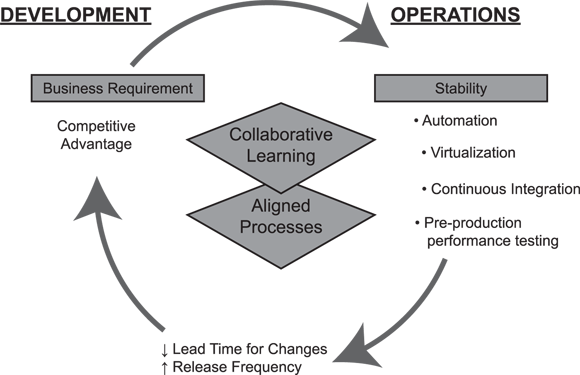
Traditional IT tasks are being shifted to the scrum teams developing the product, which not only offloads tasks from IT but also enables developers to take their product development further to production with fewer IT dependencies. Virtualized datacenters make this practice increasingly possible because IT manages the platform, which makes creating new virtualized environments possible by people with DevOps access and capabilities on a scrum team.
IT dependencies can now be done within the scrum team. Higher quality and faster speed to finish are achieved within the sprints.
What challenges could arise when shifting IT operational responsibilities into scrum teams?
A set of practices that combines software development (Dev) and IT operations (Ops), aiming to shorten the development lifecycle and provide continuous delivery with high software quality.
“This reunion ensures product development is aligned with all other aspects of delivering a quality product, including maintenance, security, architecture, and infrastructure.”
Security challenges
You may have heard some of these terms: bots, worms, malware, phishing, and security breach. For some people, the Internet is fertile ground for malicious activities. Major data breaches are making the headlines far too regularly. Following are just a few examples of companies and organizations that recently experienced compromised customer information:
- June 2021: LinkedIn (700 million people affected)
- March 2020: CAM4 (10.8 billion people affected)
- April 2019: Facebook (533 million people affected)
Too often, security is an afterthought. Managers sometimes consider it nice to have and say, “We’ll deal with it when it becomes a problem.” Security risks are increasing and need to be addressed earlier rather than later, which is a primary focus of DevSecOps. Following are some common ways that scrum can help expose security-related issues and facilitate improvements in the way they’re handled:
-
Refine your definition of done. At both the release and sprint levels, the definition of done is critical. Decide on security requirements that should be met at each level. By adding a security task to each requirement to address your definition of done, costs of mitigating security risk can be spread out over the life of the product. Make security a high priority from the first appropriate spot.
Want to go deeper? The role of security guilds in scrum teams
Guilds are groups of people in an organization that share knowledge, tools, and practices. A guild is like a community of practice in which people regularly engage in collective learning and sharing knowledge of common interests or practices. Examples of guilds include security, system administration, database, quality, and agile practitioners.
Guilds should be open to anyone interested in mentoring others or learning more, including those who are new to the skill or practice. The guilds should meet often enough to build knowledge and increase learning and skill levels across an organization.
Consider making sure that at least one person on every scrum team becomes a member of the security guild. This will go a long way toward ensuring that security practices are common and awareness is being built across and throughout teams.
- As a scrum team member, if security isn’t as high a priority as you feel it should be, address it at the next retrospective. The business stakeholders and/or product owner may need to be trained about the issues. Identify the issues and place them in the product backlog.
- Have IT team members with security expertise attend sprint reviews and provide security feedback or someone with that experience on the team.
- Automate security testing as much as possible. Consider automating penetration testing, cross-site scripting, and vulnerability scanning.
- Consider establishing an organizational security guild that promotes awareness and skill development on security common practices and technologies throughout the organization.
How can scrum teams ensure that security is embedded into every stage of product development?
A community of practice within an organization where members share knowledge, tools, and practices around a common skill or topic, such as security or quality assurance.
Security is only a concern at the end of product development.
Security must be considered from the very start and embedded throughout the development lifecycle, as emphasized by DevSecOps practices.
When Facebook experienced a breach affecting over 500 million users, the lessons learned led to new company-wide security requirements being added to their definitions of done, ensuring every new feature is vetted from the start.
Which practice helps scrum teams ensure security is consistently addressed throughout product development?
- DevOps unites development and operations, improving alignment and delivery speed.
- Scrum teams can embed security practices throughout the development process.
Maintenance
After an application is deployed, maintenance teams provide support. This support can be in the form of responding to support inquiries, fixing defects, and implementing minor enhancements to address functionality gaps in production.
When scrum teams focus on product or broader project work, whether software or IT, triaging operational issues can be disruptive. Product development and maintenance work are quite different. They require different types of work and effort by developers, which also involves a different cadence. We like having scrum teams that create a product also be responsible for supporting it. Through that level of ownership, they create high quality and value for their customers. But if a scrum team is interrupted frequently enough to affect release schedules that are of business value and functionality to the customer, some adjustments should be made to how they operate as a scrum team.
By separating maintenance from the scrum teams’ new development efforts, maintenance can be streamlined, and new development can progress uninterrupted. We recommend a maintenance scrum team structure that separates these two functions so that interruptions are minimized without increasing overhead (see Figure below).
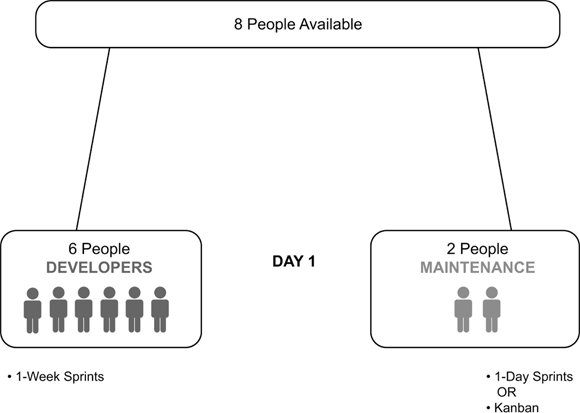
Many organizations report improved team morale and fewer delays after implementing dedicated maintenance teams, freeing developers to innovate without frequent context-switching.
Analyze how interruptions affect your team’s delivery flow.
- List out all tasks your team handles in a typical sprint, noting which are maintenance and which are new development.
- Estimate the time spent on interruptions (maintenance tasks) in the last sprint.
- Discuss with your team: How would separating maintenance and development affect your productivity and delivery speed?
What might be the trade-offs of separating maintenance and development teams in your organization?
Kanban within a scrum structure
Some scrum and agile teams use a kanban board to visualize their workflow. Here’s how the process in the diagrams above works:
- At the start of a new release cycle, split out maintenance and development tasks onto separate boards for clarity and focus.
- Use columns to indicate task status: To Do, In Progress, Code Review, Testing, Done.
- Track maintenance items in real time, ensuring the team avoids bottlenecks and delays.
What is the main purpose of a security guild?
Tap to revealTo share security knowledge, tools, and best practices across teams, building organizational awareness and expertise.
Define DevSecOps in one sentence.
Tap to revealDevSecOps integrates security practices into every phase of the DevOps process, making security a shared responsibility.
What does separating maintenance work from development work help prevent?
Tap to revealIt helps prevent frequent interruptions to development, allowing new features to be delivered more efficiently.
Reflect on your current team’s structure: How do you handle maintenance and security, and what improvements could be made by adopting DevOps or guild practices?
DevOps and agile practices unite development and operations, embedding security and maintenance into the workflow for faster, higher-quality, and more resilient product delivery.
Separating maintenance from development, supported by tools like Kanban and communities like guilds, helps teams focus, reduce interruptions, and build lasting organizational capability.
Security should be addressed only after a product is released to users.
How might using Kanban boards improve your team’s workflow and communication between development and maintenance?
Describe a situation where separating maintenance from development could lead to better outcomes for both teams and customers.