How can visualization tools like the product canvas and customer maps help Scrum teams create products customers truly love?
What happens when product development and marketing join forces? They unlock a toolkit that gives teams a sharper view of customer needs, assumptions, and business realities—all essential for building offerings that hit the mark.
A handful of tools already in use in product development would be beneficial to marketing. In addition, marketing may be more expert with specific tools than product development is. Some key examples are below:
Marketing Tools
Product canvas
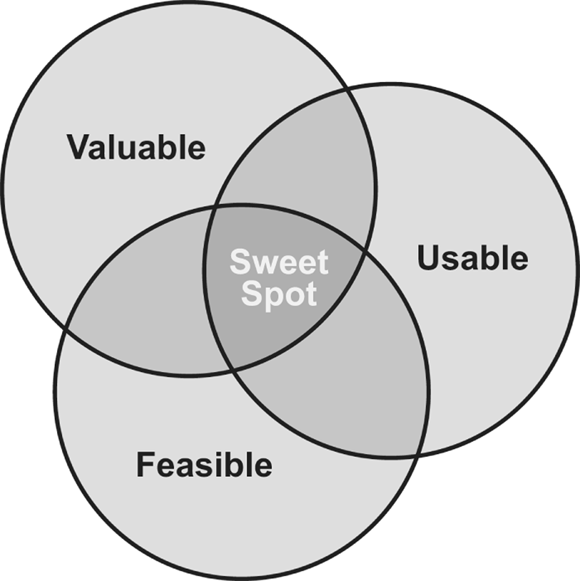
In Inspired: How to Create Tech Products Customers Love (Audible Studios), Marty Cagan wrote, “discover a product that is valuable, usable, and feasible.” What he meant by this, as shown below, is that successful product development hits the sweet spot at the cross-section of:
- Valuable: Will customers buy it?
- Usable: Do customers need it?
- Feasible: Can we do it?
The product canvas evolved from the business model canvas but is tailored specifically for product teams to rapidly test and iterate ideas before significant investment.
Many marketing teams use a visualization technique, such as a product canvas, to start to explore and understand the key factors, partners, unique value proposition, problems, and potential solutions that may contribute to finding the sweet spot, where value, usability, and feasibility meet.
The product canvas is a collaborative tool that enables teams to accomplish two tasks in a brief amount of time: One, start identifying desired goals or product outcomes. Two, start to validate assumptions about the problem to solve for the customer and ready the team for development. Product canvas exercises can inspire a clear product goal.
Think about a product you love—do you believe its creators truly understood what was valuable, usable, and feasible? Why?
Teams use the product canvas as a visualization activity to create a shared understanding of the customer and their needs. The tool is a starting point for the team’s assumptions and enables them to dive deep into gathering new product insights.
Many variations of canvases are available, such as a lean canvas or a business opportunity canvas. They all serve a similar purpose of organizing ideas, challenging assumptions, and collaborating to find a strategic direction. The product canvas commonly used with scrum teams divides into two halves: the left addresses market and customer issues, while the right addresses product and business issues. The left defines the customer segment, customer problems with alternatives, value proposition, channels, and revenue projections. The right defines the solution, key stakeholders, success factors, resources, partners, and costs. Both halves enable a team to do a more detailed market analysis of their product.
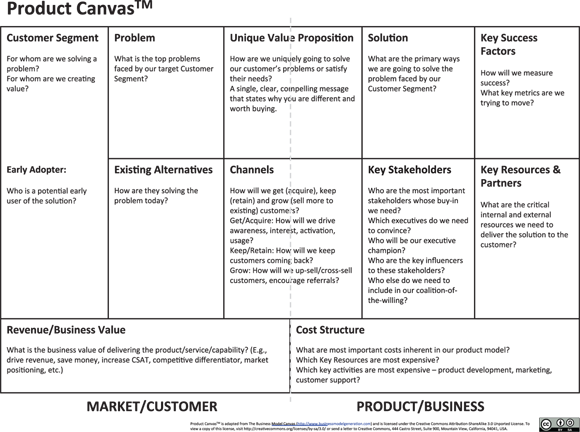
Following are some categories a team might use in building its product canvas:
- Customer segment: Describe the target customer segment that needs the problem solved. For whom is the value being created?
- Early adopter: Describe the initial target customer. Remember, your product can’t be everything to everybody — at least not at first. What market segments are opportunities for testing your product idea first?
- Problem: Describe the primary problem experienced by the target customer segment.
- Existing alternatives: Describe available alternatives to your product.
- Unique value proposition: Describe a single, clear, compelling message that states why or how your product is different and worth buying.
- Channels: Describe the channels for acquiring, retaining, and increasing customers. List ideas for creating awareness, interest, activation, and usage. Describe what will entice customers to return and encourage referrals. List upselling opportunities.
- Solution: Describe how the target customer segment’s problems will be solved.
- Key stakeholders: List the most important people to your product. This list may include people whose buy-in and support you need, executives, and influencers. Who are the people you can trust to criticize your product and tell you the truth?
- Key success factors: Describe how success will be measured — measure outcomes, not outputs. Are there key metrics you can use to test your hypotheses?
- Key resources and partners: Describe the critical internal and external people, equipment, or resources needed to deliver the solution to the customer.
- Revenue/business value: Describe the business value of delivering the product, service, or capability. Consider what will drive revenue, save money, increase customer satisfaction, differentiate you from your competition, improve market positioning, and more.
- Cost structure: Describe the important costs inherent in the product model. Identify what will be most expensive, for example, resources, activities, development, marketing, or support.
In practice, teams often update their product canvas throughout a project as they learn more about their market and users—it’s a living document, not a one-time artifact.
Which product canvas category do you think is most challenging to define—and why?
Using the foundation of a product canvas helps the team understand the customer better and desired outcomes and enables the product owner to build a concise yet strategic product goal with a supporting product roadmap. The product goal and roadmap are discussed elsewhere in the course.
Customer maps can also help enable early customer feedback and are powerful visualization activities for a team seeking to understand its customers better.
Want to go deeper? The science behind customer mapping tools
Customer mapping tools like the empathy map and journey map are rooted in design thinking and human-centered design. They help teams visualize the user’s experience and emotional journey, enabling the discovery of pain points and moments of delight. Research shows that teams who regularly use these tools build more intuitive, higher-impact products because they avoid blind spots and surface unspoken assumptions before they become costly mistakes.
Customer map
Below are two common customer mapping tools: a journey map and an empathy map.
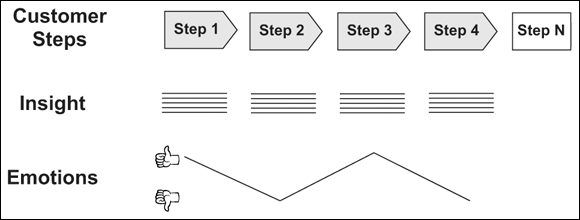
A journey map helps the team visualize a customer’s day-to-day experience when accomplishing a goal or addressing a specific problem. Actions follow goals in a timeline format by calling out the user’s emotions or thoughts. The journey map creates a narrative. The insights gained inform product designs. The illustration below outlines the flow of a journey map and the relationships between the customer’s goals and their steps, insights, and emotions.
A visual tool that helps teams collaboratively define, test, and iterate on the key aspects of a product, including the customer segment, problem, value proposition, solution, and business model.
A timeline-based visualization that captures a customer’s experience, actions, emotions, and pain points as they interact with a product or service.
An empathy map helps the team think through the user’s emotions and senses. It explores what the customer sees, hears, thinks, feels, and does. It identifies the pain the customer experiences and the gains they hope for, creating a more rounded view of the user.
When Spotify designed its onboarding, it used journey maps to pinpoint moments where new users might feel lost or excited. These insights led to targeted guidance, increasing user activation and retention rates.
How might mapping your own customer’s journey change the way you design, market, or support your product?
The product canvas is a collaborative tool that enables teams to accomplish two tasks in a brief amount of time: One, start identifying desired goals or product outcomes. Two, start to validate assumptions about the problem to solve for the customer and ready the team for development.
- You can explain the purpose of a product canvas and its core categories.
- You understand how journey maps and empathy maps help visualize the customer experience.
Marketing tools like the product canvas are only useful for marketers and aren’t relevant to scrum teams or product development.
The product canvas and customer maps are powerful tools for any scrum team, enhancing collaboration, validating assumptions, and aligning everyone on customer needs and business goals.
Pick a product idea (real or imaginary) and quickly map out the following:
- Define the customer segment and early adopter.
- List the main problem and any existing alternatives.
- Write a unique value proposition in a single sentence.
- Identify one channel you would use to reach customers.
Think of a time when a product or service failed to meet your needs as a customer. Which stage of the product canvas (value, usability, feasibility) do you think was missed—and how might using a canvas have changed the outcome?
Using visual tools like the product canvas and customer maps empowers scrum teams to validate assumptions early, align on customer needs, and design products that are valuable, usable, and feasible.
Collaborative marketing tools are not just for marketers—they are essential for cross-functional teams seeking agility and customer-centricity.
What are the three qualities that define the “sweet spot” for successful products?
Tap to revealValuable, usable, and feasible—products customers want, can use, and can be built by the team.
What is a product canvas used for in scrum teams?
Tap to revealTo collaboratively map assumptions, identify goals, understand customers, and create a strategic direction for product development.
How does a journey map inform product design?
Tap to revealBy visualizing the customer’s actions, feelings, and pain points over time, it reveals insights that guide more effective design choices.
Which of the following is NOT a category typically found in a product canvas?
How confident are you that you can explain the difference between a product canvas and a customer journey map?