As organizations grow, coordinating work across multiple agile teams becomes a massive challenge. Scrum@Scale offers a way to align priorities, remove impediments, and deliver integrated products—while preserving the speed and autonomy that make Scrum so effective at the team level.
The Scrum@Scale framework was co-created by Dr. Jeff Sutherland, one of the original architects of Scrum. Today, it’s used by organizations of all sizes—from startups to global enterprises.
Scrum@Scale facilitates alignment through roles. The Scrum@Scale approach for scrum teams working together is a form of the scrum of scrums model for scrum masters and product owners, coordinating communication, impediment removal, priorities, requirement refinement, and planning. Using a scrum of scrums model for the scrum master and product owner enables daily synchronization among teams across programs.
Following the vertical slicing model of scrum of scrums, Scrum@Scale groups approximately five scrum teams into a scrum of scrums team (SoS), which limits the complexities for effective cross-team communication. The teams comprising the scrum of scrums team are responsible for a fully integrated increment of product at the end of every sprint.
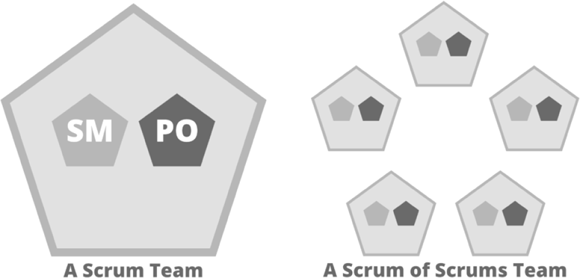
In larger organizations, multiple scrum of scrums teams may be grouped into scrum of scrum of scrums (SoSoS) teams as needed to deliver larger and more complex solutions.
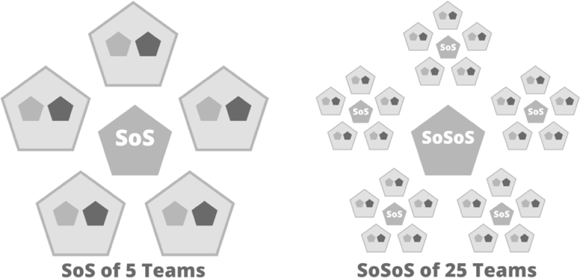
A coordination forum where representatives from multiple Scrum teams synchronize progress, resolve impediments, and align on shared objectives.
An executive-level group accountable for removing organizational impediments that individual scrum teams or SoS cannot resolve on their own.
Why might limiting a Scrum of Scrums to about five teams help prevent communication overload?
To coordinate what gets done in the sprint, Scrum@Scale scales sprint planning and sprint review. To coordinate how the work gets done across the program, Scrum@Scale scales the daily scrum and sprint retrospective.
The most notable activity in Scrum@Scale happens daily through the scaled daily scrum (SDS), which involves representatives from each of the scrum teams in the SoS inspecting their progress toward the sprint goal and making sure impediments raised are addressed quickly.
Want to go deeper? The science behind scaling agile teams
Research on team size and coordination shows that as the number of interdependent teams increases, the number of communication channels grows exponentially. By grouping teams into manageable clusters (like SoS and SoSoS), Scrum@Scale reduces complexity, enabling faster decision-making and clearer escalation paths. This mirrors well-established organizational design principles from systems theory and network science.
The scrum master cycle
A scrum master scrum of scrums coordinates release activities as the release team and continuous improvement and effectiveness of the SoS.
The scrum master accountabilities for an entire agile organization are fulfilled by an executive action team (EAT), removing the organizational impediments that the scrum of scrums groups can’t remove.
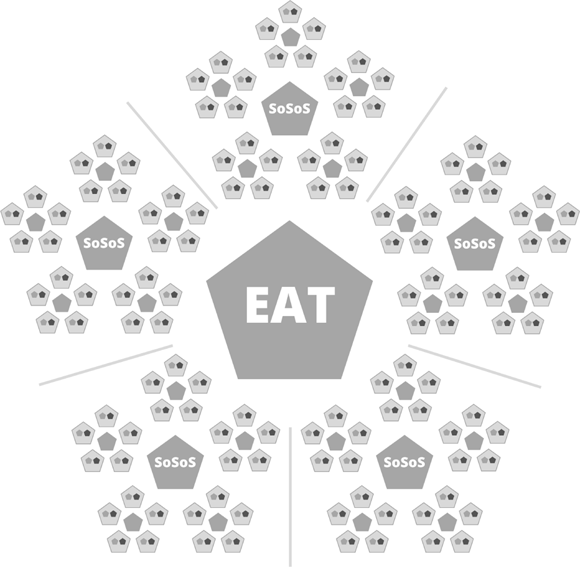
How does the Executive Action Team (EAT) help sustain agility at scale in large organizations?
- Scrum@Scale uses the scrum of scrums model to organize teams for effective coordination.
- Scaling scrum master and product owner roles ensures both “how” and “what” are managed across programs.
The product owner cycle
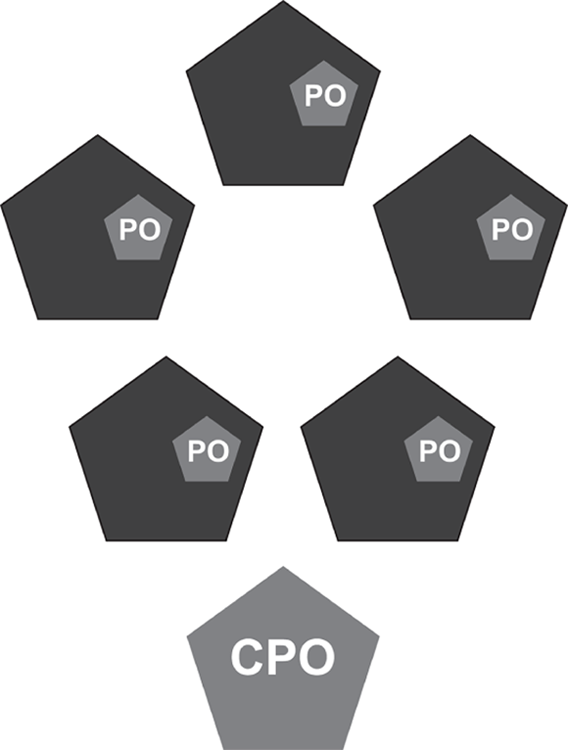
For each SoS, a shared common backlog feeds the network of teams. Product direction is led by a product owner team (PO Team), including a chief product owner. The PO team’s focus ensures priorities are aligned across all scrum teams. Essentially, they do what a single scrum team product owner does: coordinate individual teams’ backlogs and create alignment with stakeholders and customers.
The product owners organize along the same lines as the SoS and SoSoS. An executive metascrum (EMS) fulfills the product owner role for the entire organization. The chief product owner meets with executives and key stakeholders as a forum for leadership to express their preferences to the PO Team, set strategic priorities, manage budgets, and align teams to maximize delivery of value.
Global tech companies use Scrum@Scale to roll out new features across multiple continents, ensuring that every regional Scrum team works towards unified goals and delivers customer value in a coordinated way.
Scaling Scrum means creating one giant team with a single product owner and scrum master for everything.
Scrum@Scale preserves the autonomy of each team while coordinating through specialized roles and regular forums like scrum of scrums and metascrum meetings.
Synchronizing in one hour a day
In an hour or less per day, an organization can align priorities for the day and accomplish effective coordination of impediment removal. At 8:30 a.m., each scrum team holds its daily scrum. At 8:45 a.m., the scrum masters hold their scrum of scrums, and the product owners hold their level-one metascrum meetings. At 9:00 a.m., scrum masters meet in scrum of scrums of scrums, and the product owners meet in level-two metascrums. Finally, at 9:15 a.m., the scrum master scrum of scrums of scrums meets with the EAT, and the product owner metascrum representative meets with the EMS.

For a complete understanding and walk-through of Scrum@Scale, visit www.scrumatscale.com/scrum-at-scale-guide/.
What are the advantages of synchronizing all scrum teams within a daily hour-long coordination window?
The beauty of scrum is that it is designed to be flexible and to scale. Scrum@Scale is a simple way to maintain the autonomy of each scrum team within a wider program context.
Scrum@Scale enables organizations to coordinate many agile teams efficiently by scaling Scrum roles, events, and artifacts—without sacrificing team autonomy or agility.
Effective scaling depends on organizing teams into scrum of scrums and metascrum structures, ensuring both product alignment and operational excellence across programs.
Visualize how your teams might be grouped within the Scrum@Scale framework.
- List all scrum teams in your company or department.
- Group them into hypothetical scrum of scrums teams (SoS), each with up to five teams.
- Determine how many SoS groups would form a scrum of scrum of scrums (SoSoS).
- Identify who might serve as your EAT and EMS.
Imagine your organization implements Scrum@Scale. What potential challenges and benefits can you foresee, and how might you address the most significant barrier?
What is a Scrum of Scrums (SoS)?
Tap to revealA coordination group where representatives from multiple Scrum teams meet to synchronize work, resolve impediments, and align objectives.
What is the primary role of the Executive Action Team (EAT) in Scrum@Scale?
Tap to revealThe EAT is responsible for removing organizational impediments that are beyond the scope of individual scrum teams or SoS.
What is a Metascrum?
Tap to revealA forum where product owners across multiple teams align on priorities, set strategy, and ensure stakeholder alignment.
What is meant by “vertical slicing” in Scrum@Scale?
Tap to revealOrganizing groups so that each scrum of scrums is responsible for a fully integrated increment of product at each sprint, not just a single technical layer.
How does Scrum@Scale synchronize daily work across all teams?
Tap to revealThrough a synchronized schedule of daily scrums, scrum of scrums, and metascrums that align priorities and address impediments in under an hour.
How could your team benefit from adopting elements of the Scrum@Scale framework, even if you don’t scale to dozens of teams?
Practitioners report that keeping the daily synchronization meetings efficient—no more than 15 minutes per level—requires a strong focus on priorities and disciplined facilitation.
What risks might arise if SoS or metascrum meetings become status updates instead of problem-solving forums?
How confident are you that you can explain how Scrum@Scale structures teams and roles to coordinate work across large organizations?
What is the main function of the Executive Action Team (EAT) in the Scrum@Scale framework?