At the heart of every business decision lies finance: making the tough calls about where to invest, when to pivot, and how to maximize value. When it comes to developing new products, the difference between financial success and massive waste often comes down to how — and when — funding is allocated.
Just one failed IT project can cost a company hundreds of millions of dollars — and most of these losses are preventable with better funding strategies.
The goal of business is to make money to provide and improve products or services. Therefore, finance lies at the heart of any successful product development effort. Increasing competition and tightened budgets require making tough, wise funding decisions.
Billions of dollars are wasted yearly on products that failed or died somewhere along their protracted and painful development. Here are just a few examples:
- Ford Motor Co. abandoned a purchasing system after deployment, resulting in a $400 million loss.
- J Sainsbury PLC (UK) abandoned a supply chain management system after deployment, resulting in a $527 million loss.
- Hewlett-Packard experienced a $160 million loss due to problems with an enterprise resource planning (ERP) system.
- AT&T Wireless experienced problems with a customer management system upgrade, resulting in $100 million lost.
- McDonald’s canceled its innovative information-purchasing system after already spending $170 million.
These are only a few examples of preventable financial waste.
According to a KPMG survey on global IT project management, 49% of organizations reported at least one project failure in the previous 12 months, and only 2% always achieved targeted benefits. Most of these setbacks could have been avoided with smarter funding approaches.
A survey conducted by KPMG on global IT project management unearthed some startling findings. When respondents were asked about their experiences in delivering value in projects after receiving funding, this is what they found:
- 49 percent said they’d experienced at least one project failure in the previous 12 months.
- 2 percent achieved their targeted benefits with every project in the same 12 months.
- 86 percent said they’d lost up to 25 percent of targeted benefits across their entire project portfolio.
Most of this was likely preventable.
Why do you think so many projects fail to deliver their intended benefits, even after significant funding?
Incremental funding
Not surprisingly, companies want to fund an initial deliverable before they decide whether to keep funding a product. In scrum, product increments are produced every sprint and packaged for release every release cycle, so incremental funding is easily incorporated.

Incremental funding is a financially driven method of funding product development efforts. It focuses on maximizing returns by delivering sequenced, portioned customer-valued functionality to maximize a product’s net present value — the present value of future incoming cash flows minus the purchase price and any future outgoing cash flows.
What used to happen in corporations is that the business team would go before a funding committee with a proposal and return on investment (ROI) numbers that team members believed were necessary to fund their product development effort. If they were successful, the team spent every nickel of that funding and then delivered results or asked for more funding. Few people looked at the ROI numbers from months or years earlier because the company wasn’t going to get that money back anyway. Sunk costs meant that companies had to move forward at all costs.
In scrum, the product owner goes before a funding committee with his product goal and monetized product roadmap. He might say, “I need $3 million to implement all these features.” The funding committee can respond, “Okay, we’ll allocate $3 million for your project. But first, we’ll give you $500,000. Show us that you can deliver the ROI promised for your initial release, and we’ll give you more money. But if you can’t deliver on a little bit, you can’t deliver on a lot.”
How does incremental funding change the relationship between teams and stakeholders compared to traditional funding models?
Many companies prefer to use incremental funding for their product development with or without the accompanying scrum practices. Incremental funding is used to do the following:
- Mitigate risk: Stakeholders and product owners can test the projected ROI at minimal cost to see whether they hit it.
- Reduce costs: A minimal investment is used at the start.
- Maximize returns: Earlier monetization leads to higher revenue.
Another way to look at team funding is in terms of MVP (minimum viable product). You should be able to monetize the MVP (explicit ROI). If the MVP realizes the projected ROI, fund the next MVP.
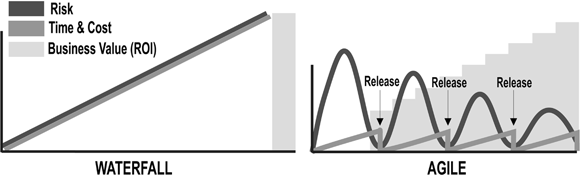
Incremental funding creates an opportunity for product owners and stakeholders to examine their ROI at every release. At each release, if problems exist, depending on the size and complexity of those problems, stakeholders can invest in fixes or terminate the development before more money is wasted.
Want to go deeper? The science behind incremental funding and ROI
Incremental funding is rooted in financial principles like the net present value (NPV) and the concept of minimizing sunk costs. By regularly reviewing ROI at set intervals, organizations can avoid the psychological trap of “throwing good money after bad,” a phenomenon known as the sunk cost fallacy. In agile approaches like scrum, this aligns perfectly with short feedback loops and adaptability — driving both financial discipline and innovation.
Revenue can be started earlier. The goal is not just less waste but earlier return — and earlier return means higher return. Value is delivered to the customer earlier, and his buy-in increases. Controlling risk and cost is important; so is providing value. If you can identify ways to deliver distinct features for generating revenue in earlier time frames, you should chunk them out and deliver them first, so the customer can realize revenue without having to wait until the lowest-priority item is deployed. As revenue comes in, the initial costs are offset earlier, and overall revenue and profit over the product’s life are higher.
A method of allocating funds to product development in small portions, contingent on achieving specific value milestones at each stage.
The financial benefit gained from an investment, calculated as the difference between incoming cash flows and the total cost of the investment.
Once funding is allocated to a project, it should be spent in full, even if problems arise.
Incremental funding allows companies to invest in stages, revisiting ROI and halting further funding if value isn’t being delivered.
Historically, a product’s ROI is projected, and funding is received based on that projection. Product development is rarely canceled because testing and customer feedback are left until the end of the development cycle. Even if problems are discovered, it’s difficult to take money back after it’s been allocated. Not surprisingly, ROI projections are sometimes inflated to get funding.
Scrum encourages honest ROI assessment by requiring teams to demonstrate value at every increment — making it easier to stop or redirect investment before losses mount.
With incremental funding, the ROI is kept honest because it needs to be proven at each release. If the increment fails to deliver, no more money is invested.
This lower cost of failure allows developers to nurture their creativity and even form an intrapreneurial culture. Fresh ideas can be tested, and if the ROI is met, they can be continued. Company cultures change as trust is built through tangible delivery and the intrapreneurial spirit is nourished.
Failure no longer exists; it’s replaced by consistent learning toward the next success when costs are low, and innovation is encouraged. Self-organizing teams have the freedom and motivation to come up with their own best designs and solutions.
How might incremental funding and regular ROI reviews shape the culture of innovation within a team?
“Failure no longer exists; it’s replaced by consistent learning toward the next success when costs are low, and innovation is encouraged.”
- You’ve discovered the pitfalls of traditional funding and the value of incremental funding in scrum.
- You understand how early delivery and honest ROI reviews can transform business outcomes.
The following sections discuss standard accounting practices that align with this incremental financing approach.
Incremental funding empowers organizations to maximize returns, reduce risk, and foster innovation by making investment decisions based on real, demonstrated value at every stage of product development.
Early and honest ROI review is essential to preventing financial waste and building a culture of agile learning and continuous improvement.
What is the primary benefit of incremental funding in product development?
Choose one of the failed projects listed above. Using what you’ve learned about incremental funding, consider how things might have gone differently.
- Pick a project from the list (e.g., Ford’s purchasing system).
- Identify one point where incremental funding could have changed the project’s direction.
- Describe how releasing value in increments would have affected the outcome.
Think of a time you or your organization invested significant time or resources into a project that didn’t deliver as hoped. How might incremental funding and honest ROI reviews have changed the story?
The Shift
- Incremental funding reduces financial waste by tying investment to demonstrated product value at every stage.
- Honest, ongoing ROI reviews empower both teams and stakeholders to make smarter, lower-risk funding decisions.
- Scrum’s incremental approach encourages a culture of innovation, adaptability, and early value delivery.