As organizations grow, so do their projects—and their teams. But how can a collection of agile teams keep moving forward together, ensuring that integration, priorities, and dependencies don’t derail the program’s momentum? Enter the Scrum of Scrums model: a practical framework for scaling agile collaboration across teams.
The term “Scrum of Scrums” was inspired by the way rugby teams coordinate—each team huddles regularly, but the captains gather to align strategy across the whole field.
The scrum of scrums model facilitates effective integration, coordination, and collaboration among scrum teams by means of vertical slicing. Almost all scaling frameworks use some form of scrum of scrums to enable daily coordination among scrum teams.
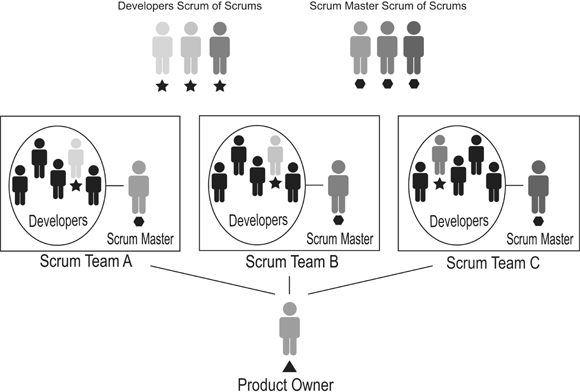
People on one team coordinate daily with people in the same roles on other teams regarding priorities, dependencies, and impediments that affect the broader program team. The scrum of scrums for each role is facilitated by the integration-level person for each role. Without an integration scrum team, anyone in the scrum of scrums can do the facilitation. Thorough integration and release efforts establish a consistent, regular scrum of scrums model.
Each day, scrum teams hold their own daily scrums at approximately the same time, in separate locations or web-conferencing rooms. Following these daily scrums, scrum of scrums meetings occur.
What challenges might arise when multiple teams work on interconnected features, and how could a Scrum of Scrums help address those issues?
Developer Scrum of Scrums
Each day after the teams’ daily scrums, one developer from each scrum team attends the integration team’s daily scrum (the developer scrum of scrums) and participates with integration team developers in discussing the following:
- Any integrations that need to be coordinated since the last scrum of scrums meeting
- The integrations that will be needed between now and the next meeting
- Technical concerns with which the team needs help
- Technical decisions that the team has made
- How to prevent potential issues

Consider rotating the developers who attend the scrum of scrums—daily or for each sprint—to ensure that everyone stays tuned in to the integration efforts of the portfolio.

With continuous automated integration, the developer scrum of scrums may just be the representative developers from each scrum team without a separate integration scrum team.
How might rotating the developer representatives impact overall team awareness and problem-solving?
Scrum Master Scrum of Scrums
The scrum masters from each scrum team also meet with the integration scrum team’s scrum master for no longer than 15 minutes to address any escalation needed to deal with each team’s impediments. Typically, each scrum master addresses:
- The individual team-level impediments resolved since the last meeting with the integration team and how those impediments were resolved (if other scrum masters run into the issue and can implement the solution)
- New impediments identified since the last meeting and which impediments the team needs help resolving
- Potential impediments that everyone should be aware of
The integration team scrum master ensures escalated impediments are addressed after the daily scrum of scrums.
With continuous automated integration, the scrum master scrum of scrums may just be the representative scrum masters from each scrum team without a separate integration scrum team.
A method of organizing work so that each team is responsible for delivering complete slices of functionality, ensuring integration across all layers of a system.
A group or person at the program level responsible for facilitating coordination and integration among multiple scrum teams.
In large technology firms, hundreds of developers work on different modules. Daily scrums keep each team on track, but the Scrum of Scrums ensures that everyone is building towards the same integrated solution.
Think about a time when coordination across teams (in school, work, or a group project) was challenging. How might a systematic approach like the Scrum of Scrums have made a difference?
Want to go deeper? Who really owns architecture in a scaled Scrum environment?
Your organization should have existing architectural standards, technical standards, and style guides to avoid reinventing the wheel. But who owns architectural decisions? It depends on which modules are affected. If a decision only affects module A, that team decides. If it impacts multiple teams, the integration-level developers shared by all affected teams must make the decision. Vertical slicing allows teams autonomy, but also structure for timely, relevant architectural conversations.
Form small groups and simulate daily scrum and scrum of scrums meetings, focusing on dependencies and blockers.
- Each group acts as a scrum team and holds a 5-minute daily scrum to identify today’s priorities and blockers.
- Afterward, send one representative from each group to a 5-minute “Scrum of Scrums” to discuss cross-team dependencies and impediments.
- Debrief: What issues surfaced in the Scrum of Scrums that weren’t apparent within a single team?
Scrum of Scrums is just a big meeting for everyone in the program.
Scrum of Scrums is a focused coordination mechanism where representatives from each team align on priorities, dependencies, and impediments, not simply a gathering of all team members.
Vertical slicing is a simple way to maintain the autonomy of each scrum team to deliver valuable functionality within a wider program context.
Scrum of Scrums
Tap to revealA scaled coordination meeting where representatives from multiple scrum teams discuss integration, dependencies, and impediments.
Vertical Slicing
Tap to revealA technique for breaking work into end-to-end slices of functionality, ensuring teams deliver integrated value.
Integration Team
Tap to revealA group or person responsible for coordinating integration efforts across multiple scrum teams.
What is the primary purpose of the Scrum of Scrums meeting?
Practitioners often find that the Scrum of Scrums evolves as teams mature—shifting from rigid reporting to fluid problem-solving sessions focused on cross-team value delivery.
Why is it important to have both team-specific and cross-team mechanisms for discussing impediments?
- Scrum of Scrums enables daily coordination and integration across multiple Scrum teams.
- Both developers and scrum masters participate with unique roles and topics for discussion.
The Scrum of Scrums is essential for scaling agile, maintaining alignment, and addressing dependencies across multiple teams without sacrificing autonomy or speed.
Vertical slicing and regular cross-team meetings empower organizations to integrate complex work efficiently while retaining the benefits of agile practices.
How might your organization benefit from implementing a Scrum of Scrums, and what practical steps could you take to get started?
The Shift
- The Scrum of Scrums model enables agile teams to scale effectively and deliver integrated value.
- Vertical slicing and structured communication ensure autonomy and cross-team alignment.
- Facilitated daily coordination reduces impediments, enhances integration, and accelerates delivery at scale.