As organizations grow, so do their challenges with aligning teams, managing complexity, and ensuring agility doesn’t get lost in scale. The Scaled Agile Framework (SAFe) offers a structured solution — but with structure comes new questions. How do we balance rigor with autonomy? Where’s the tipping point between helpful frameworks and overwhelming bureaucracy?
A set of organizational and workflow patterns that help enterprises scale lean and agile practices across large, complex product development efforts.
Scaled Agile Framework (SAFe) provides enterprise solutions to scaling product development based on Lean and Agile principles. The SAFe Essential Big Picture is a visual summary of key roles and flows within the framework.
SAFe has become one of the most widely adopted scaling frameworks for agile, used by organizations ranging from startups to Fortune 100 companies.
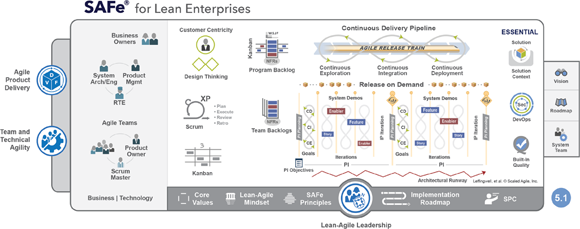
In addition to SAFe Essential, other configuration options exist that build on the essential configuration:
- Large Solution SAFe: For enterprises that are building large and complex solutions but do not require portfolio-level constructs.
- Portfolio SAFe: Supports the development of multiple solutions across a portfolio.
- Full SAFe: Represents the most comprehensive configuration, supporting large, integrated solutions that may require hundreds of people to develop.
Some aspects of SAFe that have made it useful to many organizations include agile release trains (ART) and program increment (PI) planning.
Why do you think visual frameworks like SAFe help portfolio managers and leaders in large organizations?
ARTs
A long-lived team of agile teams (typically 5–12 teams) that, together, deliver incremental value on a fixed schedule or cadence.
The “agile release train” (ART) model is a team of agile teams delivering incremental releases of value. The train departs the station on a reliable schedule of release opportunities that each program can jump on if ready. If you miss one release, you can catch it when another one comes along. The ART provides a fixed cadence with which the program teams synchronize.
At this level of integration, the work of the individual teams comes together to form release packages through continuous exploration (CE), continuous integration (CI), and continuous deployment (CD).
In a large tech company, dozens of agile teams may coordinate their releases through an ART, ensuring new features are delivered reliably to customers regardless of individual team delays.
How might a fixed release cadence help reduce stress and improve predictability for teams working together?
PI planning
A program increment is the functionality created during a timebox in which an ART delivers incremental value. A PI is usually 8–12 weeks long, most commonly about four two-week-long sprints.
PI planning is a face-to-face, “large room” event where all the teams of the ART come together to coordinate priority and scope for the program increment. In PI planning:
- The business context and vision are presented
- Architecture vision and development practices are agreed on
- Teams create their iteration plans and objectives
- Management reviews the overall plan draft
- ART teams make planning adjustments based on management’s review
- Program risks are identified and mitigated
- Confidence vote across the ART to move forward or rework until confidence is achieved
PI planning enables fast decision-making through real-time, synchronous collaboration, builds the social network needed for the ART to work well together throughout the PI, and ensures development and business goals are aligned and dependencies are broken down in planning.
Portfolio managers like the SAFe model because of how visual it is. For larger organizations, it also provides the structure for middle management’s involvement with scrum teams.
Practitioners often emphasize that the greatest value of PI planning is the informal communication and network building that happens when everyone is in the same room — even in remote settings.
What is the main purpose of PI planning in the SAFe framework?
- SAFe provides structured approaches like ARTs and PI planning for scaling agile
- PI planning brings all teams together to align on priorities and manage risks
Empowerment
Empowerment, or the authority or power given to someone to do something, is essential for true agility. Product owners, developers, and scrum masters are empowered to act in the best interests of the organization and team. Scrum encourages the people most familiar with the problem at hand to solve the problem.
A top-down approach to scaling can often lead to organizational leaders making decisions that should be made by the people closest to the problem or customer. Some leaders see themselves as the most knowledgeable about the customer’s needs when, in fact, they may be somewhat distanced.
This lack of empowerment and centralized decision-making has the potential to convert teams from teams of thinkers and doers to simply doers, cutting off the legs of empowerment.
Scaling agile always improves team performance, regardless of how empowered the teams are.
Without genuine empowerment, scaling often leads to lost agility and teams that merely follow orders instead of solving problems.
Consider a time when you felt empowered at work. How did it impact your motivation and results?
Complexity
If a scaling model requires hundreds of pages to describe the framework, flow, and roles, watch out for the excess structure it might introduce. The introduction of excessive additional roles, artifacts, and meetings can distract from good scrum and return you to high-compliance and oversight structures you’re trying to get away from.
Want to go deeper? The science behind scaling and complexity
Research in organizational behavior shows that as frameworks become more complex, communication, coordination, and decision-making often slow down. The most effective scaling approaches focus on maintaining team-level autonomy and minimizing unnecessary hierarchy.
Organizational change
Scrum is a different way of approaching process and product development than what most organizations have been doing. Implementing scrum will require change, in many cases significant change. If a scaling model seems to be encouraging traditional, hierarchical, siloed, and specialist structures by simply renaming them, chances are the model will not lead your organization to increased agility. To avoid these pitfalls, return to the basics of scrum. Getting scrum right at the team level is the foundation for effective scaling.

Don’t scale bad scrum.
Scrum is an exposure framework. It purposefully exposes everything so facts and ineffectiveness can be seen and addressed. Your scaling model should enhance and support this, not cover it up.
As mentioned earlier, scaling is an antipattern. The best way to prevent the need for scaling is to enable your teams to become highly aligned and highly autonomous. Break down work and features into the smallest and most valuable increments.
Effective scaling requires first mastering scrum at the team level and ensuring empowerment—frameworks like SAFe should support, not stifle, true agility.
Organizational complexity should not come at the cost of team autonomy; always prioritize simplicity and clarity when scaling agile practices.
Scrum is an exposure framework. It purposefully exposes everything so facts and ineffectiveness can be seen and addressed.
Visualize how your organization could use ARTs to synchronize multiple teams.
- List the teams currently working on related products or features.
- Sketch out how their work might align on a single release cadence, identifying potential dependencies.
- Discuss with a partner how PI planning might help these teams align priorities and resolve risks.
Reflect on your own organization or one you know: Where would empowerment boost agility, and where might complexity be holding teams back? How could SAFe or another framework help—or hinder—those dynamics?
What is an Agile Release Train (ART)?
Tap to revealA team of agile teams that delivers incremental value on a fixed schedule in the SAFe framework.
What is the main goal of PI planning?
Tap to revealTo align all teams on priorities, scope, and risks for the upcoming program increment.
Why is empowerment critical in scaling agile frameworks?
Tap to revealWithout empowerment, teams lose autonomy and agility, reducing the effectiveness of scaling efforts.
How confident are you that you can explain the role of PI planning in the SAFe framework?