What makes a network robust? Beyond complexity and connectivity, the presence of circuits—closed loops—adds a hidden layer of flexibility that can keep traffic moving, ensure utilities remain available, and help you model more resilient systems in GIS.
The famous London Underground map is a practical example of a network with many circuits. These loops allow riders to find alternative routes when there are train delays.
Defining Circuitry
Networks are characterized by their complexity. The gamma index, described earlier, provides a way to measure this complexity. Another characteristic of networks is circuitry, which influences both network connectivity and robustness in traffic modeling. Circuitry refers to the presence of closed loops in a network, allowing alternative travel paths. Think of a roundabout, a bypass, or even a river flowing around an island. Each of these circuits offers an alternative route within the network.
Highway bypasses and city loop systems are designed as circuits, letting drivers avoid traffic jams and keeping cities connected even during road closures.
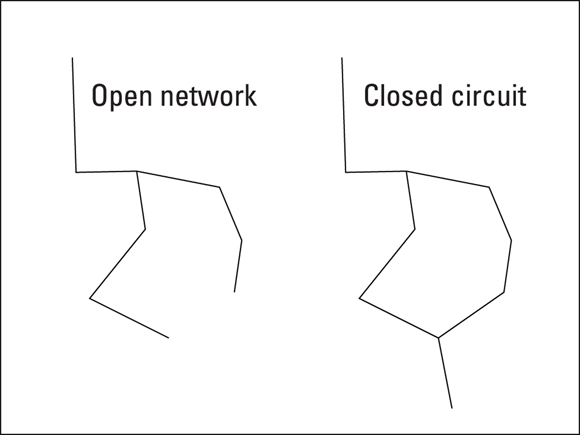
All networks with multiple connections automatically offer alternative routes if one path is blocked.
Only networks with closed loops (circuits) provide true redundancy and alternative routes—branching alone is not enough.
Can you think of a network in your daily life that would be less effective without closed loops?
Understanding how circuits improve networks
Circuits are ubiquitous. If you’re modeling streams, you may come across an area where a stream splits around an island, moving in two different directions. In many cities, roundabouts create small circuits that keep traffic moving. In the United States, highway bypasses and loop systems do the same thing but on a larger scale, allowing vehicles to avoid slow-moving, inner-city streets.
In GIS, circuits increase your route options. For example, even if a looped path is longer, it may save time by reducing traffic-related delays. These closed loops also improve connectivity and redundancy, making networks more efficient and resilient.
Civil engineers and urban planners often add circuits to transportation networks to boost traffic flow and minimize the risk of bottlenecks during rush hour or emergencies.
Why might a longer route with a circuit be preferable to a shorter, direct path in some situations?
Measuring and modeling circuits
To measure circuitry, GIS uses the alpha index, a ratio that compares the number of actual circuits to the maximum possible circuits in a network. Whereas the gamma index measures overall connectivity, the alpha index focuses specifically on loops. Here are some examples of using the alpha index:
- A sparse network with no loops (circuits) has an alpha index near 0.
- A dense network with multiple circuits approaches an alpha index of 1.
Most GIS software includes tools to calculate the alpha index automatically. Although the math is fun (well, if you like math, that is), modern GIS users typically focus less on the math and more on how circuits enhance real-world situations, like improving traffic flow or ensuring that utility networks remain operational during outages.
The presence of closed loops within a network, enabling alternative travel paths and enhancing robustness.
A measure of circuitry in a network, calculated as the ratio of actual circuits to the maximum possible circuits.
Want to go deeper? The science behind the alpha index
The alpha index is calculated using the formula: α = (e − v + 1) / (2v − 5), where e is the number of edges (links) and v is the number of vertices (nodes). This formula gives a value between 0 (no circuits) and 1 (maximum possible circuits for that network size). It is a practical way to compare the redundancy of different networks, regardless of their size.
How might a high alpha index affect emergency response routes in a city?
Sketch or examine a simple map (like your school, office, or neighborhood). Try to find and highlight all the closed loops (circuits) in the network. Then, consider these steps:
- Mark all possible routes from one point to another.
- Identify which routes give you more than one path (i.e., which include circuits).
- Discuss: What happens if one path is blocked? How does the presence of circuits influence your options?
What is a circuit in the context of networks?
Tap to revealA closed loop within a network that provides alternative paths and increases robustness.
What does the alpha index measure?
Tap to revealThe ratio of actual circuits to the maximum possible circuits in a network, indicating its level of redundancy.
Why are circuits important for network resilience?
Tap to revealCircuits provide alternative routes, allowing a network to remain functional even if one path is blocked.
Describe a situation where having a circuit in a network—be it roads, utilities, or waterways—made a real difference in your life or your community. How did it impact outcomes compared to a network without circuits?
- Circuitry introduces closed loops to a network, offering redundancy and alternative travel paths.
- The alpha index quantifies how many circuits are present compared to the maximum possible in a network.
Circuits—closed loops in a network—are the key to creating robust, flexible systems that can adapt to disruptions and improve overall flow.
Closed loops provide flexibility in a network and play a crucial role in improving flow and resilience.
What does the presence of circuits in a network allow?
How confident are you that you can explain how circuits enhance network resilience in GIS?
The alpha index is a powerful tool in GIS for measuring the redundancy of a network by quantifying its circuits.
The Shift
- Circuits (closed loops) are essential for network resilience, providing alternative paths during disruptions.
- The alpha index offers a quantifiable way to assess circuitry and redundancy in GIS networks.
- Understanding and modeling circuits leads to more efficient, robust transportation, utility, and natural systems.