Breaking Down Requirements
How can breaking down requirements—and prioritizing them—help scrum teams deliver value faster and avoid wasted effort?
Have you ever faced a mountain of requirements and wondered how to climb it efficiently? In scrum, the process of breaking down requirements transforms overwhelming complexity into actionable pieces that drive real progress.
Scrum teams often achieve 30–70% cost savings compared to traditional methods, simply by focusing their energy on the highest-priority requirements first.
Progressive Elaboration: The Art of Decomposition
It won’t take long to notice that one product requirement can be broken into several pieces. Chances are those pieces can be broken down further, and those pieces, we’re willing to bet, can be peeled apart too. This ongoing process is called progressive elaboration, and it’s central to scrum product development.
When you encounter a complex requirement, do you instinctively look for ways to break it down? Why or why not?
Prioritization of Requirements
With the product roadmap, you begin with the largest pieces. This roadmap truly provides an eagle’s-eye view and is based on what makes sense according to business value and/or risk elimination. These pieces (requirements) are prioritized by the product owner, who decides what is most important to get to that customer first and which requirements logically belong together.
As requirements are prioritized, they become part of the product backlog. In scrum, you work on the smallest set of highest-priority items necessary to generate value, not just anything scoped for the product, which is why scrum teams achieve outcomes faster.
Take two things into consideration as you prioritize: business value and risk. Business value is easy. If a thing is high value, it has high priority. There are four reasons you also want to take on the highest-risk requirements first (assuming they are also high-value):
- At the beginning, you have the simplest model to work with. You want to take on your highest-risk items within the simplest system.
- You have the greatest amount of money at the beginning. If you’re going to take on something that involves high risk, you should do so with the greatest resources at your disposal.
- If you’re going to take on a high-risk item, do so with the benefit of the longest runway possible.
- If you’re going to fail, fail early and cheaply. If a fundamental flaw exists, you want to know as early as possible. The highest-risk requirements are where the landmines are lurking.

Working the highest-priority requirements to completion isn’t just convenient, it also saves money and is why products using scrum can come in at a 30–70 percent cost savings. If you run out of money 80 percent of the way through, you can say, without a doubt, that you have 80 percent of the highest-priority items completed, functioning, and accepted. What about the remaining 20 percent? If they were such a low priority, you can often live without them anyway. Efforts to develop products using agile techniques like scrum typically run out of value before they run out of time or budget. Read more about maximizing value in a release.
The product roadmap creates your first cut of dependencies. Using our water heater example, you don’t need to worry about having functionality to drain condensation until you have a controller to manage heat. Critical dependencies are revealed early and help the product owner prioritize the product backlog. Teams begin working on the highest-priority items on day 2, not day 120.

A requirement must earn the right of your investment. Only the highest-priority items deserve your effort to break them into digestible requirements. Everything else can wait. This way, you’re always working on only the most important things. Don’t waste your time trying to boil the ocean. Learning and adapting are valuable even while building requirements.
- Requirements are broken down through progressive elaboration.
- Prioritization focuses effort on value and risk, saving time and money.
Levels of Decomposition
When decomposing your requirements into smaller pieces, you want to capture as little detail as possible. In fact, we want you to become an expert in doing the bare minimum, progressively elaborating requirements as the likelihood of bringing them into a sprint grows. Gone are the days of spending endless hours working on defining and refining requirements that never see the light of day.
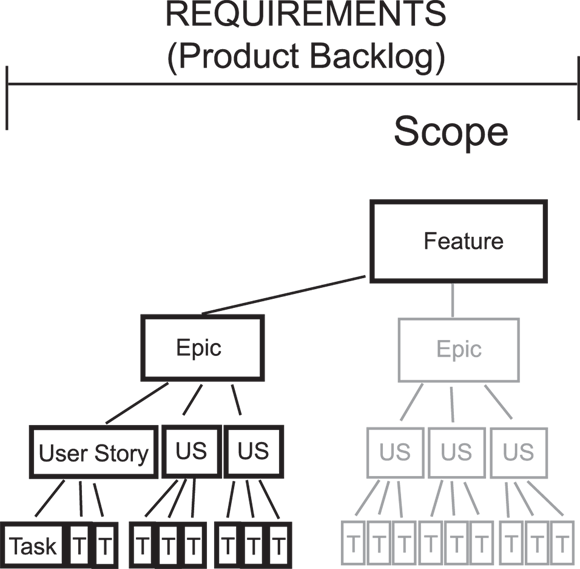
This approach ensures you only invest detail in requirements when they are relevant and ready to be worked on, keeping your team agile and focused.
Imagine building a new feature for an e-commerce site. Instead of fully detailing every possible scenario up front, scrum teams break the work down: first by theme (e.g., checkout), then by feature (credit card payment), and finally into smaller tasks (validating payment, integrating with a payment gateway). This allows real progress and rapid feedback at every stage.
Want to go deeper? The science behind prioritization.
Research in agile teams shows that tackling high-risk, high-value requirements early leads to faster detection of flaws and greater learning. This “fail fast” principle not only reduces sunk costs, but accelerates the team’s ability to adapt solutions to real stakeholder needs. By focusing on business value and risk, scrum teams maximize their impact and avoid wasted effort.
Seven Keys for Product Development
Seven types of work are involved in building valuable product increments. Using these approaches, you know the product works, can be integrated, and has been approved by the product owner. You’re tangibly building products to showcase to stakeholders from whom you can garner feedback. This feedback is then used to refine and create new requirements that make the product better reflect stakeholder needs, and the cycle is run again. You incrementally improve the product based on reality.
The seven keys for building valuable products are:
- Requirement elaboration
- Design
- Development
- Comprehensive testing
- Integration
- Documentation
- Approval
Like developer, the term development simply means the act of creating a product or service. Development can include writing code in software development, but it can just as easily refer to any type of solution implementation or creating, configuring, sculpting, or even building. We’ve used the term development throughout to simplify.
Which of the seven keys do you feel is most often overlooked—and why do you think that happens?
Practitioner tip: Don’t over-document requirements too early. Progressive elaboration allows teams to avoid investing effort in requirements that may never be implemented.
A prioritized list of requirements, features, and tasks that the scrum team works on. Only the highest-priority items are actively decomposed and refined.
The process of continuously breaking down requirements into more detailed and manageable pieces as they become more likely to be worked on.
You need to define every detail of every requirement before starting development.
In scrum, only the highest-priority requirements are broken down in detail, and elaboration happens progressively as items are brought closer to a sprint.
Pick a product requirement and break it down through progressive elaboration.
- Choose a requirement (e.g., “User can purchase items online”).
- Identify the main features involved.
- Break each feature into smaller actionable tasks.
- Prioritize the resulting tasks based on business value and risk.
How does breaking down and prioritizing requirements change your approach to product development?
Think of a past project where requirements were not well prioritized or broken down. What challenges resulted, and how would a scrum approach have changed the outcome?
Scrum teams achieve faster outcomes and significant cost savings by breaking down requirements progressively and focusing only on the highest-priority, high-value, and high-risk items.
Progressive elaboration prevents wasted effort by ensuring only relevant requirements are detailed and worked on, enabling teams to adapt quickly to feedback.
“Efforts to develop products using agile techniques like scrum typically run out of value before they run out of time or budget.”
What is progressive elaboration?
Tap to revealThe process of continuously breaking down requirements into more detail as their likelihood of being worked on increases.
What are the two main criteria for prioritizing requirements?
Tap to revealBusiness value and risk.
Why tackle high-risk requirements early?
Tap to revealBecause you have the most resources, the simplest system, and failing early is less costly.
What is the main reason scrum teams focus on high-priority and high-risk requirements first?
How would you apply progressive elaboration to a complex project in your own work or studies?
The Shift
- Progressive elaboration ensures requirements are broken down only as needed, preventing wasted effort.
- Prioritizing by business value and risk accelerates delivery and reveals issues early.
- Scrum teams deliver more value by focusing their energy on the highest-priority items, adapting quickly as feedback arrives.