Product Backlog Common Practices
What makes a product backlog truly effective in driving agile development and delivering value sprint after sprint?
Agile techniques have revolutionized how organizations plan and execute work. While no universal set of best practices exists, certain common methods have emerged that help teams achieve clarity, focus, and rapid value delivery. This lesson explores these practices—user stories, personas, and further refinement—to illuminate how you can shape your own product backlog for maximum impact.
Product Backlog Common Practices
Thousands of companies and organizations practice agile techniques throughout the world. As a natural result, common agile practices abound. We incorporate some of these practices into our consulting business and discard others. We recommend that you do the same. No universal set of best practices exists.
User Stories
A brief, customer-focused description of a desired feature or function, written from the user’s perspective to clarify requirements and deliver value.
User story is a common pattern for communicating and gathering requirements to achieve shared understanding across the entire scrum team. Developers create better value when they clearly understand the user’s perspective.
User stories are an action of value that a user will achieve; for example, “As a homeowner, I want to adjust the thermostat so I can control my water temperature.”
Multiple small user stories go into every sprint, and each is the highest priority at that time. On average, you may have six to ten user stories per sprint. Therefore, at the end of each sprint, if the developers concentrate on completing one user story at a time (a process called swarming), you always have something valuable and usable to show for your work.
Swarming: The process where the team focuses its effort on completing one user story at a time, ensuring high-value delivery and team collaboration.
We use 3×5 index cards to write user stories. Even with these small cards, because we use a Card ⇒ Conversation ⇒ Confirmation model—the three Cs—we get rich requirement clarity. User stories aren’t the only way to describe what needs to be done, but we’ve found them to be incredibly effective.
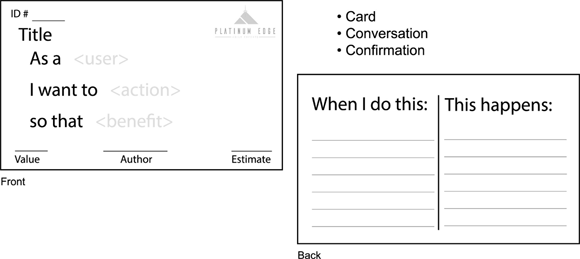

Don’t use technical jargon in your user stories. You’re writing them with the user in mind. Keep them direct, customer-focused, and simple.

In the Card ⇒ Conversation ⇒ Confirmation model, the product owner uses the 3×5 card as a reminder of the requirement—a reminder that a conversation must take place to refine and clarify it. This model enables the immensely valuable activity of conversing with developers and answering their questions, supported by an explicit description of what success looks like on the back of the card.
Before agile, teams often relied on lengthy requirement documents that attempted to answer every possible question. User stories and conversation models have replaced this with more dynamic, collaborative approaches.
Personas
A fictional character that embodies the target qualities of your customer, used to guide design and ensure user needs are met.
Sometimes, it’s easiest to work with personas, which are fictional characters that are amalgams of your clients’ target qualities. A persona for a dating product might be a professionally employed 35-year-old single male living in Portland, Oregon, looking for his future significant other. Use a persona to ensure that your product meets your target customer’s needs.
A user story description is simple yet focused, clearly describing the user, the action, and the benefit. On each card, enter the following lines:
-
An ID number that’s the same as in the product backlog and assigned by the product owner when they accept an item into the product backlog
 REMEMBER
Keep your product ID numbers simple. You don’t need to be able to track every item back to its more generic origin; you just need to give it a numerical name like 123, not like 10.8.A.14. You minimize the amount of work you do by ridding your work of timewasters so you can focus on the important things.
- A shorthand title
- A description of the user (who?)
- What the user wants to accomplish (what?)
- The reason the user wants to accomplish the task (why?)
Critical to the user story is what’s written on the flip side of the card—the acceptance criteria. This is how you know that the user story has been successfully implemented. It’s phrased as “When I do <insert task>, <insert result> happens.”
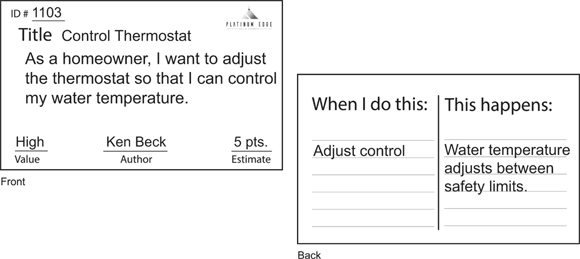
Each user story is written in the first-person point of view. (“When I do this, I get this.”) First-person puts the author in the shoes of the user or customer.
How does writing user stories from the user’s perspective improve requirement clarity and value?
The person who writes the user story gives it to the product owner to share with the scrum team. Often, the stakeholder also participates in the conversation, sitting down with the product owner and developers to go over every card. This act of direct communication is vital to a thorough understanding of the tasks necessary to achieve the desired result. As a result, communication is clearer, there are fewer mistakes, and product quality and delivery speed increase.
Further Refinement
Developer effort determines whether a requirement needs to be broken down further to progress to the product roadmap, the release plan, or the sprint. Especially at the beginning, as you discover how to apply user stories within your scrum framework, you may find that the ones you write are too big to fit into a sprint.
Want to go deeper? The science behind INVEST in user stories
Bill Wake, an early influencer in the eXtreme Programming (XP) movement, introduced the INVEST mnemonic for user stories. INVEST stands for Independent, Negotiable, Valuable, Estimable, Small, and Testable. These qualities help ensure user stories are actionable, meaningful, and ready for development. By applying INVEST, teams can avoid common pitfalls like overly large stories or ambiguous requirements, leading to smoother sprint planning and execution.
Practitioners often revisit user stories during backlog refinement meetings, breaking down larger stories into smaller, more manageable tasks to fit within the sprint’s scope.
What challenges might you face when breaking down user stories, and how could the INVEST model help?
- User stories help teams focus on value and communicate requirements clearly.
- Personas guide story creation by centering on the real user’s needs.
Practice writing a user story using the three Cs model and incorporating a persona.
- Choose a persona relevant to your project or product.
- Draft a user story in the format: “As a [persona], I want to [action] so that [benefit].”
- On the reverse side, write the acceptance criteria for your user story.
- Share your draft with a peer or team member for feedback.
How does direct communication between stakeholders and developers improve the quality and speed of product delivery?
Many successful software firms use backlog refinement sessions to decompose large user stories and ensure that each sprint delivers a usable product increment, leading to higher customer satisfaction and fewer missed requirements.
“The value of a user story is in the conversation, not the card.”
What are the “three Cs” of user stories?
Tap to revealCard, Conversation, Confirmation—these guide how user stories are written, discussed, and validated.
Define “persona” in agile product development.
Tap to revealA persona is a fictional character representing your target user, used to guide product requirements and ensure customer needs are met.
What is the primary purpose of acceptance criteria in user stories?
Tap to revealAcceptance criteria define how you know the user story has been successfully implemented by specifying the expected outcome.
User stories must include every possible requirement detail before development starts.
User stories are meant to spark conversation and refinement; their value lies in collaboration and iterative clarification—not exhaustive documentation.
User stories, personas, and refined acceptance criteria empower agile teams to prioritize customer value, foster collaboration, and deliver usable increments each sprint.
The INVEST mnemonic ensures that user stories remain actionable, valuable, and ready for development, improving sprint outcomes and team agility.
Reflect on a recent project or task: How might rewriting requirements as user stories and discussing them as a team have changed the outcome?
Which quality does the “V” in the INVEST mnemonic for user stories represent?
The Shift
- User stories and personas make requirements actionable and user-centered.
- INVEST criteria ensure stories are ready for development and testing.
- Direct communication and iterative refinement drive higher quality and faster delivery.