Release Plan Basics
How can you determine the right timing and content for your product releases to maximize value and minimize wasted effort?
Imagine you’re navigating a journey: First, you set your destination and define what success looks like. Next, you chart a course, mapping the landmarks and features that will get you there. As you close in, you focus on the immediate steps—what will you accomplish and deliver next? That’s the essence of release planning.
Your roadmap to value starts with a clear product goal—your destination and desired outcomes. The product roadmap offers a holistic view of the features that support this goal. As you focus and add detail, you arrive at release planning: the third element in your journey. While release planning isn’t an official scrum concept, the release plan artifact is widely used by scrum practitioners to organize and mobilize teams.
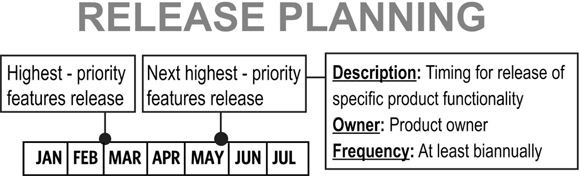
A high-level timetable for releasing a set of product requirements, segmenting the roadmap from big-picture goals to immediate actions.
With a release plan, you’re working down from the broad roadmap to a focused plan that provides clarity and direction for your team and stakeholders. Later, you’ll plan at the sprint level, but for now, the release plan becomes your focal point.

Do the minimum amount possible that still creates a working product. When planning features to release, always ask, “What is the minimum set of features that delivers value to my customer?” This is your minimum viable product (MVP).
Release as often as you have something valuable to offer—your MVP. Releases may follow a regular schedule (quarterly, monthly, weekly, or even daily) to help you stay quick to market and responsive to customer needs.
Want to go deeper? The science behind prioritization and cost-value formulas
The formula AC + OC > V comes from economic principles of opportunity cost—what you give up by not pursuing alternatives. In software, this means ending development when further work costs more (including what you miss elsewhere) than the value added. This approach is rooted in lean thinking, maximizing impact while minimizing waste.
Do the minimum amount possible that still creates a working product.
The minimum set of features that delivers value to the customer, enabling early release and feedback.

Consider the pen-and-pencil rule: commit with a pen to your next release plan; everything beyond is written in pencil. Plan just in time for each release, adapting as you learn.
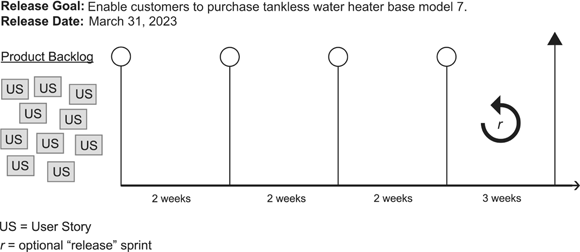
A product can have multiple releases. For each, you start with a goal supported by the highest-priority features and requirements. This pattern repeats at every stage: each release has a goal, and you commit to one release at a time. What you learn from one release can change what you do in the next.

The number of sprints in each release varies. You may use release trains—fixed schedules so everyone knows when to expect releases.
At every scheduled release, the product owner decides which completed functionalities will be released. Organizations and customers benefit from predictable schedules, and scrum teams can plan their releases to a cadence.
Many SaaS companies use release trains, scheduling feature drops every two weeks. This lets customers anticipate new capabilities and keeps teams focused on delivering incremental value.
Scrum relies on empirical processes: you inspect, adapt, and respond to changing needs. You may have a bird’s-eye view of several releases, but you plan in detail only one at a time. What you learn in the first release informs the second.

Your organization may hesitate to release incrementally, believing you must finish the entire backlog before releasing any work. Overcome these antipatterns to support more effective and frequent releases.
Releases should only happen after all features are complete and the entire backlog is finished.
Incremental releases, based on MVPs and priority, enable faster delivery and ongoing improvement, adapting to feedback and changing needs.
How does incremental release planning help teams respond to customer feedback and changing market needs?
Prioritize, prioritize, prioritize
Identifying the highest-priority requirements—by business value and risk—and working only on those is a key agile practice. Each release becomes the next incremental MVP.
When planning a release, ask:
- What makes a requirement important for this release?
- What “barely sufficient” set of features provide enough business value to the customer we need to bring to market next?
- Which requirements present the greatest risk and should be addressed sooner rather than later?
A famous Standish Group study updated in 2015 by Jim Johnson showed on more than 1,000 software projects that only 20% of features were used always or often by customers. Thirty percent were infrequently used, and half were hardly ever used.
Practitioners often use customer interviews, analytics, and feedback loops to weed out features that won’t be used. This lets teams focus resources on the 20% of features that actually matter.
What criteria might you use to decide which features deliver the most value in your context?
- Understand the role of release planning in the value roadmap
- Recognize the importance of MVP and prioritization
- Identify how empirical processes guide release adaptation
Pick a hypothetical product and practice identifying its minimum viable product.
- List 8–10 features or capabilities your product could have.
- Rank them by value to the customer and risk.
- Circle the smallest set that would deliver value as an MVP.
- Write down why these features are critical and others can wait for later releases.
How might your MVP change after feedback from users? What would trigger a new release?
Describe a situation where you or your team released a product or feature sooner than planned. What was the outcome, and what did you learn about incremental delivery?
What is a Release Plan?
Tap to revealA high-level timetable for releasing a set of product requirements, bridging the gap between the roadmap and sprint planning.
Define Minimum Viable Product (MVP).
Tap to revealThe smallest set of features that delivers value to the customer and allows release to the market.
What is the purpose of the pen-and-pencil rule?
Tap to revealCommit firmly to your first release plan, but keep future plans flexible to adapt as you learn.
What is the main purpose of identifying a minimum viable product (MVP) during release planning?
Effective release planning focuses on delivering the minimum viable product (MVP) as soon as it provides value, enabling ongoing adaptation and faster time-to-market.
Prioritizing requirements based on business value and risk ensures that releases address the most important features first.
The Shift
- Release plans bridge product goals and sprint actions, focusing teams and stakeholders on what to deliver next.
- Defining and prioritizing the minimum viable product (MVP) enables faster, incremental releases and adaptation to feedback.
- Empirical, just-in-time planning and release trains support predictable, value-driven delivery while minimizing wasted effort.