Your Product Backlog
How can a constantly evolving product backlog drive both rigorous planning and flexible innovation in your Scrum team?
Picture your product’s journey as a dynamic map—one that’s continually being updated with new routes, detours, and destinations. In Scrum, that map is called your product backlog, and it’s the central artifact guiding your team’s progress, priorities, and learning.
Your Product Backlog
The product backlog is a true scrum artifact and the to-do list for the entire product. All scrum products have a product backlog, which is owned and maintained by the product owner.
In some organizations, even the company barista has contributed ideas to the product backlog! Scrum encourages input from everyone, making innovation a truly team-wide effort.
The requirements from the product roadmap initially create the product backlog, and the highest-priority ones are broken into user stories as early as day two of product planning. (We describe how in “Product backlog refinement,” later in this lesson.)
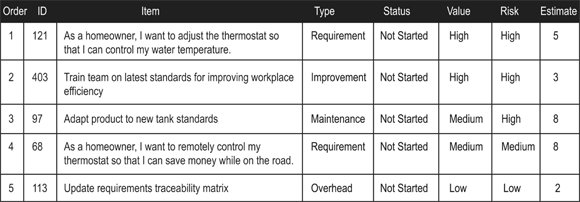
Each item in the product backlog has the following elements:
-
Specific order: Priority slot in the product backlog.
 REMEMBER
Although product backlog items may be similar in priority, they can’t be worked on simultaneously.
- ID number (optional).
- Description.
- Type of item (optional), which could be a requirement, overhead, maintenance, or improvement. (See the dynamic to-do list below.)
- Status (optional).
-
Value to the business or product.
REMEMBER
Highest-priority requirements get broken into the smallest actionable requirements possible in the product backlog. A small requirement, however, isn’t automatically a high-priority item. Many small requirements have a low priority and never see fruition.
- Risk level associated with the item.
- Estimate of the effort required to complete.
Anyone can write a product feature or requirement. A business stakeholder, developer, scrum master, product owner, and even the company barista can spark an idea or concern. Ideas are expected from everyone. Only the product owner has the power to accept or reject a requirement in the product backlog, based on whether it supports the goal for the product. The product owner is the full owner of this artifact. If accepted, the product owner will then number, refine, prioritize, and order the new requirement.
Think about a project you’ve worked on—who contributed ideas, and how were they prioritized?
Major tech companies like Spotify and Microsoft treat their product backlogs as living documents, frequently refined based on user feedback and market shifts. This practice enables them to innovate rapidly and stay ahead of competitors.
The dynamic to-do list
The product backlog never goes away while the work is active. If you have a product, you have a product backlog, which is always changing. As larger requirements are broken into smaller requirements, the backlog changes. As client feedback is received, the backlog changes. As your competitors bring new offerings to market, the backlog changes.

The product owner not only prioritizes items in the product backlog but also orders them in a logical sequence. This way, the next sprint can be quickly and efficiently organized from these ordered items.
The product owner makes all changes made in the product backlog. At any point, if anyone (product owner, developer, stakeholder) identifies a new requirement or design idea, it’s given to the product owner to be prioritized along with everything else.
In traditional project management frameworks, change is viewed as a reflection of poor planning. If something had to be changed, it was because someone messed up. In scrum, we see change as a sign of growth and learning. As you discover your product more deeply, you will identify changes that need to be made. In scrum, if you’re not changing, you’re not learning, and that’s a problem. It’s a lack of change that is a sign of failure. Every day you need to learn something that causes change. With scrum, change is no longer something you crawl under your desk and hide from. Change is good. Change is life. Change is scrum.
Frequent changes to the product backlog mean the team failed to plan carefully.
In Scrum, change is a sign of learning and growth. A dynamic backlog signals that the team is adapting and improving the product based on new insights.
- The product backlog is always evolving and never static.
- Anyone can suggest items, but only the product owner manages prioritization and acceptance.
Product backlog refinement
Product backlog refinement is how the scrum team advances its understanding of the items in the product backlog and prepares them for upcoming sprints. Product backlog refinement is a continuous process of breaking down and preparing feedback and responses to change for future development. This process is owned by the product owner and performed with the help of developers, who ask clarifying questions and provide estimates based on the best information available at that time. The scrum team, as a whole, may spend about 10 percent of its active sprint time in this process. The scrum master usually facilitates product backlog refinement activities to keep the group focused and on task.
The target outcomes of product backlog refinement are as shown below:
- Clarity: All developers and the product owner reach a clear consensus on the scope of the product backlog items being discussed.
- Acceptance criteria: All requirements (backlog items) include sufficient acceptance criteria.
- Risks identified and mitigated to the best extent possible: Other known risks should be documented and accepted by the team as necessary.
- Sizing: Requirements are estimated and broken down sufficiently to be accomplished within a sprint.

Acceptance criteria is a term frequently used in scrum practices that refers to a section on the back of the user story card or in the project software to communicate to everyone what success looks like for each story. It may include validation criteria and specific examples of the desired outcomes when the work is complete.
Backlog refinement should be a regular occurrence, but scrum doesn’t prescribe how formal or frequent refinement discussions should be; neither does it prescribe an agenda. Here are suggestions that have worked well for our clients and us:
- Format: The product owner presents one requirement to the team at a time. For each requirement, team members ask questions, challenge assumptions, explore implementation strategies, and use a whiteboard for drawing and clarification until they have a consensus on the details and scope of the requirement. Then the developers use estimation poker or affinity estimating to assign a relative size estimate.
- Time: On average, scrum teams spend about 10 percent of a sprint refining product backlog items and preparing for future sprints.
- Frequency: Backlog refinement is a progressive activity. Requirements get refined gradually, just in time, and those closer to delivery are ready for sprints. Teams may prefer conducting backlog refinement on one of these schedules…
Want to go deeper? The science behind adaptive backlogs and learning loops
Modern agile research shows that teams with dynamic backlogs outperform those with static plans because frequent refinement fosters collaboration, quicker pivots, and richer learning. By regularly updating the backlog, teams ensure that every sprint delivers the highest value possible, minimizing wasted effort on outdated priorities.
Product Backlog
Tap to revealThe ordered list of requirements, features, and tasks for a scrum product, owned by the product owner.
Product Backlog Refinement
Tap to revealThe ongoing process of clarifying, prioritizing, and breaking down backlog items to prepare for upcoming sprints.
Acceptance Criteria
Tap to revealSpecific conditions that define when a backlog item or user story is considered complete and successful.
How does your team handle changes to requirements—do you see them as obstacles, or opportunities to improve?
Write a sample backlog item for a product you care about, then refine it by breaking it into smaller actionable requirements.
- Choose a product or project and identify a new feature or improvement.
- Write a brief description of the requirement, including its value and risk.
- Break it down into smaller, actionable steps that could fit within a sprint.
- Add acceptance criteria for each step.
The team member who owns, maintains, and prioritizes the product backlog, accepting or rejecting requirements based on product goals.
Practiced product owners often spend significant time communicating with stakeholders and developers to ensure backlog items are well-understood and prioritized logically. Their role is pivotal in balancing business value, risk, and effort estimates.
A short, simple description of a feature or requirement from the perspective of the end user, used to break down high-priority backlog items.
Imagine you are the product owner: What criteria would you use to decide which requirements to accept or reject?
Describe a time when change in a project improved its outcome. How could adopting a scrum mindset transform your approach to change?
The product backlog is a living artifact: its constant refinement and prioritization fuel learning, adaptation, and value delivery in every Scrum team.
Change in the backlog is not a failure of planning, but a sign of growth—embracing change is essential for Scrum success.
Change is good. Change is life. Change is scrum.
Who is responsible for accepting, prioritizing, and maintaining items in the product backlog?
The Shift
- The product backlog is always evolving—embrace change as a learning opportunity.
- The product owner is the gatekeeper, ensuring every backlog item aligns with product goals.
- Backlog refinement is a collaborative, continuous process that prepares teams for adaptive, high-value development.