What if your team could turn every win and every setback into a powerful advantage? In Scrum, the feedback loop is the engine that makes this possible, fueling innovation and improvement with every sprint.
In economics, a feedback loop is defined as the outcome or results of one process or one cycle used to inform the next. This feedback loop is what feeds the data to the empirical inspection process.
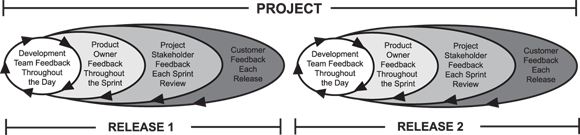
The idea behind a feedback loop is that you can continually improve from the information learned from experience if you have a way to apply the lessons learned to future situations. An inherent part of the Scrum process is recognizing that the knowledge and experience gained during each sprint need to be reintroduced in later sprints to inform the evolving plan. At the outset of a product, product roadmap and sprint plans are always made with the best information available at the time. The plans are accepted by the whole team and socialized among stakeholders. Rigid adherence to an exhaustive initial plan can ignore lessons learned during the process and stifle innovations from within the team. Instead, Scrum uses customer and team feedback to improve the plan.
Some of the world’s most successful tech products were shaped by feedback loops—Gmail, for example, launched in beta and evolved through user suggestions and team retrospectives.
A cyclical process in which the results of one iteration are used to inform and adapt the next, promoting continuous improvement in Scrum teams.
The process of regularly examining the product and process based on real-world feedback, a core principle of Scrum’s adaptability.
Think about a recent team project you were involved in—how could you have used feedback differently to improve the outcome?
You may wonder why you should plan at all if you know that an initial plan is likely flawed. You establish a plan as the first step in your learning process. Much as a flight crew files a flight plan based on the expected conditions, so crew members and air-traffic controllers know what to expect, product roadmaps lay out the Scrum team’s preflight expectations. After a flight crew takes off, the members evaluate actual conditions such as weather, winds, and scheduling to adjust the flight plan as needed. Likewise, in Scrum, you provide feedback daily, and as you learn more information, you adapt your ideas and plan.
Want to go deeper? The science behind delaying decisions
Lean development suggests making decisions at the “last responsible moment”—the point at which delaying further would limit options or increase risk. This approach leverages ongoing learning and emerging information, so teams make the best possible decisions with the most current data, rather than locking themselves into choices that might soon be outdated.
It’s best to stick to the original plan in product development, even if new information emerges mid-sprint.
Scrum encourages adapting plans as new feedback is received, allowing teams to learn and innovate throughout each sprint.
After launching a new feature, a development team notices that users aren’t interacting with it as expected. By discussing this feedback in their next retrospective, the team decides to adjust the user interface, leading to a measurable increase in engagement during the following sprint.
Why might it be risky to delay all decisions until the last possible moment? How could this impact a project’s timeline or quality?
Practice categorizing upcoming team decisions to make optimal use of feedback and learning.
- List three decisions your current or recent team is facing.
- For each, decide if it’s known, knowable, or unknowable at this time.
- Discuss with a peer which should be made now, and which should be delayed until more information is available.

Feedback loops can be positive (resulting from successes) or negative (resulting from failures). Success can breed success, but failure can inform success if you learn from it. This concept is why we ask both what worked well and what can be improved during each sprint retrospective. It’s important to continue to support scrum successes and look for changes that can have a positive effect.
During a sprint retrospective, why is it important to discuss both what went well and what can be improved?
What is a feedback loop in Scrum?
Tap to revealA cyclical process where results from one cycle inform and improve the next, promoting continuous adaptation.
What is the purpose of a sprint retrospective?
Tap to revealTo review what went well and what can be improved, ensuring both successes and failures inform future sprints.
What are the three “buckets” for decision timing in Lean thinking?
Tap to revealKnown, knowable, and unknowable—helping teams decide when to make or delay decisions.
Reflect on a time when you changed your plan based on feedback from your team or customers. What was the outcome? What did you learn about the value of adapting your approach?
- Feedback loops help Scrum teams adapt and improve continuously.
- Decisions should be timed based on what is known, knowable, or unknowable.
Success can breed success, but failure can inform success if you learn from it.
Scrum teams achieve the greatest results when they use feedback loops to adapt plans, support successes, and transform failures into opportunities for improvement.
Waiting to make decisions until the “last responsible moment” enables teams to incorporate the most relevant information, but not all decisions benefit from delay.
Describe a scenario where delaying a decision based on the feedback loop could lead to a better outcome for a Scrum team.
How confident are you that you can explain the role of feedback loops in Scrum product development?
The Shift
- Feedback loops empower Scrum teams to continually adapt and improve their process and product.
- Both successes and failures should be actively examined during sprint retrospectives to maximize learning.
- Timing decisions based on what is known, knowable, or unknowable can optimize outcomes and reduce wasted effort.