Imagine starting each workday knowing exactly what your team is focused on, what challenges lie ahead, and how you can help each other succeed. The daily scrum is a short, focused meeting that keeps everyone connected, proactive, and moving in sync toward delivering value—one day at a time.
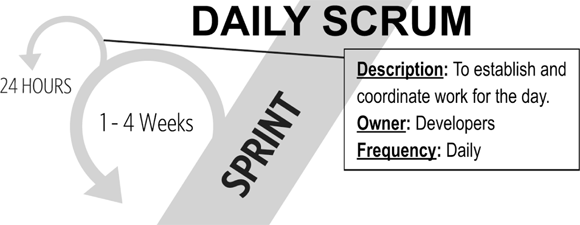
The 15-minute daily scrum is sometimes referred to as the “standup” because many teams conduct it while literally standing—encouraging brevity and focus!

Planning is huge in scrum. You don’t set a goal, forget it, and then gather six months later to see what happened. You inspect and adapt every single day — and even throughout the day.
Because developers swarm daily to attack a single requirement, coordination is key. Removing impediments is also crucial for developers who work closely together to deliver potentially releasable increments within short periods. The daily scrum is how they coordinate.
If you manage your product development by weeks (that is, with weekly project manager status reports that may not get reviewed promptly), you slip by weeks. In scrum, you may still slip but only by a day, because scrum teams manage by day through the sprint backlog using direct interaction in the daily scrum.
A 15-minute, daily meeting where developers coordinate, inspect progress toward the sprint goal, and adapt their plan as needed.
Think about a time when your team’s communication broke down. How might a daily scrum have helped prevent this?
Defining the daily scrum
As its name implies, a daily scrum takes place daily during each sprint. The timebox is 15 minutes maximum, no matter the sprint’s overall length. Meetings in scrum, like artifacts, are barely sufficient. Anything longer than 15 minutes would eat into valuable development time. Besides, 15 minutes is plenty of time to accomplish everything necessary.
The purpose of the daily scrum is to inspect progress toward the sprint goal and adapt the sprint backlog as necessary, adjusting the upcoming planned work. The team coordinates the day’s sprint activities and identifies impediments keeping the developers from accomplishing their sprint goals. Every developer participates, so everyone is dialed into what the entire team is working on. If an impediment comes up during the daily scrum, it’s dealt with following the daily scrum. The event is a coordination meeting, not a problem- or complaint-solving meeting.
The scrum master is causing the removal of impediments by facilitating the conversation about them and coaching the team, so they reflect and find a way to improve the area. Some impediments may need to be removed by the product owner or require discussion between a team member and someone outside the team.
Anything that blocks or slows the team’s progress toward their sprint goal; identified and addressed through daily scrum discussions.
At a fast-growing technology startup, the daily scrum helped one team spot a recurring deployment issue that had been slowing releases. By raising the impediment in their daily meeting, they quickly involved the right people and resolved it—shaving days off their delivery time.
Participants in the daily scrum are the developers. The scrum master ensures that the meeting takes place and stays within the timebox, and the developers direct the meeting. The product owner may attend and provide clarifications on prioritization as needed, and anyone else who’s involved and interested can listen in but don’t say anything. This way, they can enjoy the daily transparency and be involved in the daily process, but they can’t hinder or derail it.
We often like to have scrum masters participate beyond facilitation by addressing the impediments identified and/or in progress.
The daily scrum is how developers self-organize and self-manage. Each day, the team decides who will do what and who will help whom. Nobody dictates work from the outside, such as a project manager or another nondeveloper.
The daily scrum is just a status-report meeting for developers to update the project manager or product owner.
The daily scrum is a peer-to-peer coordination meeting where developers inspect progress, adapt plans, and help each other achieve the sprint goal—no one is reporting upward.
Why is it important for the daily scrum to be developer-led rather than managed by an external project manager?
A common misconception about the daily scrum is that it’s a time for the developers to report to the product owner or a time for product owners to introduce new requirements or update a sprint goal. Don’t let the daily scrum become a business-status-reporting meeting; it’s a coordination meeting to enable high performance.
Scheduling a daily scrum
Because a daily scrum lasts only 15 minutes, everyone needs to be on time and ready. To reduce the complexity, the daily scrum is held at the same time and place every working day of the sprint. You’ll find a direct correlation between how late a meeting starts and how loose the focus is after the meeting starts.
Many teams find starting their daily scrum a half an hour after the normal workday begins to be ideal. This schedule gives your team time to get coffee, answer emails, discuss the previous evening’s antics, and cover anything else in their morning rituals.
A key disruptor of the daily scrum is distraction. Encourage team members to prioritize the daily scrum over text dings, emails, phone calls, and even unexpected Amazon deliveries.
What strategies could your team use to reduce distractions and ensure the daily scrum starts on time?
- The daily scrum is a 15-minute, developer-led meeting focused on coordination and removing impediments.
- It is not a status report for managers or product owners, but a peer-driven event.
- Consistency, punctuality, and focus are key to an effective daily scrum.
Conducting a daily scrum
Imagine a scrum team gathering around its physical or virtual sprint backlog or task board at the beginning of the day. Each person can see at a glance the progress made the day before; then each person proactively chooses a new task for the current day. Team members coordinate where help is needed to accomplish a task before the day ends; then, they go straight to work.
Tasks should be broken down so they can be accomplished in a day or less. Even then, when developers are left to themselves for days on end without coordinating and swarming as a team, they can get bogged down in unnecessary details or problems that could be easily resolved with help.
Daily scrums synchronize a team, and everyone goes to work helping each other do what it takes to get to done. Together they completely own the outcome. Come the next day, the team members are excited as they inspect their progress.
The daily scrum is not the only time developers adjust their plan. Anytime they see a need, they can address it to keep the work moving forward.
Daily scrums improve communications, identify impediments, promote quick decision-making, and consequently, reduce the need for other meetings.
The key takeaway from a daily scrum is clarity about what it means to be successful that day. Then the team swarms if necessary to do the highest-priority work.
Want to go deeper? Why 15 minutes is the magic number
Meetings can easily expand to fill whatever time is available, known as Parkinson’s Law. By timeboxing the daily scrum to 15 minutes, teams stay focused on the essentials: inspection, adaptation, and coordination. Anything else is parked for follow-up outside the meeting, protecting precious time for real work.
Making daily scrums more effective
The following tactics can keep your daily scrum meetings quick and effective: establish a consistent time and place, stick to the 15-minute timebox, focus on progress toward the sprint goal, allow only developers to speak, and address impediments after the meeting. Keep the conversation peer-to-peer, and ensure everyone is prepared to participate.
Design a daily scrum ritual for your team that maximizes focus and participation.
- Decide on a fixed time and location for your daily scrum.
- List three ground rules your team will follow to keep the meeting on track.
- Identify one common distraction to avoid, and how you’ll handle it.
Many remote teams use virtual boards or dashboards during the daily scrum so every member—regardless of location—can visualize progress and update tasks in real time.
The daily scrum is a short, focused meeting where developers coordinate directly, inspect their progress, adapt their plans, and help each other reach the sprint goal—every single day.
Journaling Prompt: Reflect on the last team meeting you attended. What would have changed if it had been run as a daily scrum? How might team ownership and clarity have improved?
What is the main purpose of the daily scrum?
Tap to revealTo inspect progress toward the sprint goal, coordinate the day’s work, and adapt plans as needed.
Who leads the daily scrum?
Tap to revealThe developers direct the meeting; the scrum master facilitates and ensures it stays within the timebox.
How long should the daily scrum last?
Tap to revealA maximum of 15 minutes, regardless of the sprint’s overall length.
Which of the following best describes the daily scrum?
The true power of the daily scrum lies in fostering team transparency, self-organization, and adaptability—enabling the team to collectively overcome obstacles and consistently deliver value.
How confident are you that you can explain the purpose and format of the daily scrum to a new team member?