How can embracing uncertainty actually lead to better products and outcomes in Scrum?
In the fast-paced world of product development, the urge to predict every outcome can feel overwhelming. But what if the very pursuit of certainty is holding your team—and your product—back?
The “Cone of Uncertainty” is not just a software term—it’s widely used by meteorologists to forecast the paths of hurricanes, illustrating how predictions become more accurate as an event approaches.
Management’s need for certainty of outcomes may well drive the downward spiral or decay of many products and great ideas. They could refuse to accept the basic reality of uncertainty, settling for the relative safety of the known at the expense of the better. The power of empiricism is being okay with uncertainty until you’ve learned the information you need to have more certainty about the outcome of your product or goal.
Think of a time when a project you worked on changed direction late in development. How did the need for certainty impact the outcome?
For example, it will be difficult to know six months from now if a needed component being built by another team will be finished on time if the other team won’t begin development for three months. But two weeks before its expected delivery, you can have a much clearer expectation of its readiness.

Empirical means to learn or verify by means of observation. So, scrum is, by definition, an empirical process control model because each step of the way, you inspect your results and adapt immediately to a better outcome.
Why do you think organizations often prefer the illusion of certainty over the reality of empiricism?
Learning by observation, inspection, and adaptation rather than relying on assumptions or predictions.
Figure 7-1 depicts the forecasting tool known as the Cone of Uncertainty. The basic principle is that outcomes are hard to predict across a span of time, but as you arrive closer to your goal, certainty increases.
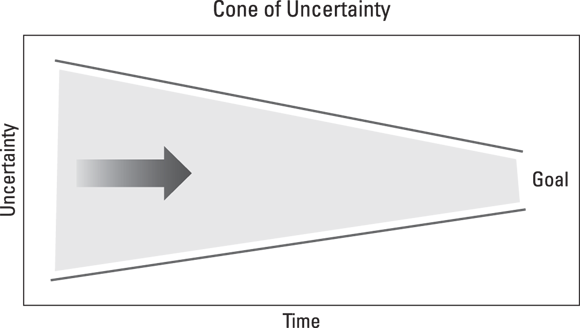
A visualization showing that predictions about future outcomes become more accurate as you gather more information and approach the event.
In a weather forecast, the path of a hurricane is shown as a widening cone—early predictions cover a large area of possible outcomes, but as the storm gets closer, the prediction narrows. Scrum uses the same principle: early estimates may be broad, but become sharper with ongoing inspection and adaptation.
Weather forecasters use the Cone of Uncertainty to depict the path of hurricanes over several days. Empiricism embraces the reality of some uncertainty and provides a framework for managing the associated risks by continually improving and adapting.
Want to go deeper? The science behind the Cone of Uncertainty
The Cone of Uncertainty originated in project management to describe how initial estimates for time, cost, or scope can be wildly inaccurate. As projects progress and more data is gathered, the range of possible outcomes narrows. This is why Scrum values frequent inspection and adaptation: the more you observe real progress, the more confident your predictions become.
Practitioners note that trying to eliminate all uncertainty can lead to overly rigid planning and missed opportunities for innovation. Adapting as you learn is often more productive than demanding certainty up front.
How might embracing uncertainty change the way your team plans and executes work?
Scrum teams should be able to predict all outcomes at the start of a project to satisfy management’s need for certainty.
Scrum embraces uncertainty, relying on empirical observation, inspection, and adaptation to increase certainty as work progresses.
Visualize how certainty changes throughout a project.
- Think of a recent project or task you worked on.
- Draw a cone, wide at the left and narrowing to the right.
- Mark key milestones or decision points along the timeline.
- Write down what was uncertain at the start and how certainty increased as you approached each milestone.
- Reflect on how this approach might help you in future projects.
Embracing uncertainty and using empirical approaches enables teams to adapt and improve outcomes, rather than being trapped by the illusion of early certainty.
The power of empiricism is being okay with uncertainty until you’ve learned the information you need to have more certainty about the outcome of your product or goal.
According to Scrum, how does the Cone of Uncertainty change as you get closer to a project’s goal?
Describe a situation where accepting uncertainty led to a better outcome for your team or project. What would have happened if you had tried to force certainty instead?
- Certainty early in a project is often an illusion; empiricism helps teams adapt as new information emerges.
- The Cone of Uncertainty illustrates how predictions become more reliable over time.
What is empiricism in the context of Scrum?
Tap to revealIt means learning or verifying through observation, inspection, and adaptation, rather than relying solely on predictions.
What does the Cone of Uncertainty illustrate?
Tap to revealIt shows that predictions about outcomes are less certain farther from completion, but become more accurate as a project progresses.
How does Scrum use uncertainty to its advantage?
Tap to revealBy accepting uncertainty and continuously inspecting and adapting, Scrum teams improve their chances of success with better, evidence-based decisions.
The need for certainty can hinder innovation, but using empirical methods allows teams to adapt, manage risks, and create better products.
The Shift
- Certainty is often an illusion early in the product development process; empiricism is key to navigating uncertainty.
- The Cone of Uncertainty demonstrates that predictions improve as you gather more real-world data and approach your goal.
- Adapting to new information, rather than clinging to early assumptions, leads to better outcomes in Scrum teams.