Before you set off on any ambitious journey—whether it’s launching a new product or exploring uncharted territory—you need to know where you’re headed and how you’ll get there. In product development, this guiding path is called the product roadmap.
Even though the product roadmap isn’t required by Scrum, most successful Scrum teams use one to increase transparency and unity of purpose.
In the seven roadmap to value elements, you begin with the end in mind by creating your product goal. The next step is creating a map to help you achieve that goal.
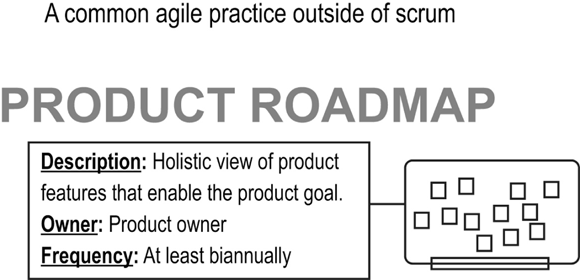
Although the product roadmap is not a formal aspect of Scrum, it is commonly used by Scrum teams.
Why do you think teams and stakeholders find it helpful to visualize the journey to their product goal?
A vehicle to deliver value with a clear boundary, known stakeholders, and well-defined users or customers. This could be a service, physical product, or something more abstract.
The word product is meant to describe a much broader spectrum of value than simply software, hardware, or physical products. It’s also broader than a project as it is long-term.
Imagine setting sail on a voyage with a crew and passengers. Would you cast off without knowing your destination or route? Of course not! The same logic applies to building products: a roadmap outlines the journey, aligning everyone before the journey begins.
- Decide where you want to go (define the product goal).
- Figure out how to get there (visualize the product roadmap).
- Socialize the goal (communicate the plan).
“Socializing” the product roadmap means sharing it widely with all influencers and stakeholders to build understanding and commitment to the direction and path.
The product roadmap can change, but it gives you something tangible to start with, thereby increasing effectiveness. By socializing the roadmap as an artifact of planning or replanning, you can make sure that influencers and stakeholders understand the direction and path. Adjustments to the plan are less costly, and a shared vision contributes to team unification.
A product roadmap provides a high-level, dynamic guide that aligns teams and stakeholders around a shared vision and evolving plan for delivering value.
Take the Long View
The product roadmap is a holistic, high-level view of the features or capabilities necessary to achieve the product goal. Natural affinities are established (“If we do this, we should logically do that”), and gaps are made readily visible (“Hey, where is …?”).
The evolving, prioritized list of features, epics, and user stories that make up all the work to realize the product goal.
The product roadmap is the initial product backlog—your master to-do list. As the likelihood of product backlog items being developed increases, items are increasingly broken down (progressive elaboration). The product backlog expands to include items that are:
- Small (imminently realized; often referred to as user stories)
- Midsize (midrange realized; often referred to as epics)
- Conceptual (clear but lacking details; often referred to as features)

See the sidebar, “Roadmap and Backlog Terminology,” later in this module for more information about features, epics, and user stories.

The product roadmap isn’t fixed in stone and fully paved; it’s a living, dynamic artifact. Review and update your roadmap regularly to keep pace with reality.
Although the product owner fully owns the goal, the entire Scrum team needs to be part of the roadmap-building process. Developers are the technical experts who will be doing the work and must provide constraints and effort estimates. If the developers haven’t been chosen yet, include the functional managers after you create the initial product roadmap to help identify the necessary skills.
When working with clients, teams often create both the product goal and product roadmap on day one—so development can begin as soon as day two. This accelerates alignment and delivery.
How might involving the entire Scrum team in creating the roadmap impact the project’s success?
Use Simple Tools
When creating your product roadmap, use the simplest tools possible. Sticky notes and a whiteboard—physical or digital—work wonders, even for distributed teams. Each product feature or capability fits onto a sticky note.
Human brains weren’t created in the digital age. Studies have proved that electronics have a dulling effect. In fact, it takes less brain-wave function to watch TV than to watch paint dry. Yet, using a simple system like sticky notes is physically and mentally engaging, and using it fosters an environment of change and creativity.
Teams we’ve worked with have built product roadmaps for large-scale products in just a few hours, starting with the highest-priority items and moving stickies around as the roadmap takes shape.
Want to go deeper? The science behind sticky-note collaboration
Research shows that tactile and visual methods like sticky notes increase engagement, creative thinking, and group problem solving. When people physically move notes, they’re more likely to spot connections and gaps than when using digital-only tools.
Gather your team (physically or virtually) and try building a simple product roadmap together.
- Choose one product or service you want to plan.
- Write one requirement or feature per sticky note (physical or digital).
- Arrange stickies on a whiteboard into logical groups or sequences.
- Discuss and adjust until your roadmap tells a coherent story from goal to value.
What did you notice about team dynamics when using sticky notes for the roadmap? Did it change the energy or participation compared to digital tools?
Create Your Product Roadmap
You can use seven easy, common-sense steps to build your product roadmap. Perform these steps on day one as part of your product planning; they should take no longer than a few hours. For smaller efforts, you’ll get the job done over morning coffee. The product owner completes the steps with the rest of the product team (the entire Scrum team and the stakeholders).
Using sticky notes, several colors of flags, and a whiteboard, follow these steps to build your product roadmap:
-
Write down one product requirement per sticky note.
Think of as many product requirements as you can.
 TECHNICAL STUFF
You’ll know you’re on the right track if you can read each sticky note as a completion of the sentence, “My customer can …<sticky note text>.” For example, “My customer can now <Adjust the Temperature>” makes more sense than “Design the Temperature Touchscreen.” Product roadmaps lay out the requirement journey to value, not the tasks. Tasks come later in sprint planning.
- If appropriate and synergistic, arrange some requirements in related categories or groups.
The product roadmap isn’t fixed in stone and fully paved; it’s a living, dynamic artifact.
What is a product roadmap in Scrum?
Tap to revealA high-level, dynamic artifact that visualizes the plan for delivering the product goal and aligns teams and stakeholders.
What does “progressive elaboration” mean in the context of the product backlog?
Tap to revealIt means breaking down larger items into smaller, more detailed pieces as their likelihood of development increases.
Why is socializing the product roadmap important?
Tap to revealIt builds shared understanding and buy-in among stakeholders, making adjustments less costly and increasing team unity.
Think about a time when you worked on a project (in any context) without a clear roadmap. How did that affect your team’s alignment, progress, or results? What could a roadmap have changed?
- Identified the main purposes of a product roadmap in Scrum
- Explored tools and techniques for collaborative roadmap creation
- Reflected on the value of team involvement and communication
A product roadmap should remain unchanged once it’s created.
The product roadmap is a living artifact that should be reviewed and updated regularly to reflect evolving goals and realities.
What is the main benefit of socializing the product roadmap with stakeholders?
A simple, collaborative, and living roadmap empowers teams to adapt, innovate, and deliver value effectively.
How might you adapt the roadmap process for a team that is fully remote or distributed across time zones?
The Shift
- A product roadmap is not a static document, but a living guide that aligns and energizes teams to pursue shared goals.
- Simple, collaborative tools (like sticky notes and whiteboards) can make roadmap building more effective and engaging.
- Socializing and regularly updating the roadmap ensures continued buy-in, adaptability, and clarity for all stakeholders.